_

3 June 2015

Gotham

Yesterday, we tweeted this:
It’s a surprising one. To most people, Gotham is just another nickname for New York, and in that guise it’s by far and away best known as Batman’s stomping ground. 

Hang on—has someone done a superhero called Hawkman yet? They have? Curses. There really is nothing new under the Sun. But we digress. 

So—Batman. New York. Newcastle. Gotham City. How did all that happen?

Well, this particular story starts not with a bungled robbery in an inner-city alleyway, but way back in Tudor England. Sometime around the mid-fifteenth century, the name Gotham began to be used as a byword for any unsophisticated, backwater town or village, whose populace were all proverbially foolish, bumpkin-like characters. 

The earliest record we have of that comes from one of the Wakefield Mysteries, a series of thirty-two religious plays first performed in Wakefield, West Yorkshire, sometime in the mid-1400s. We know from the only surviving script of these plays (housed here) that one of them contained the line, “foles all sam, Sagh I never none so fare, Bot the foles of Gotham”—cut through all the late Middle English spelling and jumbled syntax, and you’ll have something along the lines of, “they’re all fools, I never saw a fool so fair [game] as the fools of Gotham.”

This allusion became so widespread in Tudor English that in 1540 an entire book of comic anecdotes about the ironically-named “Wise Men of Gotham” was published, including one story about a Gothamist who rode his horse while wearing a huge sack of grain on his back so that the horse didn’t have to carry all the weight, and another about a gang who decided to punish an eel that had eaten all the fish in a pond by trying to drown it. The joke even inspired a sixteenth-century folk rhyme, which described the hapless misadventures of three wannabe seamen from Gotham:

Three wise men of Gotham,
Went to sea in a bowl.
Had the bowl been stronger,
My song had been longer.


It’s unclear whether or not this proverbially foolish “Gotham” was based on an actual place. It’s been suggested that the real-life village of Gotham in Nottinghamshire may well have been where these Tudor writers had in mind, but connections have also been drawn to a long-lost Gotham Hall” in Essex, the proximity of which to the capital could have made its rustic inhabitants a prime target for jokes among the more urbane Londoners nearby (although if that’s the case, it’s doubtful that the earliest written record of Gotham would appear 200 miles north in Wakefield). 

But whatever or wherever the original Gotham might have been, over time use of its name started to change—and that’s where Newcastle comes in.

During the seventeenth and eighteenth centuries, Gotham began to be used as a nickname for any place whose inhabitants were seen as less sophisticated or less cultured than those of larger, more cosmopolitan cities. In this context, it was probably applied to a number of different places across England, among them—entirely unfairly, of course—Newcastle upon Tyne. But as those Tudor folktales and rhymes steadily dropped out of fashion, the name Gotham began to lose all its negative connotations so that by the time the nineteenth century came into view, it was merely being used as a byword for any large town or city, regardless of the sophistication of the people who lived there. And in that context, it remained particularly associated with Newcastle

The earliest record of that that we have—which provides the earliest reference to any large city being labelled “Gotham”—comes from a local Newcastle ballad called Kiver Awa’ (“a command used in drilling”, according to the English Dialect Dictionary) written in November 1804, and first published in a collection of Rhymes of Northern Bards in 1812:


The “Gotham of the Tyne” mentioned here was Newcastle, and the first few lines of this, the last verse of Kiver Awa’, prove that by the time the poem was written Gotham was nothing more than a local name for the city—and clearly one used with considerable pride. 

So where does New York come into the mix? Well, English emigrants are presumed to have taken Gotham, their old nickname for a large city, across to America in the early 1800s and there began using it in reference to New York. It first appeared in print in the United States in an instalment of Washington Irving’s satirical magazine Salmagundi in November 1807, which made reference to “the chronicles of the renowned and antient [sic] city of Gotham”. 

For Irving’s article to have made sense to its readers, we can presume that the nickname Gotham was already fairly well established in New York by the time he came to use it in 1807. But given that Kiver Awa’ still predates Irving’s essay by three years—and given the lengthy history that the name Gotham had back in England—we can safely say that the first city we know of being called “Gotham City” was Newcastle upon Tyne, not New York.


So the dark night rises—just over the Tyne Bridge. 


30 May 2015

Amethyst

Once upon a time, Bacchus, the louche Greek god of wine and debauchery, was pursuing a fair young maiden named Amethyste, who had caught his beer-goggled eye. Amethyste, however, was sober as a judge and had no intention of giving in to Bacchus’s bleary advances, so she fell to her knees and prayed to the gods themselves to keep her chaste. 

The gods, in their infinite wisdom, responded by keeping Amethyste safe in the only sensible way they knew how—namely by transforming her into a large slab of white quartz. (This is fiction, remember.) 

But Bacchus had had such a skinful back at the grape harvest that even a bare slab of white quartz still looked pretty alluring, so in one final attempt to woo Amethyste—and in a perfect demonstration of the kind of thinking that seems utterly logical when you’re drunk—he poured his wine all over the quartz. 

Unfortunately that had no effect at all other than to stain the quartz a deep, rich purple colour, and he was forced to retire, frustrated and unsatisfied. Amethyste’s chastity, meanwhile, remained in tact. (Well, it would do wouldn’t it, because she was now made entirely of quartz.) But, anyway—THE END.

The story of Bacchus and Amethyste, of which this is a fairly accurate précis, was written in the sixteenth century by the French Renaissance poet Rémy Belleau. Although Bellaeu’s tale is not an original Greek myth, it’s nevertheless inspired by an Ancient Greek belief that amethyst stones could prevent drunkenness; drinking from a cup made from or decorated with amethyst, you would simply never get drunk. 


I could have done with one of these at New Year

This peculiar belief was even reflected in the word amethyst itself:
Etymologically, amethyst comes from the Greek word amethystos, which is in turn based around the Greek word for “wine”, methys. The initial a– of amethyst is a negative- or opposite-forming suffix (like un- or non- in English today), and so altogether amethyst effectively means “not drunk” or “not intoxicated”.

But where did this superstition come from? Well, admittedly, no one is entirely sure, but it’s probably the amethyst’s rich, wine-like purple colour that first led to its association with booze, and from there it’s just a quick hop, stagger and jump to the idea that such a dazzling precious stone could have corresponding magic powers. 

Versions of this superstition are found dotted throughout Greek literature, with even Plato seeming to get in on the act in one of his Epigrams:
The stone is an amethyst: but I, the tippler Dionysus, say, “Let it either persuade me to be sober, or let it learn to get drunk.”
But even by the days of the great Roman scholar Pliny the Elder, this idea was already ancient history: in his Natural History, Pliny dismissively states that “the falsehoods of the magicians would persuade us that these stones are preventative of inebriety.” After all, it’s an easy enough hypothesis to test out. And here at HaggardHawks HQ, we’d be more than happy to volunteer. 


Mortgage

If you’ve managed to escape the rack-renters and have found a place to call your own, there’s a good chance you’ll have (or, at least, will once have had but have now paid off, you lucky thing) a mortgage. In which case, it’ll likely come of no surprise to find out that a mortgage is literally a deal to the death:
Hmm. Suddenly, those rack-renters don’t look so bad.

The first half of the word mortgage is the Latin word for “death”, mors, which is the same root as in words like mortician, rigor mortis and immortal. The second half, however, is more obscure: gage is an old word for a pledge or a security that is put down “to ensure the performance of some action”, as the OED explains. 

English borrowed the word mortgage from French sometime around the fourteenth century, and it steadily all but replaced (outside of esoteric legal literature, at least) the earlier Latin term mortuum vadium—literally a “dead pledge”. That in turn was paired with a vivum vadium, or a “living pledge”, which referred to someone borrowing money from someone in exchange for their allowing them to use their lands or estate, usually at a nominal annual fee gleaned from the profits of the land, until the debtor was able to repay the money.

All in all then, a mortgage is indeed literally a “death pledge”—but fear not, homeowners, because it’s not you that’s doing the dying any time soon. Instead, it’s thought that the “death” involved in the mortgage’s ominous “death pledge” isn’t that of the debtor, but rather either the debt itself, or the estate against which the debt is secured. That is to say, by entering into a mortgage, you “pledge” to continue paying your debt until it is entirely cleared (and thereby figuratively “killed”), otherwise your ownership of your estate “dies” if you can’t pay up. 

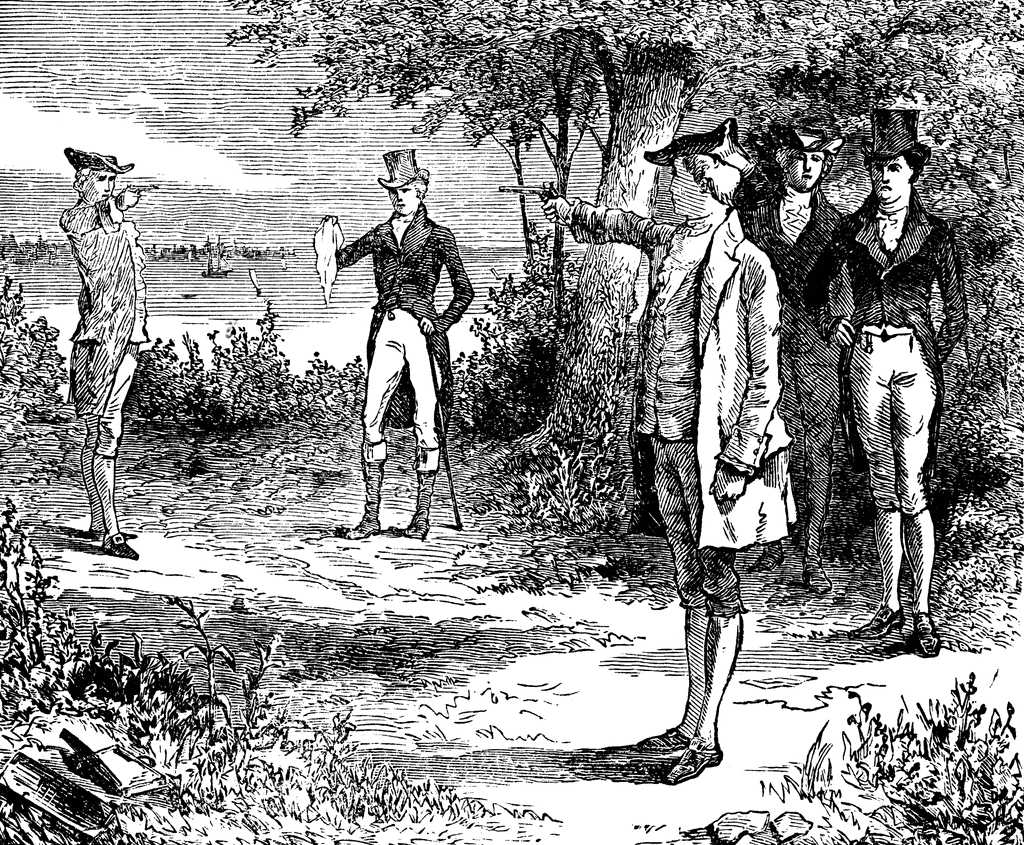
On a side note, the “gage” of mortgage was also once the name of a glove, or similar item, thrown contemptuously to the ground at the start of a conflict or duel to announce someone’s intention to fight—that’s also why you engage someone in battle. Might be worth taking one with you next time you have an appointment at the bank.
 
“You’re charging *how* much interest?”
 

26 May 2015

Feisty

It’s fair to say that some of the words and facts we tweet about are a little unusual. Yes, take a bow monkey-poop, we mean you.

But one of the most unusual we’ve posted in a long time was this nugget of etymological gold (lifted—shameless plug alert—from our new book), which we tweeted earlier this week:

So, hold your nose. We’re going in.

We might have name-checked the Tudors in that tweet, but we’ll get to them in a moment. For now, this malodorous story starts with a tenth-century English monk named Ælfric of Eynsham, who as well as being abbot of Eynsham Abbey in Oxfordshire was also one of the most prolific writers of his day. Ælfric’s output included homilies, sermons, biographies of saints, biblical translations and biblical commentaries, as well as several scholarly works written for students of Latin. Among them was a vast bilingual glossary of Latin and English, which contains the earliest records of a whole host of English words—two of which, feorting and fystinghe defined as “breaking wind”.

Unsurprisingly, the Old English word feorting is the ancestor of the modern English farting, and it’s fair to say that its meaning has lingered on, unchanged, for the last thousand years. Fysting too has survived down into modern English, but unlike feorting it’s no longer found in its original sense—instead, it’s the ancestor of a handful of seemingly innocent English words, including our old friend feisty. So how did we get from a word for “a small windy escape backwards” (as the great Francis Grose defined it in 1785), to a word meaning “lively”, “aggressive”, and “courageous”? Well, the answer lies with those aforementioned Tudors—or rather, with their flatulent dogs.

As Old English wafted into Middle English, fyst was still being used as just another general word for—well, a whiffy crackaret. But by the mid-fifteenth century, fysting had come to be used particularly in reference to foul-smelling dogs, which it can only be presumed had a notable habit of letting one go. In fact, Tudor-period English is filled with so many references to “fysting hounds” and “foisting curs” (literally “farting dogs”) that they’ve earned themselves their own entries in some historical dictionaries.

Hey, don't look at me—I can't smell anything.

Unlike Old English, of course, a lot of literature from the Tudor period still survives, and because of that we’ve even got some idea what kind of dogs these “foisting curs” were. Just take a look at this quote from De Canibus Britannicis, or Of English Dogges, a work by the sixteenth century English physician (and namesake of Caius College, Cambridge), John Caius:
Canis Meliteus … This puppitly and pleasantly curre, (which some frumpingly tearme fysteing hounds), serves ... no good vse except … to succour and strengthen quailing and quammning stomackes, to bewray bawdery and filthy abbominable leudnesse. 
We now know canis Meliteusis as the Maltese, a small white-haired lapdog seemingly once popular with Tudor women (not least because of its apparent ability to “quell filthy abominable lewdness”). But that’s not the Maltese’s only quirk: like a lot of diminutive dog breeds, it also has a gutsy, energetic character, and is quick to snappily defend what it sees as its own territory. 

And it’s this “feisty” nature—helped along by some inopportune Tudor flatulence—that brings us right up to date: by the mid-nineteenth century, feist had become just another nickname for any small dog, and it wasn’t long before the related adjective made its first appearance in print in 1896.

Now, please—someone open a window. 


5000 tweets!