_
Showing posts with label languages. Show all posts

11 August 2016

10 Words Borrowed From Other Languages - 500 Words Ep. 31


A long, long time ago over on HaggardHawks, this little fact popped up:


In retrospect, that’s a little disingenuous (not least because linguists can’t really decide what actually constitutes a word), but regardless of the parameters involved, studies of etymology tend to agree that anywhere from one-quarter to one-third of the English language has been borrowed directly into English from French.

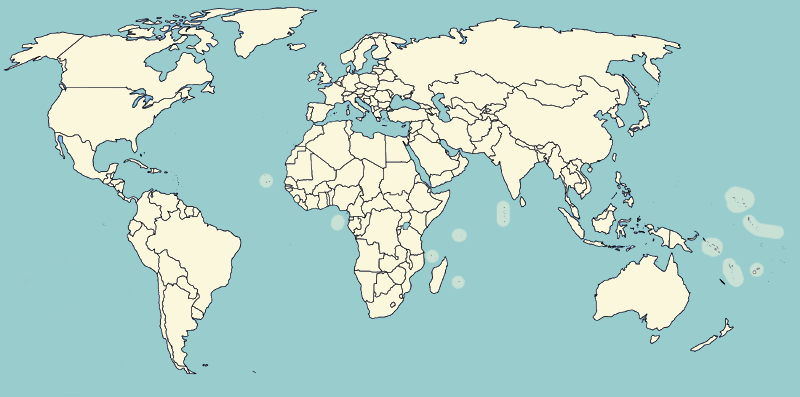
Elsewhere in the dictionary, things get increasingly far-flung: besides the likes of German, Spanish and Italian, English has adopted words from practically every major European language, including Norwegian (slalom), Finnish (sauna), and Czech (robot), as well as a number of global big-hitters like Russian (vodka), Arabic (almanac), the Chinese (lychee) and Japanese (karate) languages, and Hindi (juggernaut), Bengali (jute), Urdu (cummerbund) and all the other languages of the Indian subcontinent.

And it’s borrowed words and the languages we have taken them from that are up for discussion in this week’s HH video:


We might owe the humble word tattoo to (SPOILER ALERT if you haven’t seen the video) one of the furthest of the far-flung languages of the south Pacific, but it is by no means alone. 

Other somewhat surprising languages to have provided words to English include Tamil, another Indian language and the official language of both Sri Lanka and Singapore, which is the origin of the likes of catamaran, cheroot and pariah. Javanese, the most widely spoken language in Indonesia, is the origin of batik and lahar, another name for a volcanic mudflow. 

The native Aboriginal languages of Australia have given us billabong, budgerigar and dingo. When you run amok, you’re using a Malay word (borrowed into English via Portuguese) meaning “attacking frenziedly”. The boondocks take their name from a Tagalog word meaning “remote place”. And over in the Caribbean, the Taíno language is responsible for a number of very familiar words adopted into English via Spanish Caribbean colonists, including tobacco, hurricane, potato, canoe and even Caribbean itself. But these words, and several others like them, are almost all that remains of the Taíno civilization.

An indigenous Arawak people, the Taíno were once the most numerous people in the entire Caribbean. As such were the first Native Americans that Christopher Columbus came into contact with when he arrived in the Americas in the late 1400s; Columbus’s misinterpretation of the Carib people’s word for themselves, Caniba (as well his misapprehension that they were anthropophagous) even gave us the word cannibalism.


But as more Europeans arrived in the Caribbean, the Taíno population collapsed as its people contracted diseases for which they had no natural immunity, most notably smallpox. Within three decades, their numbers had dwindled by as much as 90%; according to some accounts, by the mid 1500s there were fewer than 500 individual Taíno people alive in the world. 

Although the population understandably never recovered, pockets of Taíno people survive across North America today. But their culture and language suffered so terrifically in the aftermath of Columbus’s arrival that the handful of Taíno words to have survived in English offer an extraordinary and tantalizingly rare glimpse of a long-lost civilization... 


26 June 2016

10 Chemical Element Names


So a lot of very big things have happened this week. For one, the UK voted to leave the European Union for some reason. Secondly, the shelves on the HH bookcase were starting to sag a bit in the middle, so they were rotated. And thirdly, the four new chemical elements discovered at the start of the year were given their names.


One of those stories is of much higher import than the others, of course, but don’t worry—those shelves will be fine. As for those chemical elements, well, the names chosen were nihonium, moscovium, tennessine and oganasson. Each has a story attached to it: the first three honour their places of discovery, Japan, Moscow and Tennessee respectively, while the last honours Russian-Armenian physicist Professor Yuri Oganessian.

Elsewhere on the periodic table, however, there are another 114 elementary etymologies to tell—although we only had enough time (and bandwidth) to talk about 10 in this week’s video…


Of course Yuri Oganessian and (SPOILER ALERT in case you haven’t watched the video) Vasili Samarsky-Bykhovets aren’t the only eponymous honourees on the periodic table. Elements like einsteinium, curium, bohrium and seaborgium honour some of the most famous names in science. 

Nor are nihonium, moscovium and their neighbours the only geographical namesakes: besides tennessine, America can offer berkelium and californium, as well as americium, while the UK has strontium, which takes its name via the mineral strontianite from the village of Strontian in the Scottish Highlands. And then there’s gallium, element number 31, which uniquely manages to honour both its place of discovery and—if the rumours are trumours—its discoverer.

The father of the periodic table, Dmitri Mendeleev (who has the element mendelevium named after him), predicted the existence of gallium in 1871, but it wasn’t until four years later the snappily-named French chemist Paul Émile Lecoq de Boisbaudran obtained a sample of it from the mineral sphalerite. The metal de Boisbaudran discovered was bright silver and brittle, and melted just above room temperature. He called it gallium, from Gallia, the Latin name for the Roman territory of Gaul, corresponding to modern-day France. But it’s possible he had other ideas in mind.

One of de Boisbaudran’s many, many names, Lecoq, means “the rooster” in French, while the Latin word for “rooster” is gallus. Had de Boisbaudran wryly named gallium after himself? Some fellow scientists at the time accused him of such, but he insisted that the connection was purely coincidental. Even if it was, it’s certainly a very convenient one and makes de Boisbaudran an interesting footnote to the dozens of famous names honoured on the periodic table. 


19 June 2016

10 Fossil Words


A while ago on the HH blog, we looked at the history of time immemorial—an expression now used to mean “time beyond memory” or “time out of mind”, but which began life as a legal term in mediaeval England referring to anything that happened before the coronation of Richard I, on 6 July 1189.


And that’s just one of 10 so-called “fossil” words that we’re looking at in this week’s YouTube video.


Fossils, or “fossilized” words, are words—like the immemorial of time immemorial, the shrift of short shrift, and the lurch of left in the lurch—that survive in the language only in one stock phrase or expression.

It’s fair to say that words like these are often hiding in plain sight: the phrases they appear in are so familiar that the obscurity of the word or words they contain slips by unnoticed. So you might not know what a caboodle is (it’s actually an alteration of boedel, an Old Dutch word for a person’s belongings), but you’ll know precisely what someone means when they talk about the whole kit and caboodle. You might not know that a pale is a wooden picket fence, but if someone or something is beyond the pale you’ll know it’s outside the accepted standards. And if we agree to let bygones be bygones, we let go of earlier contentious issues or disagreements. But what exactly is a bygone?

Well, back in the fifteenth century, bygone was an adjective rather than a noun, essentially meaning “former”, “elapsed”, or “that has gone by”—Shakespeare spoke of “the by-gone-day” in A Winter’s Tale in 1611. From there, the word came to describe anything dead or departed, and later obsolete or anachronistic—Dickens spoke of “the byegone old Assembly Rooms” in a letter dated 1869. But for bygones to be plural, it has to be a noun. So when did that happen?

Well, based on the original meaning of the word, back in the mid-sixteenth bygone came to be used not merely to describe something that has gone by or expired, but essentially as a placeholder name for it itself. Soon everything from overdue payments and financial arrears to a criminals’ previous convictions were being labelled bygones, before what we might call the modern meaning of the word—that is, “any past incident or event”—began to emerge in the mid-1600s. According to the OED, the earliest record of the phrase bygones be bygones itself dates from 1648. 


16 May 2016

18,000 followers!


Blimey, thanks everyone! We’ve flown past the 18,000 followers landmark—which can only mean one thing. It’s time for another one of our fiendish language quizzes...

Same rules as always: no time limit, just 20 tricky word-related questions covering all the kinds of things we cover on the HaggardHawks Twitter feed. Feel free to leave your scores in the comments below or let us know how you get on over on Twitter—and good luck!


12 May 2016

London


A few weeks ago over on the HaggardHawks YouTube channel, we looked at the origins of 10 city names, covering everywhere from Chicago (“a place to grow wild onions”) to Funafuri, the capital of Tuvalu (“banana-woman”).


But one city that didn’t make the final cut was the largest city in the UK and the second largest city in Europe. The home of Britain’s smallest police station. The world’s oldest underground network. Two of the world’s best universities. And a woman with a pig’s face. Yep, we’re talking about London. 

So why—to resurrect our occasional series of Questions About The Language You Never Even Thought About—is London called “London?”

In terms of etymology (or rather toponymy, to give the study of place names its proper name), London is something of a mystery. Actually, that’s putting it mildly—over the past few hundred years, a number of linguists, scholars and geographers have put their heads together and come up with little more than a mutual discrediting of each other’s theories and one gigantic Buckingham Palace-sized question mark. Why is London called “London”? The short answer at least is that no one really knows.

That’s partly to do with a lack of written evidence. It’s also partly to do with the fact that we’re dealing with exceptionally old words and word elements, the barest bare bones of the language. And partly it’s because London is such a unique name—it really just doesn’t look like any other ancient word or word element that we know about, which makes working out what it might mean an especially tricky business. But just because we don’t have a definitive answer, doesn’t mean that we don’t have any answer at all.

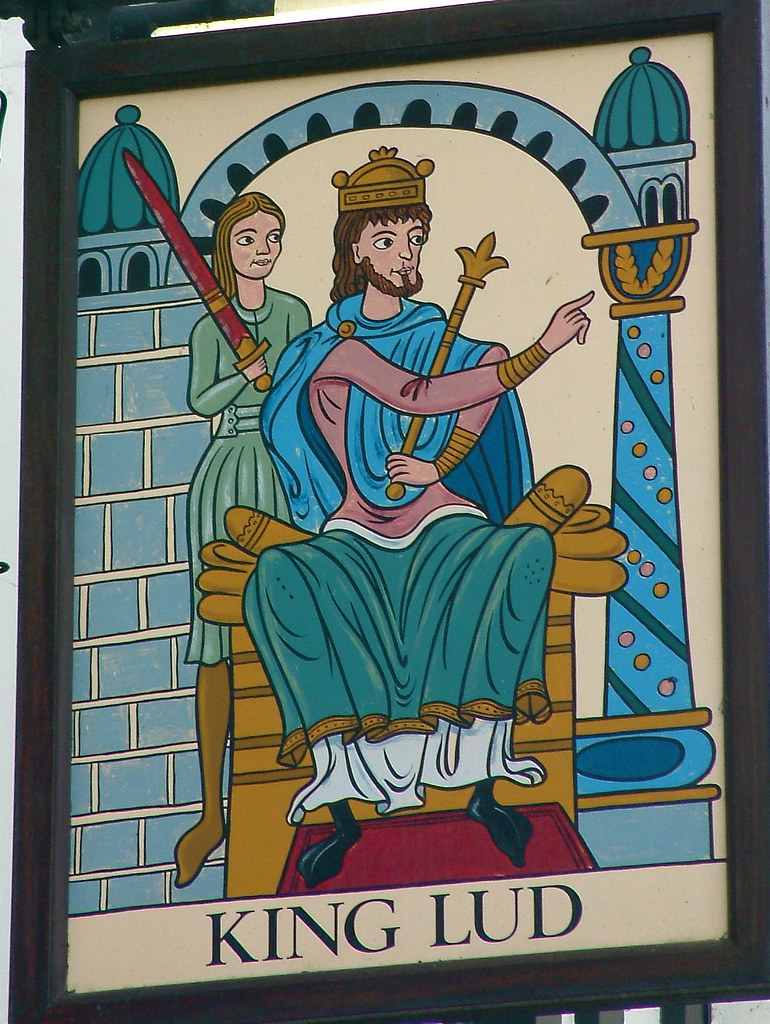
By far the oldest explanation on record is that of the twelfth century Welsh scholar and historian Geoffrey of Monmouth. In his History of the Kings of Britain (c.1135), Monmouth claimed that London was founded by and named in honour of a pre-Roman king of Britain named Lud, who built the city on the site of an even more ancient city called “New Troy” that had been founded by Brutus, grandson of Aeneas, in 1100BC. It’s a nice story alright. It’s just a shame it’s complete rubbish.


Geoffrey of Monmouth probably based his mythical tale of King Lud on that of a legendary figure from Welsh folklore called Lludd Llaw Eraint, or “Lud Silver-Hand”, who is said to have saved Wales from a plague of dragons and a magical giant who had the power to send people to sleep by playing music; to escape the giant’s soporific tunes, Lud dipped his head in a bucket of water. 

Oddly enough, it’s likely that none of that ever actually happened, which makes the idea that London is named after a dragon-slaying monarch with his head in a bucket somewhat implausible. Oh, and linguistically it’s highly unlikely that a word like Lud would morph into something like “Lond”. But still—dragons and giants. That’s probably all the proof you need there.


“...and over there is the bucket I put my head in.”

As unlikely as Geoffrey of Monmouth’s theory might be, he nevertheless might’ve been onto something by suggesting that London was named after or in honour of someone—but precisely who that “someone” was is another question.

For a while, one popular theory was that London was founded by or named in honour of someone called Londino or Londinos, a hypothetical name supposed to derive from an old Celtic word meaning “wild” or “fierce”. But there’s no historical precedent for that name whatsoever, and (without getting into too much detail) phonologists tend to agree that a Celtic word beginning lond– would give you a modern English word pronounced something like “loaned”, not like the “lund” of London. So despite being more than century old, this theory is now widely discredited. 

Alternatively it might not be the Lond– part of London that’s taken from someone’s name, but rather the –don. It’s been suggested that London might once have been called Lunadin, Luandan or Lan Dain, an ancient name meaning something like “moon temple of the goddess Diana”. Sir Christopher Wren certainly believed that he had unearthed a Roman temple dedicated to Diana when he rebuilt St Paul’s Cathedral, but again the linguistic and historical evidence just isn’t there to back this theory up.


So if it’s not an honorific name, how about a geographical one? 

Another theory is that London was originally llyn din, or llyn dain, both Welsh-inspired names literally meaning “lake-fort” or “pool of the river” respectively (the “lake” and “pool” in question possibly being the widening, deepening part of the river Thames). They’re both plausible theories, but linguistically a word like llyn would be expected to produce a modern name like Lindon-with-an-I, not London-with-an-O. 

And London has almost always been London-with-an-O: the earliest records we have of it are all from ancient Roman Latin documents and inscriptions that refer to it as Londinium or Londinion. The people of London themselves were the Londiniensi—a word taken from a stone tablet dating from around AD 150 that was unearthed at an archaeological dig in Southwark in 2002, and which provides us with the earliest known evidence of the name “London” that we have. And for the Romans to have spelled their “London” with an O (or a U, as they sometimes did) casts doubt on those Welsh-origin theories. 

Instead, we might have to look even further back in time.


Bring on the wall!

In 1998, Professor Richard Coates—then President of the English Place-Name Society—put forward perhaps the most convincing argument for the origin of the word London yet: Plowonida. If you think Plowonida sounds more like something you’d use to treat athlete’s foot rather than the origin of one of the most famous cities in the world, you’ve got a point. But the reason this looks so unfamiliar—and so unlike the modern name “London”—is because we’re dealing with impossibly old pre-Celtic language.

In Coates’ theory, Plowonida would have started life as a hydronym (a river name) referring to the part of the Thames on which London was founded. It combines (brace yourselves, we’re going even further back in time here) two Proto-Indo-European word roots meaning “to flow”, plew– and nejd–, whose descendants are found in river names all across Europe. In combination, it’s theorized that these two elements might have referred to the first noticeably deep, fast-flowing part of the Thames, where it was impossible to ford or cross on horseback.

Knowing what we know about pre-Celtic language, calling the river itself Plowonida would have given the town or village that stood on the banks of the river the name Plowonidonjon, which over centuries of simplification and alteration would have become a Celtic name along the lines of Lūndonjon, then the Latin name Londinium, and ultimately the modern English name “London”. If Coates’ theory is correct, that would mean the name “London” could be interpreted as something like “the town at the unfordable part of the river”—which is a considerably better theory that “the town of the king who put his head in a bucket”.


27 April 2016

10 Figures of Speech

Rhetorical terms and words for different figures of speech crop up every now and then on the HaggardHawks Twitter feed, and are without exception brilliant, brilliant words:


But with our YouTube channel now in full swing—incredibly, this is already video number 16!—we thought it might be good to dedicate an entire episode to bringing together a choice set of ten:


Many of the words language experts use to describe tropes like these—including all those included in the video—are based on Greek word roots, which are often brought together in quite inventive and memorable ways. Take one of those from the video, antanaclasis: it refers to a word being used with two different meanings, like “I can’t wait to wait tables all day” (which no one in the service industry has ever said) or “I can’t wait to bar him from the bar” (which absolutely everyone in the service industry has said). Because of this repetitious, back-and-forth arrangement, the word antanaclasis derives from the Greek word for a reflection.

Likewise another term from the video, chiasmus, takes its name from the X-shaped Greek letter chi because it refers to the criss-crossed arrangement of repeated words found in “ask not what your country can do for you, ask what you can do for your country”. 

And elsewhere in the rhetorician’s dictionary we find words like zeugma, which refers to the use of a single word in two different contexts in the same sentence, like “I will take my camera and some photographs”. It derives from the Greek word for an ox’s yoke, in the sense of one word “yoking” its two meanings together in one sentence. A prodiorthosis is a warning that you’re about to deliver bad news, and essentially means “a pre-apology”. Hendiadys is the emphatic use of two separate words rather than a single word and a qualifying adjective or adverb—like “the rain and the weather spoiled our holiday” rather than “the rainy weather”—and as such literally means “one through two”. And prosopopoeia is a form of personification in which an inanimate object is portrayed as talking:


Brilliantly, it literally means “making a face”.