_
Showing posts with label Jedburgh Justice. Show all posts

3 March 2016

10 Words From Victorian Slang

If you’ve been following the new @HaggardHawks YouTube channel so far this year, you might remember that a few weeks ago we posted a list of 10 Words Derived From Dickens Characters, just in time for Dickens’ 204th birthday on February 7. And following on from that, this week as part of our #500Words series we’re heading back to the nineteenth century with 10 Words From Victorian Slang.

Nineteenth century slang crops up fairly regularly on the @HaggardHawks Twitter feed (indeed a few choice examples ended up being among the most popular tweets of 2015), but we’ve picked ten of the best and most interesting examples for this week’s video—from blue fire, the perfect theatrical term for something amazing or spectacular, to collieshangie, a word for a noisy argument that’s so Victorian it was even used by Queen Victoria.

Although we’re labelling it a Victorian slang term here (as that’s when it first gained any wider currency, and is often listed as such in slang dictionaries), the word collieshangie itself actually has its origins in eighteenth-century Scotland: it probably began life as culleshnagee or cullyshang, an old Scots dialect word presumed to be a compound of collie (a sheepdog) and shangie, a word used for both a noisy quarrel, and a restraint attached to a dog’s tail to make it behave. Either way, collieshangie can fairly confidently be said to derive from one very angry dog. 


5 September 2015

Glasgow magistrate

Earlier this week, this popped up on HaggardHawks:
And, as so often happens with this kind of thing, there’s a brilliant—if a fairly sketchy—story behind it. Unlike a lot of slang expressions, the Glasgow magistrate has found its way into the OED, who have traced it back to 1833. But the OED also cites a 1950 issue of The Scots Magazine, which offers this tentative explanation of how the phrase came about:
Herring were cured there by Walter Gibson, a merchant of Glasgow and Provost of that city in 1688, and it is perhaps because of Provost Gibson that salt herring acquired their nickname of “Glasgow Magistrates.”
Walter Gibson indeed helped to found Glasgow’s lucrative herring industry in the late 1600s, and he did become provost (chief magistrate) of Glasgow in 1688. But is he really the origin of the term? And is the establishment of a herring-curing factory really the best story I could tell you? No. No it’s not.


The problem is that if Gibson were the original Glasgow magistrate, we’d have to accept a century-and-a-half gap between his appointment as provost in 1688 and the earliest record of the phrase in print in 1833. That’s not impossible of course (slang expressions are used relatively rarely in print, after all) but it nevertheless casts doubt over the Walter Gibson theory—and it becomes a lot more doubtful given the other explanation on offer. 

In the revised edition of his Dictionary of Phrase and Fable in 1894, Ebenezer Cobham Brewer included the Glasgow magistrate (alongside the Yarmouth capon and the Billingsgate pheasant) as a nickname for a salted herring. He also offered this brief yet brilliant account as an etymological explanation:
When George IV visited Glasgow, some wag placed a salt herring on the iron guard of the carriage of a well-known magistrate, who formed one of the deputation to receive him.
Where or how Brewer came across this story isn’t clear, but he goes on to explain:
I remember a similar joke played on a magistrate because he said, during a time of great scarcity, he wondered why the poor did not eat salt herrings, which he himself found very appetising.
So is this tale of a local Glaswegian scallywag secreting a herring onto a processional carriage true? 

Well, by name-checking George IV, Brewer is certainly proposing a date that seems to fit with the evidence: George took to the throne in 1820 and reigned for the next ten years, so written evidence dating from around 1833 is perfectly reasonable. There is, however, a problem: King George only visited Scotland once in his ten-year reign—and he never set foot in Glasgow.

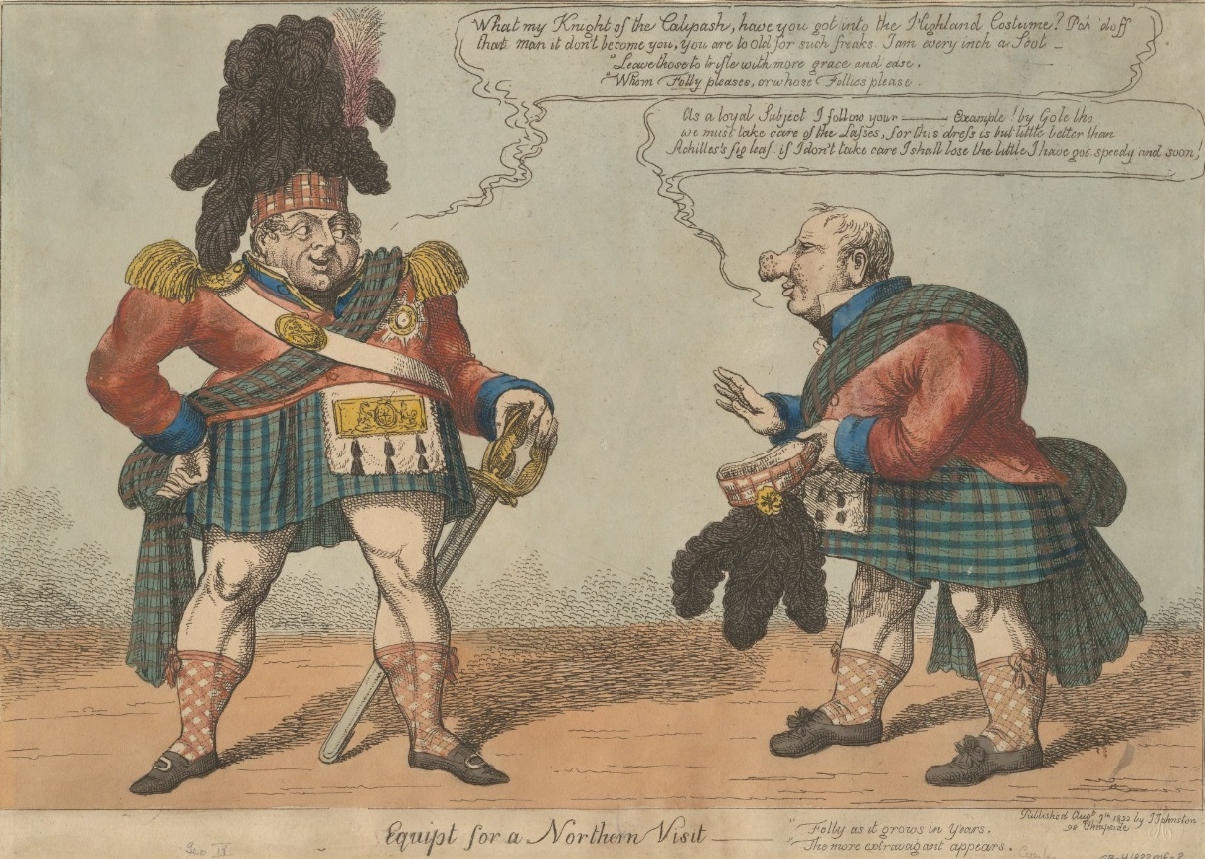
In 1822, George IV became the first Hanoverian monarch—as well as the first reigning monarch in nearly 200 years—to visit Scotland when he stayed in Edinburgh for three weeks in mid August. During that time, the king attended all sorts of predictably glamorous pageants and processions (all stage-managed by Sir Walter Scott, no less) and gamely managed to make a complete fool of himself by opting to wear bright pink stockings under a criminally undersized kilt. At no point, however, did he travel across to Glasgow. 

So does this blow Brewer’s fishy theory out of the water? Perhaps not. It’s thought that some 300,000 Scottish people—one in seven of the entire population at the time—turned out to see the various events put on for the royal visit in Edinburgh in 1822, and a large proportion of those had made the 40-mile trip from Glasgow, reportedly leaving the city all but deserted. 


So could it be that Brewer’s Glaswegian prankster was in fact among the crowds in Edinburgh, rather than his home city? It’s not only plausible, but it’s a much better story... 


24 July 2015

Admiral

Last week HaggardHawks tweeted this screenshot, taken from a brilliantly-titled dictionary of Slang and Its Analogues Past and Present, published in 1890:
  

And, well, it probably all needs a bit more explaining.


Admiral is one of those deceptively straightforward words behind which lies the kind of history that keeps etymologists awake at night. They should really cut down on the caffeine after 5pm. It’s all a bit of a bewildering hodgepodge—the OED’s etymology alone comprises a 1300-word essay—but the basic theory is that, at its root, admiral derives from the old Arabic title amir, as in emir and emirates. This ancient title was then borrowed into and reshaped by the vocabularies of various Mediterranean countries and cultures around 1000 years ago, and via the all-conquering Normans eventually began to appear in English texts in the early thirteenth century.

Initially, admiral was used as a fairly general title for a ruler, a leader, or a military commander; things get confusing when we try to find out how it came to be used exclusively of a naval leader.

The first person we know to have held a naval title along the lines of admiral was the not-all-that-impressive-sounding George of Antioch in the early 1100s. George, who had already worked in several similar naval positions in Arabic-speaking North Africa, was put in charge of the fleet of the even-less-impressive-sounding Roger II, a twelfth-century King of Sicily, who gave him the Latin title ammiratus ammiratorum

It’s around this time that (etymologically, at least) things become a little hazy: it could be that George’s title ammiratus is a Mediaeval Latin spin on the Arabic title amir, which George would certainly have known of having served in North Africa. Alternatively, it could be a purely Latin title, with no connection to Arabic at all—on its own, ammiratus ammiratorum literally means “the most admired of the admired”.

Wherever the word’s ancient history might lead us from there, however, the fact is that by the time of George’s appointment Sicily too had been conquered by the Norman French—and it was the Normans who were responsible for transplanting the title from the sunny southern Mediterranean to the rainy European northwest. 

So. If that’s the story of admiral, what about the admiral of the narrow seas?

Well, in eighteenth century slang—long after admiral had established itself as a naval title in England—a curious trend emerged for applying fictitious “titles” to various people and characters. So a Captain Queernabs was “a shabby, ill-dressed fellow”, and a Captain Cork was a man who was “slow in passing the bottle”. A boatswain-captain was the naval equivalent of a swot: an overly competent seaman who never seemed to put a foot wrong. An admiral of the red was a wine-drinker. An admiral of the white was a coward. An admiral of the blue was a drunkard, or a publican (who would typically wear a blue tabard). An admiral of the red, white and blue was a ludicrously or ostentatiously dressed person. And an admiral of the narrow seas was the queasy, mulvathered seafarer mentioned above.

A vice admiral of the narrow seas, meanwhile, was an even worse drinking companion:


6 June 2015

Grandmother

When it came to being amazed, those Victorians really knew how to respond:
If ever an old fashioned phrase needed bringing back into circulation, it was this one. But where does a saying as bizarre as this one come from?

The earliest record we have of this beats my grandmother! dates back to 1833, when it first appeared in a comic poem included in an American elocutionary reader, The United States Speaker. The poem, “Logic”, outlines a light-hearted back-and-forth conversation between a young schoolboy—“an Eton stripling”—who has just returned from boarding school, and his uncle, Sir Peter, whom he is visiting:


“Well, Tom, the road; what saw you worth discerning?
How’s all at college Tom: what is’t you’re learning?”
“Learning?—Oh, logic, logic; not the shallow rules
Of Lockes and Bacons, antiquated fools!
But wits’ and wranglers’ logic; for d’ye see
I’ll prove as clear as A, B, C,
That an eel-pie’s a pigeon; to deny it
Is to say that black’s not black;”—“Come, let’s try it?”
“Well, sir; an eel-pie is a pie of fish:” “Agreed.”
“Fish-pie may be a jack-pie:”—“Well, well, proceed.”
“A jack-pie is a John-pie—and ’tis done!
For every John-pie must be a pie-John!”
“Bravo! bravo!” Sir Peter cries,—“Logic for ever! 
This beats my grandmother, and she was clever!”

Tom’s grandmother-beating argument is that the eels in an eel-pie are fish, as are the jacks (an old nickname for a young pike) in a “jack-pie”. Jack is a pet form of John, and “John-pie” when reversed gives “pie-John”— hence, “pigeon”. Ipso facto. Quod erat demonstrandum. Logic forever, indeed.

The poem is unfortunately anonymous, which makes it hard to pin down the precise origin of this beats my grandmother. Its appearance here in an American textbook makes it tempting to presume it’s an American invention, but the reference to Eton College confuses things, as does the fact that the entire “pigeon”/“pie-John” argument is apparently considerably older than this poem might suggest: a reference to it here, for instance, from a book published in London in 1821, suggests that it was already fairly well known even by then.

But regardless of its American or British ancestry, one question remains—why on earth does it beat my grandmother? 

Well, oddly enough, this beats my grandmother! was just one in a long line of bizarre eighteenth-nineteenth century slang expressions that emphatically alluded to the speaker’s grandmother. So all my eye and my grandmother! meant “don’t talk rubbish”. So is your grandmother! was the Victorian equivalent of that schoolyard favourite, “I know you are, but what am I?” And to shoot your grandmother meant to find out a juicy bit of gossip, only to discover that everybody else already knows it. (Shameless plug: there’s more on this here.) 

Some of these expressions even made the leap from everyday colloquial English into hard-copy literature. Dickens, for instance, used the emphasizing expression not even to your grandmother in Our Mutual Friend (1865). Anthony Trollope dismissively used your grandmother! in his novel Phineas Redux (1873), as did Mark Twain in his short story How I Edited An Agricultural Paper Once (1870). And chances are you’ll have heard someone warn not to teach your grandmother to suck eggs—which Henry Fielding used in Tom Jones as far back as 1749.

As well as being the only one of these phrases to still be in use today, this egg-sucking grandma is also the oldest—and as such provides the best clue to the origin of this entire clutch of expressions. It’s earliest record dates all the way back to 1707, but before then, seventeenth-century speakers were telling each other not to teach their grandmothers “to sup sour milk”, “to make milk-kail” (a type of cabbage soup), and even “to grope a goose” (meaning to poke a goose’s rear end to see if it’s ready to lay an egg—which is likely the origin of the egg-sucking grandma).

Some geese: boy, has grandmother got a surprise for you...

The implication of all of these sayings was the same—don’t try to tell an informed, experienced person how to do something they already know how to do. Tellingly, a similar meaning is implied by another expression, you can’t teach an old dog new tricks, which has been found in a list of proverbs dating back to 1636 but is probably much, much older: a book on animal husbandry written in 1534, for instance, advises that “it is harde to make an olde dogge to stoupe [i.e. be compliant]”. The same book also explains the best technique for greasing sheep. Truly, it’s an indispensable read.

The implications in the old dog new tricks and grandma to suck eggs might be different, but there’s only a slight semantic sidestep from “old dog” to “old person”, and hence to “grandmother”—so it’s likely that the one inspired the other, and, eventually, its plethora of later variations. 

And if that doesn’t beat your grandmother, I don’t know what will.