_
Showing posts with label transport. Show all posts

2 August 2016

10 Words For Other Words


If you’ve been keeping up with the HH “500 Words” YouTube series, you’ll so far have found out about 280 of the 500 words we’re going to look at this year. But this week, we’re turning things around. 

So from hypernyms and hyponyms to holonyms and holophrases, this week’s video is looking at 10 Words for Other Words.


(And for more words like those, then be sure to check out the HH article that inspired it over on Mental Floss.)

One word that didn’t make the final cut here, however, is backronym. We’ve discussed some backronyms on YouTube before—mainly in our 10 Word Origins Stories That Are Completely Untrue video—and it’s a myth-busting topic that’s always worth revisiting.

Backronyms are words or phrases that are widely and mistakenly believed purported to be acronyms. Posh, for instance, is often claimed to stand for “port out, starboard home”, a reference to moneyed cruise ship passengers paying for the best views on both the outward and homeward bound parts of their voyage. Golf too is said to stand for “gentlemen only, ladies forbidden” (or ladies do something else that begins with F). And the distress signal SOS is famously claimed to stand for “save our souls”, or “save our ship”.


“It says, ‘you may have been missold PPI.’”

None of these is true, of course. Posh is simply thought to come from an old slang word for cash or loose change. Golf is probably descended from an old Dutch word for a club, colf or kulf (albeit with perhaps some influence of a Scots word for a stout blow to the head). And the letter combination “SOS” was chosen as a distress signal for no other reason than that its rhythmic and symmetrical combination of dots and dashes [· · · – – – · · ·] is so immediately noticeable. Incidentally, precisely the same combination of dots and dashes could also be used to spell the letters “VTB” in Morse code, but the designation SOS was used because of its own symmetry and memorability.


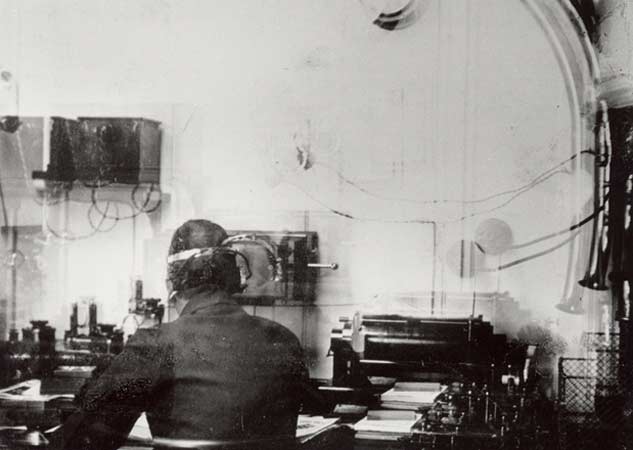
Before SOS was adopted in the early 1900s, however, the standard telegraph distress signal was “CQD” [– · – ·    – – · –    – · ·]. It’s fair to say that that’s hardly the most recognisable or memorable arrangement of dits and dahs on offer, so why pick that?

Well, on their own the letters “CQ” had long been used as a telegraphic distress signal as they sound identical to the French word “sécu”, an abbreviation of sécurité. The Marconi Telegraph Company simply added a letter D to this to make their first recommended distress signal, CQD. But just like SOS, CQD also fell foul of backronymy and before long myths had emerged claimed that it stood for “come quickly—danger!”, or “come quickly—drowning!”

Problems with interpreting the confusing set of letters “CQD” over a poor signal, however, eventually led to calls for a more immediately recognizable distress signal to be adopted, and so SOS was officially introduced in 1906. 


1 April 2016

Cacafuego


There’s really no nice way of putting this, but the fact is that poop crops up more often than it duly should on this blog. And thanks to a tweet from the HH feed the other day, we’re going back down that way again now:


There’s no denying that cacafuego is a brilliant (and unavoidably usefulword, but is it really genuine? Or, to put it another way:


Wow, imagine if that were true. A plot twist to put M Night Shyamalan to shame. But let’s not get bogged down in piss halfway through a blog about shit, so to speak.

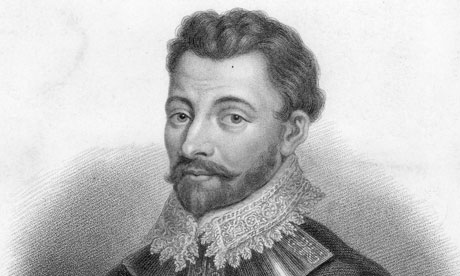
No prizes for guessing that cacafuego was borrowed into English from Spanish, and combines the verb cacar (modern Spanish cagar, “to void excrement”) with fuego, “fire”. It first appeared in English as another word for a blustering braggart in the early 1600s, but we can be fairly sure that it was in use before then thanks to the somewhat unlikely-sounding involvement of Sir Francis Drake.


Sir Francis Drake: looking a little ruff
In 1578, part-way through his circumnavigation of the Earth, Drake rounded Cape Horn and entered the Pacific Ocean, hot on the heels of a 120-tonne Spanish galleon called the Nuestra Señora that he had heard was laden with a rich cargo of silver and jewels from the Spanish colonies. And he wanted it.

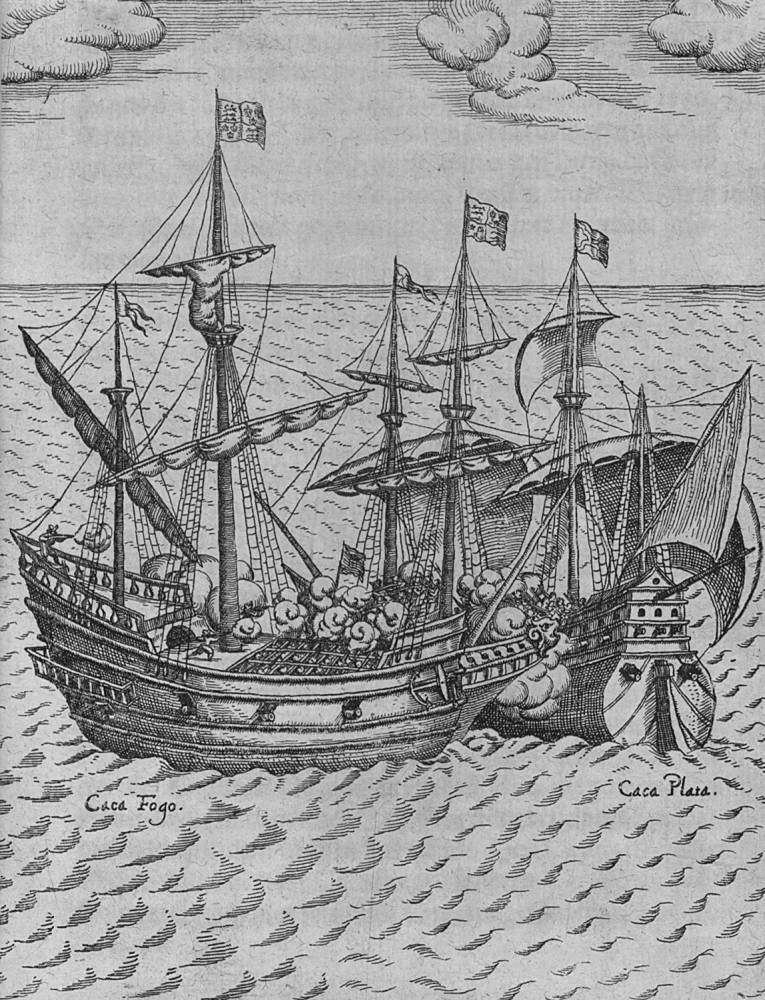
Sailing up the Pacific coast of South America, Drake’s Golden Hind caught up with the Nuestra Señora off the coast of Ecuador. Knowing that an attack made under the cover of darkness was his best bet, he slowed his progress by tying some of his ship’s store of wine to the stern and throwing it overboard, so that by the time the Hind reached the Nuestra Señora it was the middle of the night. The Spanish crew were taken by surprise, and after a brief skirmish they surrendered, allowing Drake and his men to take control of the ship.


Drake sailed both the Nuestra Señora and the Golden Hind back to the South American coast to unload her treasure. Knowing just how substantial a prize he had secured for England he treated the Spanish crew well, inviting the officers to join him for a grand banquet and giving every crewmember a parting gift and a letter of safe conduct, ensuring as safe a journey home to Europe as possible. Drake himself continued on his journey, and having completed his circumnavigation arrived back in Plymouth on 26 November 1580.

So where does all the flaming poop come into this? Well, Drake’s captured galleon might have been officially known as the Nuestra Señora de la Concepción, or “Our Lady of the Immaculate Conception”, but to her crew she was the Cacafuego, or “fire-shitter”. That might seem like an odd (and fairly uncomplimentary) nickname for—well, anything really, but just like the Spitfire centuries after her, it was probably intended to be a reference to her impressive weaponry and blazing cannon fire, or else to her speed through the water and her “fiery” temperament. 

And just as spitfire was once a nickname for an irascible, hot-tempered person, in the seventeenth century cacafuego became a byword for a blustering, swaggering braggart—a meaning perhaps influenced by the fact that, despite her impressive armoury, the Cacafuego had proved no match for Drake. 


6 July 2015

Jeep

Something over on @HaggardHawks caused a bit of a stir the other day:
For once, the main word here wasn’t the problem. Instead, what seems to have caused the most head-scratching was the inclusion of the word jeep as an example of an acronym:
Quite right too, it is a brand name. But as far as most etymological theories are concerned, it’s also an acronym. As well as an anacronym. With a reference to an obscure cartoon character thrown in for good measure. Confused? You’re not the only one...

So, first things first: how exactly is jeep an acronym? Well, the most likely theory is that the word jeep developed from an approximate pronunciation of the letters “GP”, an old military designation standing for “general purpose”. Ultimately, it’s thought that when it first appeared in American army slang in the early 1930s, the nickname jeep was originally applied to any item of widely-used military equipment, including various gadgets and gizmos, weaponry, cars, trucks, helicopters, and even early flight simulators

If this theory is correct, then jeep is an example of what is known as a “respelled initialism”, an acronym whose letters have been spelled out phonetically to form a whole new word. Linguistically these “respelled” acronyms—also known as “vocologues”—comprise a fairly rare class of words, but understandably so: after all, acronyms are motivated by brevity, so there’s little point in making them any longer than they need to be. Nevertheless, a handful of examples have emerged over the years, including emcee (from MC, a “master of ceremonies”), deejay (from DJ, a “disc jockey”), the brand name Esso (from SO, “Standard Oil”), and, most familiar of all, okay.

In the case of jeep, of course, the final –ee sound of “GP” (or “gee pee”) isn’t pronounced, which makes it an example of an even rarer class of words known as “clipped initialisms”—namely, acronyms that have been respelled phonetically, then shorted again. Veep, as a nickname for the Vice President, and Beeb, as a nickname for the BBC, both likewise fall into this category, but examples of this particular linguistic phenomenon are unsurprisingly few and far between.

There are a handful of other competing theories of the origin of jeep (at least one of which is outlined here), but most etymologists tend now to sign up to this “GP” explanation. However, many also agree that this particular story doesn’t end there, and that jeep was, somewhere along the line, influenced by something else—something, it’s fair to say, rather unexpected.


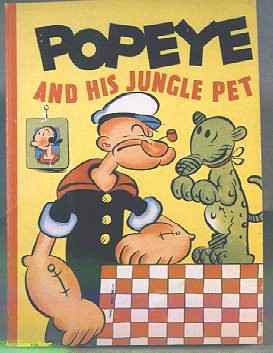
On 17 January 1929, Popeye The Sailor Man made his first appearance in print in the Thimble Theatre comic strip. Created by the US cartoonist EC Segar, as the series became increasingly popular more and more characters were introduced to the storyline, including Popeye’s mooching companion Wimpy, his bullying nemesis Bluto, and his stridewallop girlfriend Olive Oyl (who had already made her first appearance in a different comic series ten years earlier). Popeye and Olive eventually adopted a son, Swee’Pea, tracked down Popeye’s estranged father, Poopdeck Pappy, and in 1936 encountered “a mysterious strange animal” called Eugene the Jeep.

Eugene was introduced to the Popeye series when Olive Oyl was given a “jeep”—a highly intelligent dog-like animal with bright yellow fur and a large red nose—as a gift from her uncle. Puzzled by the creature’s appearance, in one edition Popeye calls in an expert, who enthusiastically explains that a “jeep” is “an animal living in a three-dimensional world … but really belonging to a fourth dimensional world.” Throughout several subsequent episodes and escapades, Eugene is ultimately shown being able to travel through time, walk through walls and doors, and teleport effortlessly from one place to another. Put another way, the “jeep” could go wherever he wanted, whenever he wanted to.

Not long after Eugene made his first appearance in 1936, the Willys-Overland Motor Company in Toledo began manufacturing its model MB Army Truck. Powerful and robust, and able to cross practically any terrain, the MB seemed to embody all of Eugene’s most impressive capabilities. As a result, it soon became known as the “jeep”—a nickname partly inspired by the earlier military slang term “GP”, and partly inspired by Popeye’s bizarre teleporting pet. 

As a representative of Willys-Overland explained in a letter in 1944:

We feel that the word [jeep] originated with Segar, King Features cartoonist, who until his recent death wrote the Popeye strips. You will recall that in this feature there was a character called “Jeep” which lived on orchids and could go anywhere and do anything. It is our contention that the boys in the service picked this name up from Segar and applied it to the Willys vehicle which has many of the “go-anywhere, do anything” characteristics of the Popeye character.
After the outbreak of the Second World War, the MB became the focus of numerous public demonstrations, all of which helped to popularize the word jeep outside of military slang: as early as February 1941, a publicity stunt was organised in which a Willys truck was driven up the steps of the Capitol Building in Washington DC, with a local newspaper report noting that “the Army’s new scout cars” were already “known as ‘jeeps’”. 

Soon, all earlier uses of the word had vanished, and the name jeep had established itself as a standard nickname for any relatively small, yet still relatively powerful, truck.