You may remember this fact from the HH Twitter feed a while back:
...which led to a bit more explanation here on the blog: the name Rebecca was used (in allusion to a story from the Old Testament) for a series of toll gate protests in Wales in the mid nineteenth century. And it’s that story again that kickstarts this week’s YouTube video, which looks at the origins and meanings behind 10 first names that can be used as words in their own right.As a verb, the girl’s name REBECCA can be used to mean ‘to destroy a gate’.
— Haggard Hawks Words (@HaggardHawks) 30 July 2015
One name that didn’t make the final cut here, however, is John.
John has a number of different uses in English, ranging from a toilet to a signature, a cuckolded husband to an unidentified corpse, and from a policeman to a priest, to the client of a prostitute. Blimey, definitions don’t get much more varied than those.
In the majority of these cases, it’s the sheer commonality (and, therefore, the familiarity or anonymity) of the name John that is the root of the meaning: John was the most popular male first name in American every year since records began in the nineteenth century through to 1924 (and it remained in the top 10 until 1987), while in the UK 5.8 million men have been named John since 1530, and either it or William held the top spot among British men from the mid-1500s right through to the mid-1900s.
In the majority of these cases, it’s the sheer commonality (and, therefore, the familiarity or anonymity) of the name John that is the root of the meaning: John was the most popular male first name in American every year since records began in the nineteenth century through to 1924 (and it remained in the top 10 until 1987), while in the UK 5.8 million men have been named John since 1530, and either it or William held the top spot among British men from the mid-1500s right through to the mid-1900s.
The use of john as another name for a person’s signature, however, owes its origin to John Hancock, the Governor of Massachusetts whose sign-manual gloriously outdoes everybody else’s on the Declaration of Independence (and which you can see—or rather, fail to miss—at the top of this page).
As another name for a toilet, meanwhile, john is probably an alteration of jakes or Jacques, a French borrowing that has been used as a euphemism for the smallest room in the house since the fifteenth century at least. And as another name for a detective, john has its roots in the French word for a policeman, gendarme.
The term gendarme (which itself began life as gens d’armes, or “men of arms”) was originally the name of a mounted soldier or infantryman, and it was in this sense that the word was first borrowed into English in the sixteenth century. It wasn’t until the first formal police forces began to be organized in the 1800s that the word gained its modern sense in its native French—and, for that matter, in English, where it quickly morphed into the humorous form johndarm in early Victorian slang:
“John Darm! Who’s he?” “What, don’t you know?! In Paris he is all the go; Like money here,—he’s every thing; A demigod—at least a king! You cannot fight, you cannot drink, Nor have a spree, nor hardly think, For fear you should create a charm, To conjure up the fiend John Darm!
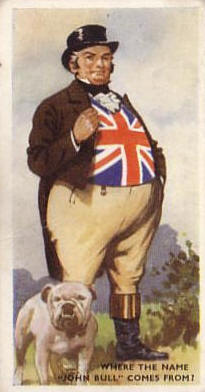 That’s an extract from John Darm, a song first published in 1823 and written by a nineteenth century “writer of verse” named John Ogden, recounting a trip taken by John Bull (the kedge-bellied personification of England and the English) to France. Once there, Bull attends a theatre, gets into a fight with a number of audience members, is arrested by “John Darm”, and thrown into prison.
 The trip ends with the two on better terms, however, with John Bull concluding:
Says I, “To-morrow home I go;
One Frenchman I’d not leave my foe;
John Bull, believe me, meant no harm—
Let’s part in peace—farewell John Darm!”
Ogden’s song (which was apparently a follow up to an earlier comic poem, Mounseer Nongtongpaw, once falsely attributed to Frankenstein author Mary Shelley) provides us with the earliest record of the name john as a nickname for a policeman that we know about. And although the word’s French origins and its connection to the gendarmerie has long since vanished into the haze of language history, the word itself has remained in use to this day.