_
Showing posts with label linguistics. Show all posts

11 August 2016

10 Words Borrowed From Other Languages - 500 Words Ep. 31


A long, long time ago over on HaggardHawks, this little fact popped up:


In retrospect, that’s a little disingenuous (not least because linguists can’t really decide what actually constitutes a word), but regardless of the parameters involved, studies of etymology tend to agree that anywhere from one-quarter to one-third of the English language has been borrowed directly into English from French.

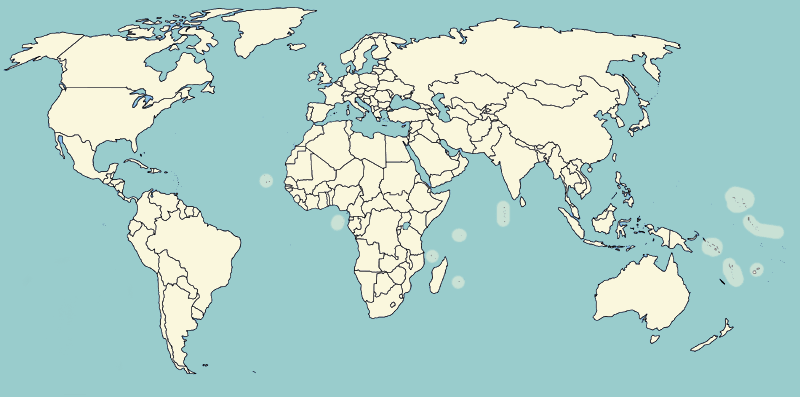
Elsewhere in the dictionary, things get increasingly far-flung: besides the likes of German, Spanish and Italian, English has adopted words from practically every major European language, including Norwegian (slalom), Finnish (sauna), and Czech (robot), as well as a number of global big-hitters like Russian (vodka), Arabic (almanac), the Chinese (lychee) and Japanese (karate) languages, and Hindi (juggernaut), Bengali (jute), Urdu (cummerbund) and all the other languages of the Indian subcontinent.

And it’s borrowed words and the languages we have taken them from that are up for discussion in this week’s HH video:


We might owe the humble word tattoo to (SPOILER ALERT if you haven’t seen the video) one of the furthest of the far-flung languages of the south Pacific, but it is by no means alone. 

Other somewhat surprising languages to have provided words to English include Tamil, another Indian language and the official language of both Sri Lanka and Singapore, which is the origin of the likes of catamaran, cheroot and pariah. Javanese, the most widely spoken language in Indonesia, is the origin of batik and lahar, another name for a volcanic mudflow. 

The native Aboriginal languages of Australia have given us billabong, budgerigar and dingo. When you run amok, you’re using a Malay word (borrowed into English via Portuguese) meaning “attacking frenziedly”. The boondocks take their name from a Tagalog word meaning “remote place”. And over in the Caribbean, the Taíno language is responsible for a number of very familiar words adopted into English via Spanish Caribbean colonists, including tobacco, hurricane, potato, canoe and even Caribbean itself. But these words, and several others like them, are almost all that remains of the Taíno civilization.

An indigenous Arawak people, the Taíno were once the most numerous people in the entire Caribbean. As such were the first Native Americans that Christopher Columbus came into contact with when he arrived in the Americas in the late 1400s; Columbus’s misinterpretation of the Carib people’s word for themselves, Caniba (as well his misapprehension that they were anthropophagous) even gave us the word cannibalism.


But as more Europeans arrived in the Caribbean, the Taíno population collapsed as its people contracted diseases for which they had no natural immunity, most notably smallpox. Within three decades, their numbers had dwindled by as much as 90%; according to some accounts, by the mid 1500s there were fewer than 500 individual Taíno people alive in the world. 

Although the population understandably never recovered, pockets of Taíno people survive across North America today. But their culture and language suffered so terrifically in the aftermath of Columbus’s arrival that the handful of Taíno words to have survived in English offer an extraordinary and tantalizingly rare glimpse of a long-lost civilization... 


12 May 2016

London


A few weeks ago over on the HaggardHawks YouTube channel, we looked at the origins of 10 city names, covering everywhere from Chicago (“a place to grow wild onions”) to Funafuri, the capital of Tuvalu (“banana-woman”).


But one city that didn’t make the final cut was the largest city in the UK and the second largest city in Europe. The home of Britain’s smallest police station. The world’s oldest underground network. Two of the world’s best universities. And a woman with a pig’s face. Yep, we’re talking about London. 

So why—to resurrect our occasional series of Questions About The Language You Never Even Thought About—is London called “London?”

In terms of etymology (or rather toponymy, to give the study of place names its proper name), London is something of a mystery. Actually, that’s putting it mildly—over the past few hundred years, a number of linguists, scholars and geographers have put their heads together and come up with little more than a mutual discrediting of each other’s theories and one gigantic Buckingham Palace-sized question mark. Why is London called “London”? The short answer at least is that no one really knows.

That’s partly to do with a lack of written evidence. It’s also partly to do with the fact that we’re dealing with exceptionally old words and word elements, the barest bare bones of the language. And partly it’s because London is such a unique name—it really just doesn’t look like any other ancient word or word element that we know about, which makes working out what it might mean an especially tricky business. But just because we don’t have a definitive answer, doesn’t mean that we don’t have any answer at all.

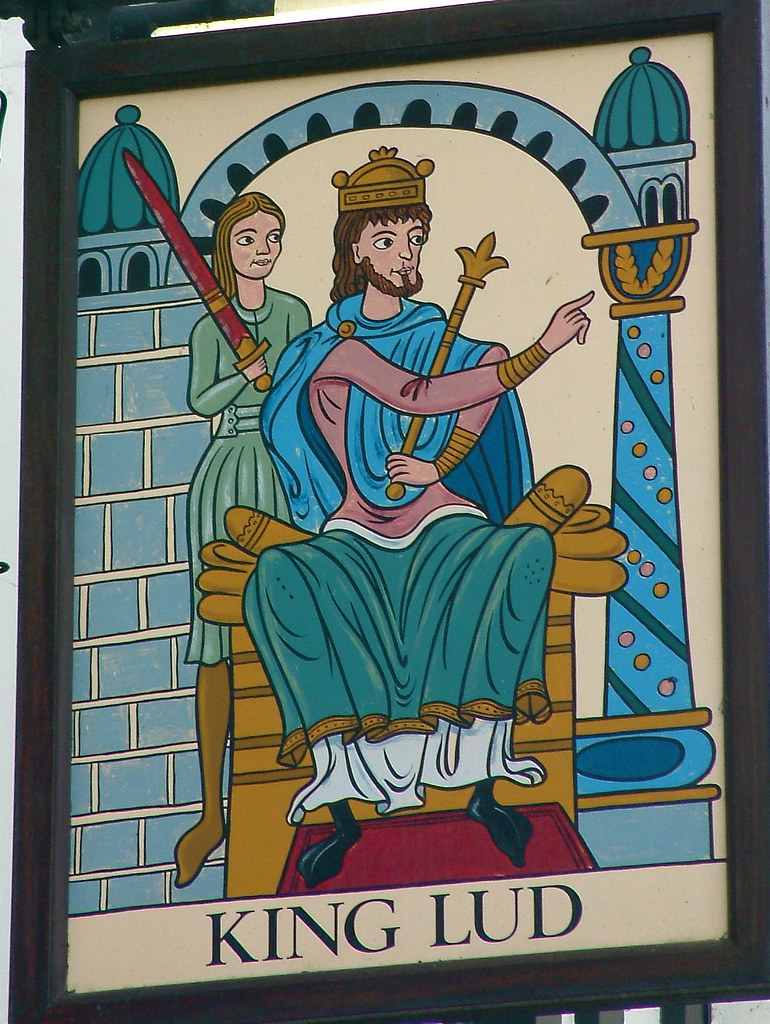
By far the oldest explanation on record is that of the twelfth century Welsh scholar and historian Geoffrey of Monmouth. In his History of the Kings of Britain (c.1135), Monmouth claimed that London was founded by and named in honour of a pre-Roman king of Britain named Lud, who built the city on the site of an even more ancient city called “New Troy” that had been founded by Brutus, grandson of Aeneas, in 1100BC. It’s a nice story alright. It’s just a shame it’s complete rubbish.


Geoffrey of Monmouth probably based his mythical tale of King Lud on that of a legendary figure from Welsh folklore called Lludd Llaw Eraint, or “Lud Silver-Hand”, who is said to have saved Wales from a plague of dragons and a magical giant who had the power to send people to sleep by playing music; to escape the giant’s soporific tunes, Lud dipped his head in a bucket of water. 

Oddly enough, it’s likely that none of that ever actually happened, which makes the idea that London is named after a dragon-slaying monarch with his head in a bucket somewhat implausible. Oh, and linguistically it’s highly unlikely that a word like Lud would morph into something like “Lond”. But still—dragons and giants. That’s probably all the proof you need there.


...and over there is the bucket I put my head in.

As unlikely as Geoffrey of Monmouth’s theory might be, he nevertheless might’ve been onto something by suggesting that London was named after or in honour of someone—but precisely who that “someone” was is another question.

For a while, one popular theory was that London was founded by or named in honour of someone called Londino or Londinos, a hypothetical name supposed to derive from an old Celtic word meaning “wild” or “fierce”. But there’s no historical precedent for that name whatsoever, and (without getting into too much detail) phonologists tend to agree that a Celtic word beginning lond– would give you a modern English word pronounced something like “loaned”, not like the “lund” of London. So despite being more than century old, this theory is now widely discredited. 

Alternatively it might not be the Lond– part of London that’s taken from someone’s name, but rather the –don. It’s been suggested that London might once have been called Lunadin, Luandan or Lan Dain, an ancient name meaning something like “moon temple of the goddess Diana”. Sir Christopher Wren certainly believed that he had unearthed a Roman temple dedicated to Diana when he rebuilt St Paul’s Cathedral, but again the linguistic and historical evidence just isn’t there to back this theory up.


So if it’s not an honorific name, how about a geographical one? 

Another theory is that London was originally llyn din, or llyn dain, both Welsh-inspired names literally meaning “lake-fort” or “pool of the river” respectively (the “lake” and “pool” in question possibly being the widening, deepening part of the river Thames)They’re both plausible theories, but linguistically a word like llyn would be expected to produce a modern name like Lindon-with-an-I, not London-with-an-O. 

And London has almost always been London-with-an-O: the earliest records we have of it are all from ancient Roman Latin documents and inscriptions that refer to it as Londinium or Londinion. The people of London themselves were the Londiniensi—a word taken from a stone tablet dating from around AD 150 that was unearthed at an archaeological dig in Southwark in 2002, and which provides us with the earliest known evidence of the name “London” that we have. And for the Romans to have spelled their “London” with an O (or a U, as they sometimes did) casts doubt on those Welsh-origin theories. 

Instead, we might have to look even further back in time.


Bring on the wall!

In 1998, Professor Richard Coates—then President of the English Place-Name Society—put forward perhaps the most convincing argument for the origin of the word London yet: Plowonida. If you think Plowonida sounds more like something you’d use to treat athlete’s foot rather than the origin of one of the most famous cities in the world, you’ve got a point. But the reason this looks so unfamiliar—and so unlike the modern name “London”—is because we’re dealing with impossibly old pre-Celtic language.

In Coates’ theory, Plowonida would have started life as a hydronym (a river name) referring to the part of the Thames on which London was founded. It combines (brace yourselves, we’re going even further back in time here) two Proto-Indo-European word roots meaning “to flow”, plew– and nejd–, whose descendants are found in river names all across Europe. In combination, it’s theorized that these two elements might have referred to the first noticeably deep, fast-flowing part of the Thames, where it was impossible to ford or cross on horseback.

Knowing what we know about pre-Celtic language, calling the river itself Plowonida would have given the town or village that stood on the banks of the river the name Plowonidonjon, which over centuries of simplification and alteration would have become a Celtic name along the lines of Lūndonjon, then the Latin name Londinium, and ultimately the modern English name “London”If Coates’ theory is correct, that would mean the name “London” could be interpreted as something like “the town at the unfordable part of the river”—which is a considerably better theory that “the town of the king who put his head in a bucket”.


27 April 2016

10 Figures of Speech

Rhetorical terms and words for different figures of speech crop up every now and then on the HaggardHawks Twitter feed, and are without exception brilliant, brilliant words:


But with our YouTube channel now in full swing—incredibly, this is already video number 16!—we thought it might be good to dedicate an entire episode to bringing together a choice set of ten:


Many of the words language experts use to describe tropes like these—including all those included in the video—are based on Greek word roots, which are often brought together in quite inventive and memorable ways. Take one of those from the video, antanaclasis: it refers to a word being used with two different meanings, like “I can’t wait to wait tables all day” (which no one in the service industry has ever said) or “I can’t wait to bar him from the bar” (which absolutely everyone in the service industry has said). Because of this repetitious, back-and-forth arrangement, the word antanaclasis derives from the Greek word for a reflection.

Likewise another term from the video, chiasmus, takes its name from the X-shaped Greek letter chi because it refers to the criss-crossed arrangement of repeated words found in “ask not what your country can do for you, ask what you can do for your country”. 

And elsewhere in the rhetorician’s dictionary we find words like zeugma, which refers to the use of a single word in two different contexts in the same sentence, like “I will take my camera and some photographs”. It derives from the Greek word for an ox’s yoke, in the sense of one word “yoking” its two meanings together in one sentence. A prodiorthosis is a warning that you’re about to deliver bad news, and essentially means “a pre-apology”. Hendiadys is the emphatic use of two separate words rather than a single word and a qualifying adjective or adverb—like “the rain and the weather spoiled our holiday” rather than “the rainy weather”—and as such literally means “one through two”. And prosopopoeia is a form of personification in which an inanimate object is portrayed as talking:


Brilliantly, it literally means “making a face”.


23 April 2016

10 Words Shakespeare Used That No One Can Work Out


In honour of the #Shakespeare400 anniversary on 23 April 2016, this week’s HaggardHawks YouTube video is looking at a part of Shakespeare’s writing that isn’t dealt with all too often.

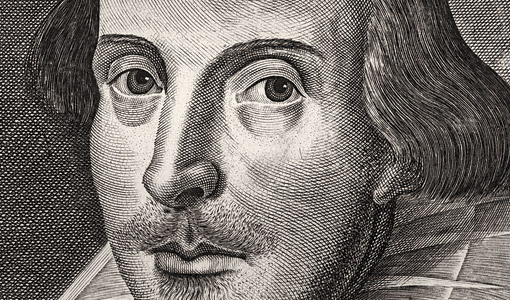
Everybody knows Shakespeare invented a considerable number of the 31,534 words he used in his work—as many as 1 in every 20, if some statistics are to be believed—and alongside those, he transformed many pre-existing words into different parts of speech, a process known as anthimeria. So if you’ve ever grazed, squabbled with, elbowed, caked or ghosted someone, then you’ve got Shakespeare to thank for it: none of those had been used as verbs before he got hold of them...

All this linguistic playfulness, however (coupled with the obvious fact that his writing is four centuries old) can make Shakespeare’s work tough to navigate these days, and a little patience and background knowledge is often are needed to unlock some of his toughest lines. But even the best Shakespeare scholars have to admit that—well,  sometimes we just don’t know what the hell he’s talking about.

Armgaunt. Eftest. Pajock. In his buttons. The list of words and phrases that crop up in Shakespeare’s work that no one can quite decipher runs on and on. But just because we don’t know for sure what he meant doesn’t mean that we can’t have an educated guess. And it’s that that we’re looking at in this week’s video…


14 April 2016

10 Words From Johnson’s Dictionary


The great Samuel Johnson’s Dictionary of the English Language was first published 261 years ago today, on 15 April 1755. Its two volumes defined a total of 42,773 words, illustrated by 114,000 literary quotations (the majority from Shakespeare), and unlike dictionaries today, it was infused throughout with Johnson’s own personality and humour. 

Words that he personally disliked or thought unimportant were omitted (so out went recent French loanwords like champagne and bourgeois), as was the letter X, which he bluntly explained in a note on page 2,308 “begins no word in the English language.” The definitions too were full of Johnson’s wit and wisdom:


And who, of course, could forget this:


Or, indeed, this:


Johnson was paid the princely sum of 1,500 guineas (equivalent to more than £200,000 today) to compile the work, which he did so single-handedly over nine years, with assistants only ever brought in to reproduce pages and copy out quotations. It was, frankly, a monumental achievement and remained the standard English dictionary for the next 150 years.

So in honour of the anniversary of Johnson’s wonderful contribution to our language, this week on the HH YouTube channel we’ve picked 10 long-forgotten words from his dictionary that deserve to be revived:


As explained in the video, that doesn’t mean that Johnson is personally responsible for coining these words (although it’s thought that a number of his entries were his own invention), nor that his dictionary provides us with their earliest written record. Instead, these are just words that were included in his Dictionary but which have long since disappeared from the language—and more than deserve to be recovered.


17 March 2016

I, Part II

Last year on the HaggardHawks blog, we looked at why the lower-case letter i—and its alphabetical cousin j, for that matter—has a dot above it. Turns out it had something to do with stopping intelligent people being mistaken for their knees. But this week in our noticeably infrequent series of Questions About The Language You Never Even Thought About, we’re posing another I-related conundrum: why do we capitalize the pronoun I?

After all, none of the other English pronouns—including all the other first person pronouns, like me, mine, my and myself—is capitalized, unless you happen to be God or He Who Should Not Be Named. Nor was I’s ancestor, the Old English word ic, written with an uppercase letter. And the translated equivalent of I in most other languages is usually left in lowercase, like the French je, Spanish yo, Italian io, and German ich.


Speaking of German, it of course capitalizes all of its nouns, like Mann and Frau, Apfel and Orange, Kapitalbuchstaben and Kleinbuchstaben. That’s something that English reserves only for its proper nouns (John Smith, Australia, the Cabinet, Sister Act), unless you happen to have some kind of point-making rhetorical effect in mind, as in “He doesn’t just think he’s the bee’s knees, he thinks he’s The Bee’s Knees”.

German does however capitalize the formal form of its second person pronoun, Sie, “you”, along with all its derivate case forms like Ihr, “your”. That’s part of a linguistic phenomenon known as the T-V Distinction, which has nothing to do with how much better than terrestrial television Netflix is, but rather the way in which some languages like to show polite respect by altering the pronouns used to refer to people you don’t know very well or hold in high regard. It’s the same reason why French speakers will politely ask you to respondez s’il vous plaît, unless they know you particularly well (in which case résponds s’il te plaît will do just fine). Same goes for voulez-vous coucher avec moi, çe soir, but you really shouldn’t be saying that to someone you don’t hold in high regard.


So is this what’s happening in English? Do we think so highly of ourselves that we’ve grown accustomed to capitalizing our first person pronoun? Some etymologists have suggested so, and have even theorized that there’s a latently egocentric, psychological reason behind uppercase I. But if that’s the case, why hasn’t that filtered down to the likes of me and myself, or we and ourselves? And why is it only English speakers who are self-centred enough to capitalize ourselves while other languages are not? Don’t answer that.

So perhaps there’s something more pragmatic going on. An alternative theory claims that because the pronoun I occurs so frequently in sentence-first position, it’s only natural that it would eventually become capitalized. It’s a plausible idea, but does I really occur enough times in sentence-initial position to permanently alter its form in every other context? And again, why hasn’t the same thing happened to all the other pronouns?

Instead the most likely explanation of how we ended up with capital I is a surprisingly practical one, instigated by the fact that around the time capital-I first began to appear in English texts—in the Middle English period, roughly 700-800 years ago, so Chaucer’s Canterbury Tales provides much of its early evidence—there was a phonological change also taking place.

At that time, many dialects of English were busy reducing the Old English word for Iic or ich, which was pronounced a bit like “itch” but without the T—to a single “i” sound, making the Cs and Hs normally used to spell it no longer necessary. In written English, however, a single lowercase letter i can look a little lost on its own, and in a densely handwritten document it’s easy to imagine just how easily a solitary pint-sized stroke, even with or without its dot, might be misread, overlooked, or even dismissed as a smudge or dash.

As a result, early Middle English scribes began making their single letter Is a little bigger, so that they could stand a little prouder and little more robust on the line of text. And over time, that became the standard and gave us the pronoun capital I. And that’s The Truth—or at least, the Best Theory We Have.