_
Showing posts with label French history. Show all posts

8 September 2016

10 First Names Used As Words | 500 Words Ep. 35


You may remember this fact from the HH Twitter feed a while back:
...which led to a bit more explanation here on the blog: the name Rebecca was used (in allusion to a story from the Old Testament) for a series of toll gate protests in Wales in the mid nineteenth century. And it’s that story again that kickstarts this week’s YouTube video, which looks at the origins and meanings behind 10 first names that can be used as words in their own right.


One name that didn’t make the final cut here, however, is John.

John has a number of different uses in English, ranging from a toilet to a signature, a cuckolded husband to an unidentified corpse, and from a policeman to a priest, to the client of a prostitute. Blimey, definitions don’t get much more varied than those. 

In the majority of these cases, it’s the sheer commonality (and, therefore, the familiarity or anonymity) of the name John that is the root of the meaning: John was the most popular male first name in American every year since records began in the nineteenth century through to 1924 (and it remained in the top 10 until 1987), while in the UK 5.8 million men have been named John since 1530, and either it or William held the top spot among British men from the mid-1500s right through to the mid-1900s.

The use of john as another name for a person’s signature, however, owes its origin to John Hancock, the Governor of Massachusetts whose sign-manual gloriously outdoes everybody else’s on the Declaration of Independence (and which you can see—or rather, fail to miss—at the top of this page).

As another name for a toilet, meanwhile, john is probably an alteration of jakes or Jacques, a French borrowing that has been used as a euphemism for the smallest room in the house since the fifteenth century at least. And as another name for a detective, john has its roots in the French word for a policeman, gendarme.

The term gendarme (which itself began life as gens d’armes, or “men of arms”) was originally the name of a mounted soldier or infantryman, and it was in this sense that the word was first borrowed into English in the sixteenth century. It wasn’t until the first formal police forces began to be organized in the 1800s that the word gained its modern sense in its native French—and, for that matter, in English, where it quickly morphed into the humorous form johndarm in early Victorian slang:
“John Darm! Who’s he?” “What, don’t you know?! In Paris he is all the go; Like money here,—he’s every thing; A demigod—at least a king! You cannot fight, you cannot drink, Nor have a spree, nor hardly think, For fear you should create a charm, To conjure up the fiend John Darm! 
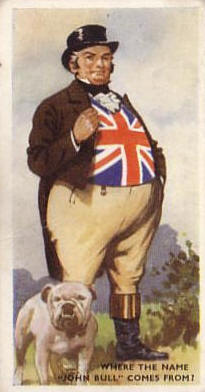
That’s an extract from John Darm, a song first published in 1823 and written by a nineteenth century “writer of verse” named John Ogden, recounting a trip taken by John Bull (the kedge-bellied personification of England and the English) to France. Once there, Bull attends a theatre, gets into a fight with a number of audience members, is arrested by “John Darm”, and thrown into prison. 

The trip ends with the two on better terms, however, with John Bull concluding:

Says I, “To-morrow home I go;
One Frenchman I’d not leave my foe;
John Bull, believe me, meant no harm—
Let’s part in peace—farewell John Darm!”

Ogden’s song (which was apparently a follow up to an earlier comic poem, Mounseer Nongtongpaw, once falsely attributed to Frankenstein author Mary Shelley) provides us with the earliest record of the name john as a nickname for a policeman that we know about. And although the word’s French origins and its connection to the gendarmerie has long since vanished into the haze of language history, the word itself has remained in use to this day.

24 July 2015

Admiral

Last week HaggardHawks tweeted this screenshot, taken from a brilliantly-titled dictionary of Slang and Its Analogues Past and Present, published in 1890:
  

And, well, it probably all needs a bit more explaining.


Admiral is one of those deceptively straightforward words behind which lies the kind of history that keeps etymologists awake at night. They should really cut down on the caffeine after 5pm. It’s all a bit of a bewildering hodgepodge—the OED’s etymology alone comprises a 1300-word essay—but the basic theory is that, at its root, admiral derives from the old Arabic title amir, as in emir and emirates. This ancient title was then borrowed into and reshaped by the vocabularies of various Mediterranean countries and cultures around 1000 years ago, and via the all-conquering Normans eventually began to appear in English texts in the early thirteenth century.

Initially, admiral was used as a fairly general title for a ruler, a leader, or a military commander; things get confusing when we try to find out how it came to be used exclusively of a naval leader.

The first person we know to have held a naval title along the lines of admiral was the not-all-that-impressive-sounding George of Antioch in the early 1100s. George, who had already worked in several similar naval positions in Arabic-speaking North Africa, was put in charge of the fleet of the even-less-impressive-sounding Roger II, a twelfth-century King of Sicily, who gave him the Latin title ammiratus ammiratorum

It’s around this time that (etymologically, at least) things become a little hazy: it could be that George’s title ammiratus is a Mediaeval Latin spin on the Arabic title amir, which George would certainly have known of having served in North Africa. Alternatively, it could be a purely Latin title, with no connection to Arabic at all—on its own, ammiratus ammiratorum literally means “the most admired of the admired”.

Wherever the word’s ancient history might lead us from there, however, the fact is that by the time of George’s appointment Sicily too had been conquered by the Norman French—and it was the Normans who were responsible for transplanting the title from the sunny southern Mediterranean to the rainy European northwest. 

So. If that’s the story of admiral, what about the admiral of the narrow seas?

Well, in eighteenth century slang—long after admiral had established itself as a naval title in England—a curious trend emerged for applying fictitious “titles” to various people and characters. So a Captain Queernabs was “a shabby, ill-dressed fellow”, and a Captain Cork was a man who was “slow in passing the bottle”. A boatswain-captain was the naval equivalent of a swot: an overly competent seaman who never seemed to put a foot wrong. An admiral of the red was a wine-drinker. An admiral of the white was a coward. An admiral of the blue was a drunkard, or a publican (who would typically wear a blue tabard). An admiral of the red, white and blue was a ludicrously or ostentatiously dressed person. And an admiral of the narrow seas was the queasy, mulvathered seafarer mentioned above.

A vice admiral of the narrow seas, meanwhile, was an even worse drinking companion:


6 June 2015

D-Day

Today marks the seventy-first anniversary of the Normandy Landings—perhaps better known as D-Day. Etymologically, there’s a longstanding myth that the D of D-Day stands for something along the lines of “disembarkation”, “decision”, or “deployment”, or even “Deutschland” or “Doomsday”, but in fact:
So if the D doesn’t standing for anything, why is it there at all?

The fact is that while military operations are being planned, it’s not always clear from the outset when they’ll actually take place. As a result, their future start date—whenever that may be—is simply referred to as “D-Day”, and this title acts as a placeholder until a specific date can be finalized. (Shameless plug: there’s more on this in the new book.) 

If anything, the D of D-Day could be said to derive from the word ‘day’ (indeed the French equivalent is J-Jour, and the exact time an operation takes place is known as H-Hour) but it certainly can’t be said to stand for it.

Not only that, but the term D-Day is also a lot older than most people think. The earliest record we have of its use dates not from the Second World War, but from the First, and an American military order sent out on 7 September 1918:
The First Army will attack at H-Hour on D-Day with the object of forcing the evacuation of St. Mihiel salient.
Saint-Mihiel is a small town in the Meuse department of north-eastern France, that for three days in September 1918 was the site of one of the most important United States military operations of the entire First World War. Under the command of US Army General John Pershing, an enormous body of American Expeditionary troops—including thousands from the newly-formed United States Army Air Service, now the US Air Force—secured a decisive Allied victory over an ill-prepared and chaotic German contingent.

The Battle of Saint-Mihiel lasted from 12-15 September, during which more than half a million US soldiers, alongside 110,000 French troops, fought to secure the strategically significant Saint-Mihiel “salient”—a technical term for a narrow, isolated strip of land projecting from one region into another—in the hope of eventually recapturing the larger French city of Metz. As it happens, the attack on Metz was never realized, and as the German forces continued to crumble the War came to an end just weeks later, on 11 November 1918.

The term D-Day continued to be used intermittently throughout the 1920s and 30s, until it became all but permanently attached to “Operation Neptune”—the military codename of the decisive Normandy Landings—on 6 June 1944. 


10 April 2015

Vespasienne

We tweeted about toilets a lot today. Purely by coincidence, of course. But you know how it is—once you’ve done one, it’s hard not to do another. Though one of the things we’ve tweeted probably needs a little bit more explaining:
Urine tax. It’s all a bit too bizarre to leave open ended like that.

So, first things first: Titus Flavius Vespasian became Roman Emperor in AD69 after a brief period of turbulence—known as The Year of the Four Emperors—that was sparked by the Emperor Nero’s suicide the previous summer. Unfortunately, Nero’s successor, Galba, was assassinated after just seven months on the throne. (There we go talking about toilets again.) Then Galba’s successor, Otho, committed suicide after just ninety days in power, and in turn his successor, Vitellius, was overthrown and executed just eight months after that. Happily, Vespasian’s rule restored some much-needed stability to the Empire after a year of unrest, and he remained in power for the next decade—until he died trying to stand up during a fatal bout of diarrhoea in AD79. But we digress. That’s more than enough potty talk for now.

One of the high points of Vespasian’s rule was the construction of The Colosseum, which he commissioned in AD70, and which was completed one year after his death by his son and successor, Titus. One of the low points of his rule, however, was his introduction of the vectigal urinae, or “urine tax”. And we thought paying 30p to use the toilets at King’s Cross Station was bad. 

In Vespasian’s defence, the urine tax was actually the brainchild of Nero, who first introduced it sometime around AD60. But long after it had been repealed, it was Vespasian’s decision to reintroduce it. So why was he so keen to tax pee?

Well, chemically speaking, because the urea it contains can be used to produce ammonia, urine is actually quite a useful commodity—and the Romans knew it. They used urine to bleach fabric (including their gleaming white togas), to soak animal hides (making it easier to remove the hairs before tanning), and they even mixed it with powdered pumice to make toothpaste to whiten their teeth. 

So with all this potentially lucrative activity going on unchecked, Vespasian sought to levy his vectigal urinae onto anyone whose business involved collecting urine from the sewers and communal cesspools dotted around Rome—not exactly the most pleasant of job descriptions, but the fact that it was even worth taxing in the first place shows just how profitable a living it could be.


Roman togas: didn’t smell as clean as they looked

If you’re still a bit put off by the prospect of siphoning off other people’s urine and boiling your clothes in it, don’t worry—you’re in good company. When Titus, Vespasian’s son, first heard about the urine tax he was so disgusted by it that he complained in person to his father. In response, Vespasian simply held a gold coin up in front of his face, and asked him if he was just as revolted by it. Confused, Titus answered “non olet”, or “it does not smell”, to which Vespasian knowingly replied, “and yet, it comes from urine!” Recorded by the Roman historian Suetonius, this particular anecdote gave rise to an old Latin saying, pecunia non olet—or “cash doesn’t stink”—which is sometimes still used in English today to imply that money remains unaffected by how it’s earned.


But back to toilets—it was Vespasian’s advocacy of the urine tax that ultimately led to his name being attached to public toilets across the Roman Empire, and it’s through that that French public urinals eventually came to be known as vespasiennes

It gives a whole new meaning to the phrase “pay toilet”.


12 March 2015

Pedigree

Archery. Tapestry weaving. Playing the lute. Invading England. There were all kinds of things you could do to pass the time in medieval France. 

Another popular pastime was genealogy, the study of heritage and descent. Seemingly, the nobility of the day liked nothing more than drawing elaborate tree diagrams to boast both in print and in picture of their family’s proud French heritage.


Some of these diagrams comprised little more than lists of names connected by a series of hand-drawn strokes and lines. Others, like the one above, were more involved and more detailed. And some were even drawn as actual trees. But no matter how they were put together, there was something about the lines on these genealogical diagrams—long, flat and broad, with shorter vertical strokes linking one generation to the next—that reminded the writers and artists who produced them of birds’ feet. And, in particular, of cranes’ feet.

Today, in modern French, “crane’s feet” is pieds de grues. But back in the eleventh century, it would have been something more like pée de grue. And if that particular snippet of obscure medieval French sounds even slightly familiar, then it’s because pée de grue eventually morphed into our word pedigree—namely, the traceable ancestry or descent of something.