_
Showing posts with label crime. Show all posts

31 July 2015

Rebecca

Yesterday, HaggardHawks tweeted this fairly peculiar definition: 
In fact, Rebecca is just one of a handful of first names that you can use as a word in its own right. A George, for instance, is a loaf of brown bread. Abigail is an old nickname for a lady’s maid. A Robert is a restaurant waiter (inspired by a series of cartoons from the late 1800s). Peter can be used as a verb to mean “to blow open a safe” (because St Peter held the keys to Heaven). And as for John—well, he can be a nickname for anything from your signature (thanks to John Q Hancock) to the client of a prostitute.

But what’s the story behind Rebecca? Well, if you know your British history—and a hat-tip to @Evansianl, who got it spot on—you’re probably way ahead of us:


The Rebecca Riots were a series of disturbances in the early 1840s prompted by the increasing exploitation and worsening prospects of the local farming communities in Wales. In the years leading up to the riots, farmers had had to contend with several seasons of bad weather and failed crops, poor financial returns on their produce, increased rents from landowners, and the on-going enclosure of common land. On top of that, farmers (who were already paying 10% of their profits to the local church) were then faced with the newly-amended Poor Law Act of 1834, which increased taxes and began channelling more and more public money into the controversial workhouse system

Enough was understandably enough. And in southern Wales, local farmers began taking their frustration out on what they saw as the embodiment of all their woes: the local tollgates.

“Down with this sort of thing.”

By the early nineteenth century, there were already 30,000 miles of toll roads and 8,000 toll gates in Britain, each of which was overseen by a local body of landowners and businessmen called a turnpike trust. On paper, the idea was simple enough—the money the toll roads raised would go towards the upkeep and repair of the roads themselves. But in practice, it often proved hopelessly flawed. 


The turnpike trusts were left largely to their own devices; they could charge however much they wanted, and could introduce however many tollgates on their land as they wished. Before long, many were taking full advantage of the loopholes in the system: by the 1830s, Carmarthen in south Wales was completely encircled by tollgates, leaving no free route into or out of the town. The gates, it seemed, had to go.

On 13 May 1839, an angry crowd rallied together and destroyed the tollgate in the tiny hamlet of Efailwen, 20 miles west of Carmarthan. This initial protest quickly sparked others, and soon tollgates all across south Wales were being attacked and destroyed by groups of locals fed up with the extortionate prices they were being forced to pay. The protests rumbled on for several months, reaching a peak in 1842 when a combination of an unexpectedly successful harvest and a cut in the taxes imposed on imported meat led to the prices of corn and cattle collapsing.

Within a year, however, it was all over. As the protests had grown ever more violent (a young woman working at a tollgate in Hendy, near Llanelli, was shot and killed in 1843), a diplomatic solution was quickly sought, and the Turnpikes Act of 1844 slashed the toll rates, and amalgamated all the turnpike trusts into one regulated body.

That’s all well and good, of course, but one question remains: why “Rebecca”?

Well, to answer that we need to turn to the Bible. Rebecca was the name of Isaac’s wife, and in the Book of Genesis we’re told that before leaving her family home to go and marry him, Rebecca’s mother gave her a blessing:
And they blessed Rebekah, and said unto her, Thou art our sister, be thou the mother of thousands of millions, and let thy seed possess the gate of those which hate them. 
Clearly, it was the words “let thy seed possess the gate of those which hate them” that gave the Rebecca Riots their name—and inspired the protesters in more ways than one: if you noticed that some of the befrocked protestors shown in the picture above looked, well, less than ladylike, that’s because they quite literally are.
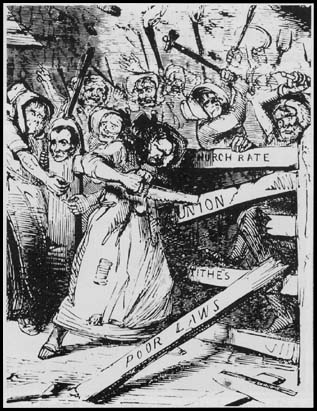
As the protests picked up pace across south Wales, any gate-destroying farmers not wanting to be identified began disguising themselves in women’s clothing. These “Rebeccas” soon became the figureheads of the “Rebecca Riots”, with the leader of each protest even taking on the role of “Rebecca” in a bizarre role play before each gate was destroyed.

As strange as all that might sound, it’s worth bearing in mind that the Rebecca Riots grew out of genuine hardship and sense of frustration, and led to a change in the law that, although not perfect, nevertheless improved conditions for hundreds of the poorest people involved. Today, they are quite rightly seen as one of the most important movements in British social history.


15 July 2015

Hooligan

Last week, we tweeted this:
It’s a great word, and given its meaning it seems plausible that it should have a much more familiar etymological cousin:
A nice idea—but unfortunately the two are unrelated. Hoolybuss is an old Cornish word, dating back to the eighteenth century at least, while the first hooligans didn’t emerge until the late 1890s, more than 250 miles away in Victorian London.

Like a lot of dialect words, a lack of early written evidence of hoolybuss makes it hard to pin down its exact etymology, but a reasonable guess would be that the hool– is probably a local pronunciation of hurl. This would make hoolybuss a distant cousin of hurly-burly, perhaps alongside other hool– words like hooloch (an old Scots word for a rockfall) and hooley (an old Irish-English word for a boisterous party). As for the –buss, that might come from bussa, another old Cornish word for an “empty-brained person”, but with so little evidence to go on, it really is difficult to say anything with any certainty.

So what about hooligan? Well, the OED’s earliest record of a hooligan comes from an 1898 article in The London Daily News, which condemned “the Hooligan gangs” now being “bred in these vile, miasmic byways”. By crikey, those Victorians really knew how to string a sentence together. 

As, apparently, originally the name of a gang, some etymologists have suggested that hooligan might derive from the surname of some notorious crook or dimber-damber, in which case it could be a slang corruption of “Houlihan”, or even the phrase “Hooley’s Gang”. It’s a neat theory, and certainly a plausible one—but as always with this kind of thing, there’s more to this story than meets the eye. For example, take a look at this:


That’s the front cover of an edition of a Victorian humour magazine called Nuggets, dating back to 1897. It depicts some of the magazine’s most popular recurring characters, namely a wacky family of Irish country-bumpkins called “The Hooligans”. In this edition, the Hooligans have cobbled together their own makeshift caravan (towed by their pet goat, of course) in which they intend to “travel ’round the country with ease and elegance”. Other editions saw them celebrating Queen Victoria’s diamond jubilee with their own ramshackle royal procession, and trying, albeit unsuccessfully, to join the Klondike gold rush. It’s all very heavily stereotyped stuff (and would undoubtedly fall foul of the censors today) but the Victorians loved it.

They also, however, loved this:


That’s a selection of theatrical reviews—taken from an 1892 edition of The Eraan old stage newspaper—for a show at the Theatre Royal in Hull, performed by a pair of Irish comedians called Jim O’Connor and Charles Brady. The duo’s act, as a number of the reviews mention, included a hugely popular musical number about a rowdy Irish family called The Hooligans:

Oh, The Hooligans!
Always on the riot, 
Cannot keep them quiet,
Oh, The Hooligans!
They are the boys
To make a noise
In our back yard!

O’Connor and Brady’s show transferred to the Elephant and Castle Theatre in central London shortly afterward, and soon proved just as big successful there as it had been elsewhere. Their Hooligans song likewise proved a roaring success in London’s music halls—speaking of which:


Stepping even further back in time, that’s the lyric sheet to an old comic broadside called Miss Hooligan’s Christmas Cake, thought to have been published in Scotland sometime around 1880. The song recounts the fictional story of a bungling Irish cook who bakes a gigantic Christmas cake that makes everyone ill:

There was plums and prunes and cherries,
And citron and raisins and cinnamon too,
There was nutmeg, cloves and berries,
And the crust it was nailed on with glue.
There was carraway seeds in abundance,
Sure ’twould build up a fine stomachache,
’Twould kill a man twice, after eating a slice,
Of Miss Hooligan’s Christmas cake.

Again, it’s all very unfairly stereotyped, but nevertheless Miss Hooligan’s nonsense musical tale proved hugely popular at the time. As did, finally, this:


That’s the opening scene of a theatrical farce called More Blunders Than One, or The Irish Valet, written way back in 1824 by the dramatist (and former manager of London’s Adelphi Theatre) Thomas G Rodwell. And one of the characters in the play, as this extract shows, was a “Mr Larry Hoolagan”. 


So. Theatrical farces. Irish comedians. Victorian cartoons. Toxic cake. Where does all this leave us?

Well, both the play and the Scottish broadside seem to prove that hooligan is indeed derived from an Irish surname—presumably, as the OED rightly suggests, “Houlihan”. It in turn derives from the old Irish Gaelic surname O’hUallachain, the –ch– of which, in its original Irish, would have been pronounced like a softer version of the ch in Bach or loch (voiceless velar fricative, if you want to get technical)

That ch sound isn’t normally used in English, so it’s not too much of a leap to presume that it could morph into an easier g sound among British English speakers, which explains the early uses and spellings of the name Hooligan in both the farce and the broadside. But they have nothing to do with riotous criminal behaviour—so for that, we need to head back to the early 1890s. 


Jim O’Connor and Charles Brady apparently chose the same surname, Hooligan, for the riotous characters in their 1892 song. And when their show transferred to London the following year, its enormous success—and the success of the music hall number it incorporated—seems to have led to a whole new word for rioting, boisterous troublemakers being adopted into the street slang of the capital. 


Soon, members of London’s criminal gangs were proudly referring to themselves as Hooligans, and when they began to fall foul of the law, the name was quickly picked up and popularized by the press: an early account of a “Hooligan boy” being arrested in 1894 has since been discovered, predating the OED’s earliest evidence by four years, and aligning the word more closely with O’Connor and Brady’s arrival in London the previous year. 


So is that the end of the story? Predictably, no. Despite all this early evidence, many etymologists still adhere to the idea that hooligan derives from the name of some notorious Victorian criminal or underworld figure, with some theories even name-checking a legendary “Patrick Hooligan”, or the disgraced politician and financier ET Hooley. Just as with hoolybuss then, it seems that until more conclusive evidence comes to light, this is yet another etymological mystery that refuses to be solved.