_
Showing posts with label Spanish. Show all posts

11 August 2016

10 Words Borrowed From Other Languages - 500 Words Ep. 31


A long, long time ago over on HaggardHawks, this little fact popped up:


In retrospect, that’s a little disingenuous (not least because linguists can’t really decide what actually constitutes a word), but regardless of the parameters involved, studies of etymology tend to agree that anywhere from one-quarter to one-third of the English language has been borrowed directly into English from French.

Elsewhere in the dictionary, things get increasingly far-flung: besides the likes of German, Spanish and Italian, English has adopted words from practically every major European language, including Norwegian (slalom), Finnish (sauna), and Czech (robot), as well as a number of global big-hitters like Russian (vodka), Arabic (almanac), the Chinese (lychee) and Japanese (karate) languages, and Hindi (juggernaut), Bengali (jute), Urdu (cummerbund) and all the other languages of the Indian subcontinent.

And it’s borrowed words and the languages we have taken them from that are up for discussion in this week’s HH video:


We might owe the humble word tattoo to (SPOILER ALERT if you haven’t seen the video) one of the furthest of the far-flung languages of the south Pacific, but it is by no means alone. 

Other somewhat surprising languages to have provided words to English include Tamil, another Indian language and the official language of both Sri Lanka and Singapore, which is the origin of the likes of catamaran, cheroot and pariah. Javanese, the most widely spoken language in Indonesia, is the origin of batik and lahar, another name for a volcanic mudflow. 

The native Aboriginal languages of Australia have given us billabong, budgerigar and dingo. When you run amok, you’re using a Malay word (borrowed into English via Portuguese) meaning “attacking frenziedly”. The boondocks take their name from a Tagalog word meaning “remote place”. And over in the Caribbean, the Taíno language is responsible for a number of very familiar words adopted into English via Spanish Caribbean colonists, including tobacco, hurricane, potato, canoe and even Caribbean itself. But these words, and several others like them, are almost all that remains of the Taíno civilization.

An indigenous Arawak people, the Taíno were once the most numerous people in the entire Caribbean. As such were the first Native Americans that Christopher Columbus came into contact with when he arrived in the Americas in the late 1400s; Columbus’s misinterpretation of the Carib people’s word for themselves, Caniba (as well his misapprehension that they were anthropophagous) even gave us the word cannibalism.


But as more Europeans arrived in the Caribbean, the Taíno population collapsed as its people contracted diseases for which they had no natural immunity, most notably smallpox. Within three decades, their numbers had dwindled by as much as 90%; according to some accounts, by the mid 1500s there were fewer than 500 individual Taíno people alive in the world. 

Although the population understandably never recovered, pockets of Taíno people survive across North America today. But their culture and language suffered so terrifically in the aftermath of Columbus’s arrival that the handful of Taíno words to have survived in English offer an extraordinary and tantalizingly rare glimpse of a long-lost civilization... 


1 April 2016

Cacafuego


There’s really no nice way of putting this, but the fact is that poop crops up more often than it duly should on this blog. And thanks to a tweet from the HH feed the other day, we’re going back down that way again now:


There’s no denying that cacafuego is a brilliant (and unavoidably usefulword, but is it really genuine? Or, to put it another way:


Wow, imagine if that were true. A plot twist to put M Night Shyamalan to shame. But let’s not get bogged down in piss halfway through a blog about shit, so to speak.

No prizes for guessing that cacafuego was borrowed into English from Spanish, and combines the verb cacar (modern Spanish cagar, “to void excrement”) with fuego, “fire”. It first appeared in English as another word for a blustering braggart in the early 1600s, but we can be fairly sure that it was in use before then thanks to the somewhat unlikely-sounding involvement of Sir Francis Drake.


Sir Francis Drake: looking a little ruff
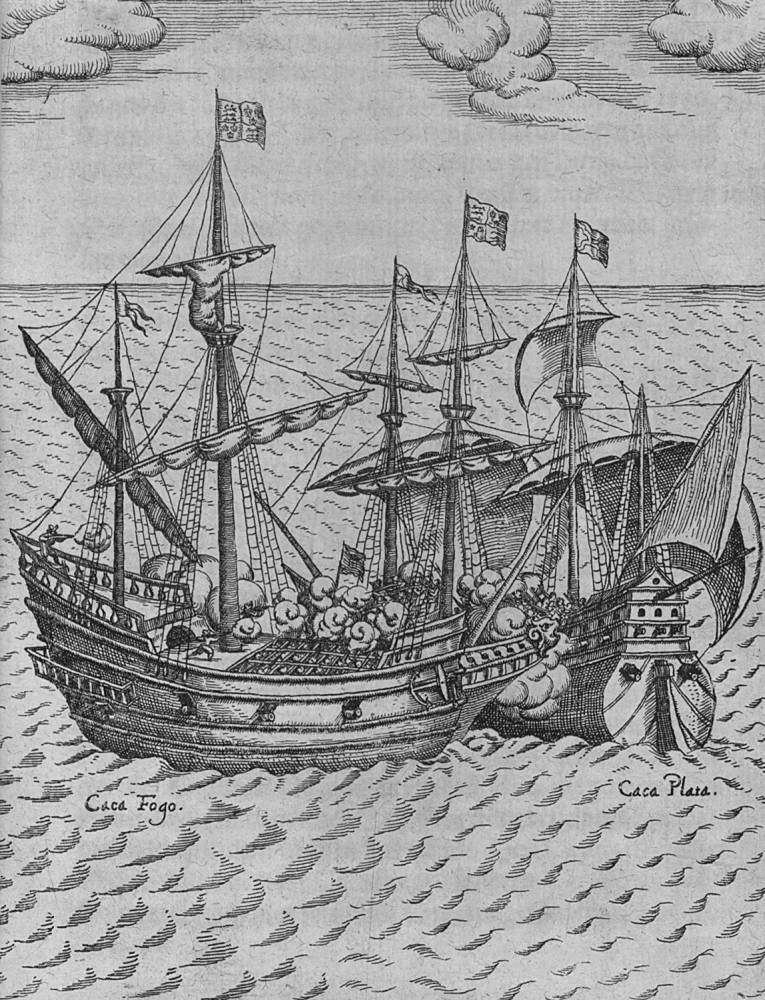
In 1578, part-way through his circumnavigation of the Earth, Drake rounded Cape Horn and entered the Pacific Ocean, hot on the heels of a 120-tonne Spanish galleon called the Nuestra Señora that he had heard was laden with a rich cargo of silver and jewels from the Spanish colonies. And he wanted it.

Sailing up the Pacific coast of South America, Drake’s Golden Hind caught up with the Nuestra Señora off the coast of Ecuador. Knowing that an attack made under the cover of darkness was his best bet, he slowed his progress by tying some of his ship’s store of wine to the stern and throwing it overboard, so that by the time the Hind reached the Nuestra Señora it was the middle of the night. The Spanish crew were taken by surprise, and after a brief skirmish they surrendered, allowing Drake and his men to take control of the ship.


Drake sailed both the Nuestra Señora and the Golden Hind back to the South American coast to unload her treasure. Knowing just how substantial a prize he had secured for England he treated the Spanish crew well, inviting the officers to join him for a grand banquet and giving every crewmember a parting gift and a letter of safe conduct, ensuring as safe a journey home to Europe as possible. Drake himself continued on his journey, and having completed his circumnavigation arrived back in Plymouth on 26 November 1580.

So where does all the flaming poop come into this? Well, Drake’s captured galleon might have been officially known as the Nuestra Señora de la Concepción, or “Our Lady of the Immaculate Conception”, but to her crew she was the Cacafuego, or “fire-shitter”. That might seem like an odd (and fairly uncomplimentary) nickname for—well, anything really, but just like the Spitfire centuries after her, it was probably intended to be a reference to her impressive weaponry and blazing cannon fire, or else to her speed through the water and her “fiery” temperament. 

And just as spitfire was once a nickname for an irascible, hot-tempered person, in the seventeenth century cacafuego became a byword for a blustering, swaggering braggart—a meaning perhaps influenced by the fact that, despite her impressive armoury, the Cacafuego had proved no match for Drake. 


11 August 2015

Toad-eater

A few days ago, HaggardHawks tweeted this:
And, well, it’s all just a little too bizarre to leave unexplained... 

There’s an old language myth that claims toad-eater comes from the Spanish mi todita (literally “my little everything”), which is itself a diminutive of toda, the Spanish word for “all”. Todita, so the story goes, was once a jocular title used by well-to-do Spaniards for their closest and most servile assistants or aides, who were only too ready to help their masters out in whatever way necessary, hence the definition above. 

It’s a neat theory—but unfortunately it’s completely untrue. In fact, the true history of the toad-eater is much more interesting, much more literal, and considerably more revolting, than all that.

According to the OED, the earliest record we have of a toad-eater comes from a seventeenth-century diarist named John Rous. Rous kept a diary from 1625-43, during which time he was the Anglican vicar of the village of Santon Downham in Suffolk, England. He recorded a predictably eclectic mix of events from both home and abroad, ranging from the coronation of Charles I in 1625 (described as “very joyous to the well-affected, but to the Papists not very welcome”) to reports of a rebellion in Portugal, Spanish ships returning from the West Indies being attacked by Dutch pirates, and, inevitably, growing unrest across England in the lead-up to what would eventually become the Civil War.

Alongside all the headlines, however, Rous’s diary contains several accounts of local goings-on in and around his own parish—including, in 1629, this account of a conversation with a shopkeeper in the nearby village of Laxfield:
I inquired of him if William Utting the toade-eater … did not once keepe [i.e. stay] at Laxfield; he tould me yes, and said he had seen him eate a toade, nay two.
Rous goes on to explain how “the toade-eater” apparently went about his business:
The man in whose house he kept went to him and … tould him that a friend of his would give a groate [4 pence] to see him eate a toade (thus was the way to see it): he accepted the offer, and went and fetche in, from under blocks, ij toads … He swallowed them downe, but presently he cast them up into his hands, and after some pawse, “Nay,” sayeth he, “I will not loose my groate.” So taking that which came up last (saith he), “thou wentst in first before and shalte doe againe.” When both then were downe, his stomach held them, and he had his groate.
Seemingly, Utting somehow managed to swallow two toads whole (after having already vomited them up once), and thereby won himself the princely some of one groat—or just under £2 (or just over $3) in 2015. But how do we get from this fairly disgusting story to the considerably less disgusting meaning in the tweet above?

Well, back in Rous’s day, toads were widely believed to be incredibly poisonous. Not only that, but their warty skin, their fondness of dark, dank places, and their ability to survive both on land and in water led to an association with black magic and witchcraft; even the Devil’s coat of arms is traditionally said to be decorated with “three unclean spirits like frogs”. To even touch a toad was, frankly, to dice with death—and so to be able to eat one was quite some feat.

Can’t you two get a room?

Rous’s toad-eater, and the many more like him who worked the country fairs and fêtes of Georgian England, knew precisely that. They also presumably knew that toads—or, by any rate, the two species of toad native to Great Britain—aren’t really as poisonous as most people believed: they can secrete a foul-tasting “milk” from glands on their skin when disturbed that contains an impressive battery of unpleasant chemicals, but unless you’re an overly-inquisitive dog or cat, or unless you fully digest the toad and its toxic skin (which toad-eaters seldom did, opting instead to either rely or sleight of hand, or else regurgitate them later), the chances are you’ll escape unharmed. 

Nevertheless, if these toad-eaters could convince people that they were somehow immune to the toad’s toxicity—or, better yet, that they had invented some kind of all-curing antidote or medical procedure—then they could not only put on an impressive show, but make an equally impressive profit.

Based on this presumption, by the late 1600s, quack physicians and itinerant charlatans all across England had begun working with toad-eaters to come up with a brand new sting: in front of an enthralled (and presumably somewhat nauseated) crowd, they would have their assistant eat, or pretend to eat, a live toad, just as William Utting had. Although unharmed, the assistant would then promptly collapse to the floor in feigned agony, whereupon the quack could either make a great show of his miraculous healing powers, or else administer some kind of homemade concoction to his assistant, who would consequently stage an immediate and impressive recovery—leaving his quack associate to sell vials of their bogus cure-all to the assembled crowd.

The original seventeenth century “toad-eater”, ultimately, was nothing more than a con artist’s assistant, and it’s from there that the sense of “someone who corroborates a lie” came about. Over time, however, toad-eater came to be used more loosely for any assistant or subordinate, and in particular one who acts obsequiously or servilely and is only too happy to perform any duty required of him—no matter how unpleasant it might be.