_
Showing posts with label Sun. Show all posts

15 April 2016

Lazy Lawrence


A long-forgotten (but no less useful) expression popped up on the HaggardHawks Twitter feed the other day:


And this isn’t the only proverbially lazy Lawrence to find his way into the dictionary. Long before lazy people had “Lawrence on their backs” there was an earlier expressionLawrence bids wages, that the OED explains was used to imply that “the attractions of idleness are tempting”—or, in other words, doing nothing looks like a lot of fun. Even Lazy Lawrence itself has been used as a nickname for an idling lazybones for centuries, as well as being the name of a mischievous fairy or sprite supposed to induce lethargy or idleness.

So apologies to anyone named Lawrence, but you’re immortalized in the language as a metaphor for laziness. Still, it’s better than being known for a one-year prison sentence or destroying gates, I suppose. But why Lawrence? And why laziness?

Well, one theory is that the connection is purely coincidence, and that Lawrence just has a nice alliterative ring to it—so this could just as easily be “Lazy Linda”, or “Leon bids wages”, or “to have Loretta Lynn on your back”. It’s certainly plausible (well, apart from the Loretta Lynn bit) but needless to say there are a couple of more imaginative explanations on offer. And one of them even involves a barbecued saint, what more could you want?

One theory is that phrases like these refer to St Lawrence’s Day, 10 August. That date puts it bang in the middle of the “dog days” at the height of the summer, when you can expect to endure the hottest, sultriest, most stifling weather of the year—the kind of weather that makes you want to lounge around and do nothing except lounging around doing nothing. The dog days are traditionally said to last anywhere from mid July to early September, and take their name from the tradition—probably started in Ancient Greece, if not Ancient Egypt—that the appearance during the summer months of Sirius, the Dog Star, just above the horizon before sunrise somehow amplified or added to the heat of the Sun. In fact, the so-called “heliacal rising” of Sirius always occurs sometime around August 10–11.
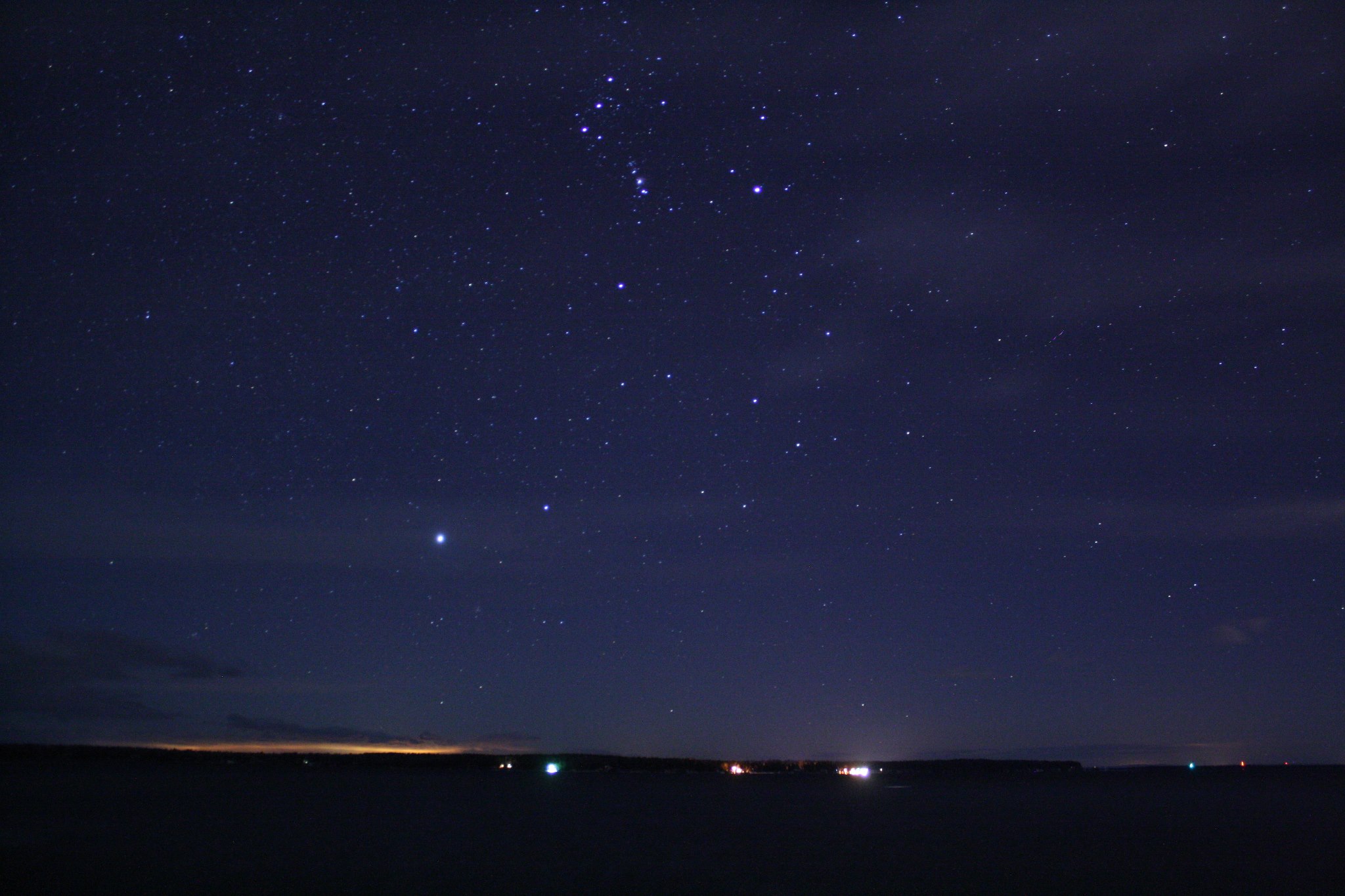

You cannot be Sirius

So is our proverbially lazy Lawrence inspired by the highest hottest heat of high summer? Possibly. But we can’t ignore the fact that there’d be no St Lawrence’s Day without St Lawrence himself. 

Lawrence of Rome was the highest-ranking of seven deacons that served under Pope Sixtus II in the 3rd century AD, whose job it was to oversee the church’s treasury and distribute alms to the poor. Everything was going splendidly for Lawrence until August AD258, when a letter arrived at the Senate from the Roman Emperor Valerian—who was imprisoned in Antioch, having left Rome to fight a war with the Persians—calling for all Christian senators to be stripped of their titles and assets, and for all priests, bishops and deacons to be arrested. If they renounced their faith and agreed to perform a sacrifice to the Roman gods, they would be freed. If they refused, they would be put to death. Valerian, it seems, wasn’t going to let a little thing like being held in prison 2,000 miles away stop him from running his Empire.
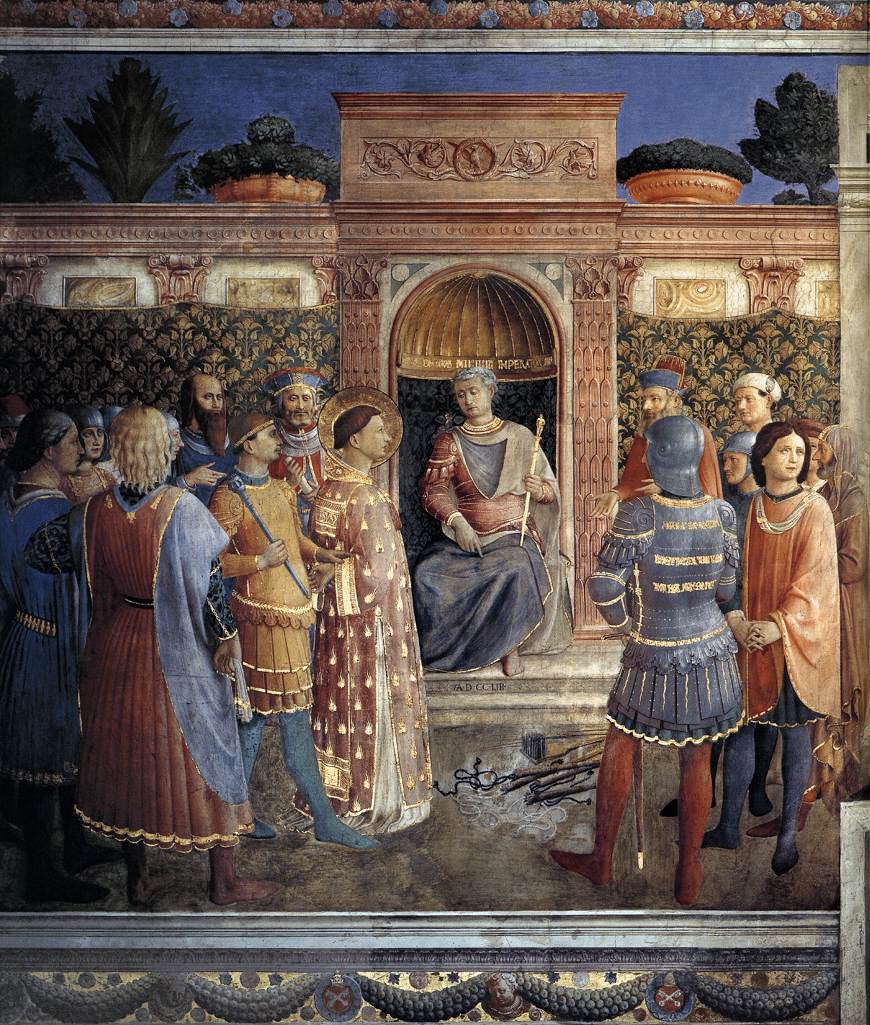
In accordance with Valerian’s orders, the Senate rounded up Pope Sixtus and his seven deacons. All eight refused to comply with the edict, and so, on 6 August 258, they were beheaded—all, that is, except Lawrence. As the archdeacon in charge of the treasury, Lawrence was given a three-day stay of execution to collect together all the church’s wealth and hand it over to the Roman state; instead, he reportedly spent the next three days giving as much of the money away as he could. On August 9, he returned to the Senate with a group of Rome’s poorest, sickest, neediest citizens, and boldly claimed that these were the true treasures of the church. The Prefect of Rome, frankly, was far from pleased.

Whereas Pope Sixtus and his other deacons had been beheaded, Lawrence’s singular act of defiance earned him an especially cruel death: the sentence was passed that he should be roasted to death, suspended on a gridiron above roaring fire.

Baby catching was all the rage in Ancient Rome

There’s some disagreement over whether or not Lawrence was actually burned to death in this way, because some sources claim that the Latin record of his death (assus est, “he was roasted”) should actually have read passus est, “he suffered”. But whether true or not, the question still remains—what does an early Christian martyr’s gruesome execution have to do with laziness?

Well, Lawrence’s death was so notably brutal that it soon became the subject of a macabre bit of folklore that claimed midway through his roasting Lawrence had quipped, “Turn me over, I’m done on this side!” It might sound more Groucho Marx than it does Archdeacon of Rome (and you can make your own mind up as to whether he actually said it or not), but this legend nevertheless apparently inspired a joke that Lawrence was “too lazy” to turn himself over. 

So is this the true origin of our lazy Lawrences? It’s impossible to say for sure, but it’s a good story all the same. And one well worth telling round the barbecue this summer.



10 February 2016

Uranus

Before we begin, let’s get a few things out of the way. The noxious atmosphere around Uranus could kill a man. Uranus has a circumference of 100,000 miles. Scientists are looking at a black hole near Uranus. What are those two circular objects either side of Uranus? Ass-teroids, of course. If you got through that without laughing, then we’re good to go.

So. The other day, one of those stop-you-in-your-tracks facts cropped up on the @HaggardHawks Twitter feed:


But this really is too bizarre a fact to leave unexplained:


…so your wish is my command.

The discovery of Uranus (stop sniggering, you at the back) is credited to the German-born English astronomer William Herschel in 1781. Although it had been observed by scientists and astronomers for centuries, Uranus had always been mistaken for a star, and right up to Herschel’s discovery it was still being classed as 34 Tauri, a minor star in the constellation Taurus. Even Herschel himself initially believed he had spotted a comet rather than a planet, after noting that an object he had been looking at from his observatory in Bath had changed position in the sky over a series of nights.

Herschel announced his discovery in March 1781. As word of his new “comet” spread, astronomers all across Europe began to take note and observe it themselves. Soon, enough data had been compiled to plot its apparent trajectory—which, to everyone’s surprise, appeared to be an almost perfect circular orbit around the Sun. Herschel’s discovery was no comet.

Full colour photo of Uranus. Stop laughing.

By 1783, it had become universally acknowledged that Herschel’s discovery must surely be a planet—moreover, it was the first planet ever discovered by telescope, and the first new planet added to our Solar System in modern history. It was a truly monumental discovery, and one that earned Herschel an annual salary of £200 (equivalent to £27,000/$40,000 today) from King George III (on the condition that he move his observatory from Bath to Windsor, to be closer to the royal household), as well as the never-to-be-repeated title of Court Astronomer to The King.

But with the existence of a new planet confirmed, a pressing question soon emerged: what on Earth should it be called?

The Astronomer Royal, Nevil Maskelyne, wrote to Herschel asking him “to do the astronomical world the favour” and “give a name to your planet,” which, he continued, “is entirely your own, [and] which we are so much obliged to you for the discovery of.” In honour of his new financial patron, Herschel plumped for the only name he saw fit: Georgium Sidus, or “George’s Star.” He wrote to the Royal Society:

In the fabulous ages of ancient times the appellations of Mercury, Venus, Mars, Jupiter and Saturn were given to the Planets, as being the names of their principal heroes and divinities… The first consideration of any particular event, or remarkable incident, seems to be its chronology: if in any future age it should be asked, when this last-found Planet was discovered? It would be a very satisfactory answer to say, “In the reign of King George the Third”.

The seventh planet from the Sun, ultimately, was to be called George. But the response to Herschel’s suggestion was far from encouraging.

Outside of Europe, astronomers were wary of using a such an explicitly “British” name, especially given that it had taken an international collaboration to prove its status as a planet. Consequently, despite Maskelyne specifying that Herschel’s discovery and his choice of name were “entirely his own”, George failed to gain any widespread use or permanency. The name Georgium Sidus effectively became a placeholder, and over the years that followed astronomers across Europe began utilising and pitching their own choices and suggestions.

One popular choice was simply Herschel, a name honouring its discoverer. The Swedish astronomer Erik Prosperin ironically opted for Neptune (now the name of the eighth planet, discovered in 1846). But eventually a clear choice emerged—namely the German astronomer Johann Elert Bode’s suggestion, Uranus.

Bode had been one of the European astronomers who had calculated Uranus’ orbit, lending weight to the idea that Herschel’s discovery was a planet not a star. He suggested the name Uranus as it not only maintained the classical and mythological theme set out by the other six planets, but fittingly Uranus was the Greek god of the sky. Moreover, just as Saturn had been the father of Jupiter, Uranus was the father of Saturn, thereby creating a mythological family tree in the heavens.

Bose’s choice quickly gained momentum, and was reinforced by the German chemist Martin Klaproth in 1789, who named his famous discovery—the chemical element uranium—in support of Bose’s suggestion.

Out of deference to Herschel, however, it took another 60 years for the name Uranus to be universally acknowledged by the scientific community, when, in 1850, the official astronomical almanac published by the Royal Greenwich Observatory in London finally abandoned Herschel’s Georgium Sidus and in favour of Uranus.


8 July 2015

Aphercotropism

Well, well, well. Every so often something just seems to click over on @HaggardHawks, and one unsuspecting tweet suddenly goes a bit berserk. The goldfinch did. Tantling did. The racehorse with the best name in history did. And that fantastically wind-sculpted tree undoubtedly did too.

But earlier this week, an obscure nineteenth century ecological term (paired with a tremendous photograph, for which we can take no credit whatsoever) broke all the HaggardHawks records:


Understandably, the obscurity of a word that seems seldom (if ever) to be used outside of old scientific literature—and so isn’t found in the pages of any major dictionaries—raised a few eyebrows:


So, 800 retweets and nearly 1000 favourites later, we thought you might like to know a bit more about aphercotropism, and thereby address a few of these queries (and the dozens more like them). Scalpels at the ready, then—let’s dissect this thing.

First of all, the prefix ap– or aph– derives from a Greek word, apo, meaning “off” or “away from”. It’s the same root we see in words like apocalypse (which literally means “uncovered” or “disclosed”), apocryphal (literally “hidden away”), and even apology, which originally referred to a formal defence or justification, or to a personal account of a story (and so literally means “from speech”).

Secondly, the –erco– part comes from another Greek word, herkos, referring to a fence, a barrier, or a some kind surrounding wall. It only has a handful of offspring in modern English, the majority of which are fairly obscure, long-forgotten terms (the kind that HaggardHawks devours) that have found their way into the dustier corners of the OED: hercotectonic (“pertaining to the construction of walls”), poliorcetic (“relating to the besieging of cities”), and hercogamous, a botanical term describing plants that grow “barriers” between their male and female parts in order to prevent self-fertilization. Apparently.

So that only leaves the suffix –tropism, which you’ll likely recognise from words like heliotropism (“turning towards the sun”) and phototropism (“growth towards a light source”). Scientists and ecologists have invented dozens of words for different kinds of “tropism” besides these, of course, including geotropism (“growth dictated by gravity”), thigmotropism (“movement in response to touch”), homolotropism (“fixed horizontal growth”), and and thixotropism, which refers to the property of certain fluids that makes them act like a solid when subjected to a force—which is why you can run across a pool of custard.

Wait a second—let me just stop to add those last six words to my bucket list… Right, let’s carry on.

Tropism
derives from another Greek root, tropos, which literally means “a turning”. So when we put everything back together, aphercotropism ultimately refers to an organism quite literally “turning away from an obstruction”. That’s all well and good, of course, but it still doesn’t explain where the word itself comes from. Did we just make it up?

No. Seriously, no. Believe me, finding out about genuinely interesting genuine words is much more fun than making them up. Instead, this particular term seems to date back to the late nineteenth century, with the earliest record we’ve so far uncovered coming from an 1899 volume of Nature Notes, a natural history journal published by The Selborne Society, an early conservationist organization:
Aphercotropism … is a peculiarity discovered by Darwin. His experiment was as follows: after allowing a radicle to be well developed in peas, beans, &c. the seed is suspended in the air. A tiny piece of card is attached to one side of the tip by a little gum; the tip will now move away from the vertical position, on the opposite side to the card. The tip may make one or more complete circles in a vertical plane; and it has been known to pass through the first loop so as to tie itself into a knot. This explains how a radish was once dug up and found to be thus tied up.


Charles Darwin outlined this experiment—in which the root of a single pea plant grows in an obscure shape in order to avoid the card glued above it—in his 1880 work, The Power of Movement in Plants. But in his account, he makes no reference to the word aphercotropism. So until any other evidence comes to light, we can presume that the word was coined sometime between the publication of Darwin’s book in 1880, and the publication of the Nature Notes journal in 1899, the author of which likewise makes no reference to having coined the word himself. Precisely who did coin the word, ultimately, remains a mystery.

Right. Now, back to that custard thing…


____________________
With grateful thanks to avid HH-er John (no surname supplied, unfortunately!) who emailed to say, quite rightly, that the second Greek root of aphercotropism discussed above should read herkos, not erkos as it did previously. For those of you not up to speed with your Ancient Greek (a minority, surely...) this is to do with “rough breathing”, an Ancient Greek diacritic marker that indicated the vowel in question was preceded by a “h” sound, which should be transliterated into English as an H, and which we had omitted the post has now been updated accordingly. Apologies for the oversight—a more up to date Dictionary of Ancient Greek has been purchased here at HaggardHawks HQ. The other has been unceremoniously banished to the back of the cupboard.

20 March 2015

Eclipse

So earlier today—across the UK and much of north-western Europe, at least—this happened:

The Moon, photobombing the Sun  (The Guardian)

A solar eclipse. The first one approaching a total eclipse of the Sun in the UK for more than fifteen years. Although here at HaggardHawks HQ, while the Moon was spectacularly blocking out the Sun, the rainclouds were spectacularly blocking out the Moon. This is the UK, after all. 

But anyway. What can we tell you about eclipses?

Well, the word eclipse first appeared in English in the fourteenth century. Like pretty much every English word dating from the fourteenth century, its earliest record comes from Geoffrey Chaucer, who used it in 1374 in a translation of a work by the Roman scholar Boethius. Before then, the word was borrowed into English from French, but its earliest origins lie in its Latin and Greek equivalents, eclipsis and ekleipsis.

The initial ec– of eclipse is the Greek word ek, meaning “out” or “outside of”. It’s the same ec– as in words like eccentric (literally “outside of the centre”), ecstasy (literally “out of place”), and anecdote (literally “not given out”—or, to put it another way, “unpublished”). But it can also be found in words like appendectomy and tonsillectomy, in both of which it appears alongside the Greek word for “cut”, temnein; the surgical suffix ectomy literally means “cut out”.

The –lipse of eclipse is leipsis, a Greek word essentially meaning “a failing”, “a leaving”, or “a shortfall”. Put these two roots together, and you’ll get the Greek verb ekleipein, which was once variously used to mean “to fail to appear”, or “to not be in your usual place”. And from there, it’s easy to see how the word came to be attached to lunar and solar eclipses. 

Although it helps that the weather is better in Greece.