_
Showing posts with label history. Show all posts

11 August 2016

10 Words Borrowed From Other Languages - 500 Words Ep. 31


A long, long time ago over on HaggardHawks, this little fact popped up:


In retrospect, that’s a little disingenuous (not least because linguists can’t really decide what actually constitutes a word), but regardless of the parameters involved, studies of etymology tend to agree that anywhere from one-quarter to one-third of the English language has been borrowed directly into English from French.

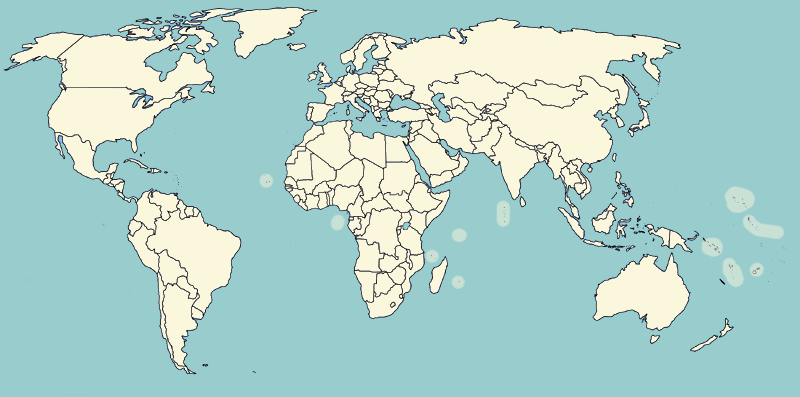
Elsewhere in the dictionary, things get increasingly far-flung: besides the likes of German, Spanish and Italian, English has adopted words from practically every major European language, including Norwegian (slalom), Finnish (sauna), and Czech (robot), as well as a number of global big-hitters like Russian (vodka), Arabic (almanac), the Chinese (lychee) and Japanese (karate) languages, and Hindi (juggernaut), Bengali (jute), Urdu (cummerbund) and all the other languages of the Indian subcontinent.

And it’s borrowed words and the languages we have taken them from that are up for discussion in this week’s HH video:


We might owe the humble word tattoo to (SPOILER ALERT if you haven’t seen the video) one of the furthest of the far-flung languages of the south Pacific, but it is by no means alone. 

Other somewhat surprising languages to have provided words to English include Tamil, another Indian language and the official language of both Sri Lanka and Singapore, which is the origin of the likes of catamaran, cheroot and pariah. Javanese, the most widely spoken language in Indonesia, is the origin of batik and lahar, another name for a volcanic mudflow. 

The native Aboriginal languages of Australia have given us billabong, budgerigar and dingo. When you run amok, you’re using a Malay word (borrowed into English via Portuguese) meaning “attacking frenziedly”. The boondocks take their name from a Tagalog word meaning “remote place”. And over in the Caribbean, the Taíno language is responsible for a number of very familiar words adopted into English via Spanish Caribbean colonists, including tobacco, hurricane, potato, canoe and even Caribbean itself. But these words, and several others like them, are almost all that remains of the Taíno civilization.

An indigenous Arawak people, the Taíno were once the most numerous people in the entire Caribbean. As such were the first Native Americans that Christopher Columbus came into contact with when he arrived in the Americas in the late 1400s; Columbus’s misinterpretation of the Carib people’s word for themselves, Caniba (as well his misapprehension that they were anthropophagous) even gave us the word cannibalism.


But as more Europeans arrived in the Caribbean, the Taíno population collapsed as its people contracted diseases for which they had no natural immunity, most notably smallpox. Within three decades, their numbers had dwindled by as much as 90%; according to some accounts, by the mid 1500s there were fewer than 500 individual Taíno people alive in the world. 

Although the population understandably never recovered, pockets of Taíno people survive across North America today. But their culture and language suffered so terrifically in the aftermath of Columbus’s arrival that the handful of Taíno words to have survived in English offer an extraordinary and tantalizingly rare glimpse of a long-lost civilization... 


2 August 2016

10 Words For Other Words


If you’ve been keeping up with the HH “500 Words” YouTube series, you’ll so far have found out about 280 of the 500 words we’re going to look at this year. But this week, we’re turning things around. 

So from hypernyms and hyponyms to holonyms and holophrases, this week’s video is looking at 10 Words for Other Words.


(And for more words like those, then be sure to check out the HH article that inspired it over on Mental Floss.)

One word that didn’t make the final cut here, however, is backronym. We’ve discussed some backronyms on YouTube before—mainly in our 10 Word Origins Stories That Are Completely Untrue video—and it’s a myth-busting topic that’s always worth revisiting.

Backronyms are words or phrases that are widely and mistakenly believed purported to be acronyms. Posh, for instance, is often claimed to stand for “port out, starboard home”, a reference to moneyed cruise ship passengers paying for the best views on both the outward and homeward bound parts of their voyage. Golf too is said to stand for “gentlemen only, ladies forbidden” (or ladies do something else that begins with F). And the distress signal SOS is famously claimed to stand for “save our souls”, or “save our ship”.


“It says, ‘you may have been missold PPI.’”

None of these is true, of course. Posh is simply thought to come from an old slang word for cash or loose change. Golf is probably descended from an old Dutch word for a club, colf or kulf (albeit with perhaps some influence of a Scots word for a stout blow to the head). And the letter combination “SOS” was chosen as a distress signal for no other reason than that its rhythmic and symmetrical combination of dots and dashes [· · · – – – · · ·] is so immediately noticeable. Incidentally, precisely the same combination of dots and dashes could also be used to spell the letters “VTB” in Morse code, but the designation SOS was used because of its own symmetry and memorability.


Before SOS was adopted in the early 1900s, however, the standard telegraph distress signal was “CQD” [– · – ·    – – · –    – · ·]. It’s fair to say that that’s hardly the most recognisable or memorable arrangement of dits and dahs on offer, so why pick that?

Well, on their own the letters “CQ” had long been used as a telegraphic distress signal as they sound identical to the French word “sécu”, an abbreviation of sécurité. The Marconi Telegraph Company simply added a letter D to this to make their first recommended distress signal, CQD. But just like SOS, CQD also fell foul of backronymy and before long myths had emerged claimed that it stood for “come quickly—danger!”, or “come quickly—drowning!”

Problems with interpreting the confusing set of letters “CQD” over a poor signal, however, eventually led to calls for a more immediately recognizable distress signal to be adopted, and so SOS was officially introduced in 1906. 


20 July 2016

10 Words For The People You Know - 500 Words Ep. 27


You might have spotted this tweet over on the HH Twitter feed the other day:


Which, as our friends at UWG English pointed out, is probably not the most appropriate word for that kind of person…:


But what about all the other characters that we know and love and love to hate? What other words are hiding out in the dictionary to describe them?

Well, from unknowledgeable critics to penniless friends, this week’s HH YouTube instalment is looking at 10 words for precisely those kinds of people:


One word that didn’t make the final cut here, however, was zoilist:


Just as (spoiler alert if you haven’t watched the video yet...) the ultracrepidarians of this world take their name from a story from Ancient Greece, the carping zoilists have their roots in a fourth-century BC Greek grammarian and literary critic named Zoilus of Amphipolis

Born in what is now Macedonia c.400 BC, Zoilus was one of the most scathing critics of the Greek poet Homer. Despite being the author of both the Iliad and Odyssey and one of the most well respected writers of Ancient Greece, writing two cornerstones of Western literature was not enough, it seems, to impress Zoilus. 

In a long-lost essay called Homeric Questions, Zoilus challenged Homer’s portrayal of the gods, and called out a number of plot holes and inconsistencies in his works: in the Iliad, for instance, Menelaus dies in battle only to be seemingly revived to witness the death of his son several pages later. Other writers might have fallen victim to Zoilus’ criticizing glare of the years, but it was for these criticisms of Homer’s writing that Zoilus was best known—and for which he deservedly the nickname Homeromastix, the “Scourge of Homer”, among his contemporaries. 

Zoilus’s writings have not survived, and as a result it’s unclear just how harsh his criticism really was. But the enduring popularity of Homer’s works has nevertheless led to history being somewhat less kind to his harshest critic. 

Various historical accounts record that Zoilus died having been thrown from a cliff by an angry mob, stoned to death on the island of Chios, or else tossed alive on top of a funeral pyre in Smyrna. Whether any of these gruesome demises ever truly occurred is debateable, but instead it’s likely that they are all just myths and smears rooted in little more than the unpopularity of Zoilus’s opinions—but it’s precisely those opinions that led to Zoilus the zoilist earning a permanent place in the language. 


2 July 2016

10 Words To Do With Halves - 500 Words Ep. 25

Ah, how the time flies. It seems like only yesterday HaggardHawks embarked on a series of fifty Top 10 YouTube videos, back when David Cameron was Prime Minister and the UK wasn’t being laughed at by everyone, but here we are! How. The time. Flies.

Unbelievably, we’re already at the halfway point in our series, as this week’s video—looking, appropriately enough, at the meanings and origins of 10 Words To Do With Halves—is the 25th of the 50 in the series. Ladies and gentlemen, we’re officially embarking on the home stretch...


Out of all the halves in the video, however, one word that nearly-but-didn’t make the final cut was Laodicean, a synonym (as Thomas Hardy fans will doubtless know) for half-heartedness or apathy, or else a byword for someone who is indifferent or uninterested in important matters.

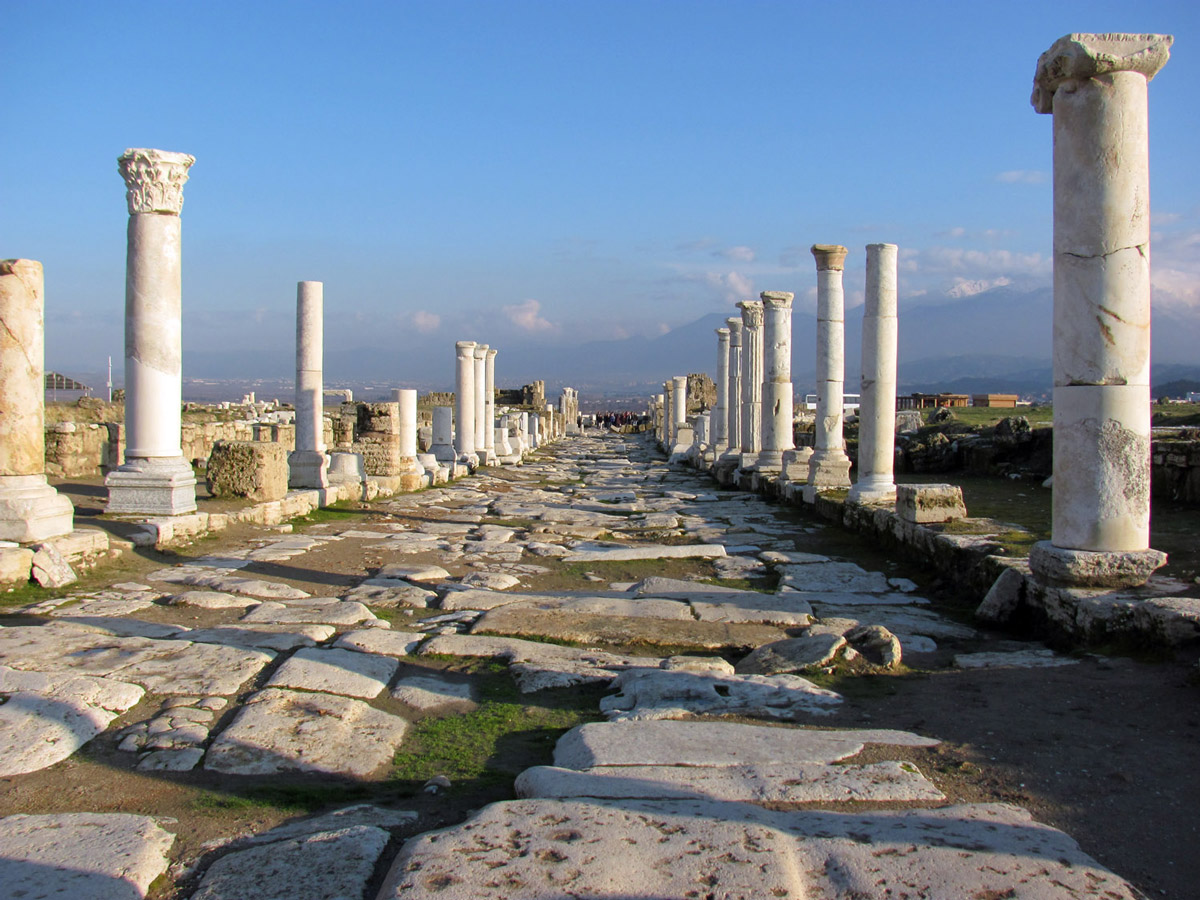
The word derives from Laodicea, a city and region of Ancient Greece now located in modern-day Turkey, whose inhabitants were notorious for their religious indifference. In the Book of Revelation, the Laodiceans were one of seven ancient peoples or Christian churches—alongside those of Ephesus, Smyrna, Pergamum, Thyateira, Sardis and Philadelphia (no, not that Philadelphia)—to whom messages were to be sent to stir them from their apathy. And in his letter to the Laodiceans, the author of the Book of Revelation John of Patmos accused them of being “neither cold not hot.”


“I would thou wert cold or hot,” he exclaimed, “so, then because thou are lukewarm, and neither hot nor cold, I will spew thee out of my mouth”. Good old John of Patmos, such a way with words.

It’s this image of someone or something being “neither cold not hot” in their opinions that led to the adjective Loadicean appearing in English in the early 1600s, as another word for a lukewarm disinterest, or apathy regarding important issues like politics and religion. Likewise, Laodiceanism is another word for unconcern or indifference—one thing John of Patmos certainly couldn’t be accused of. 


3 June 2016

10 Useful Scrabble Words


Chances are that if you like words, you’ll like Scrabble. It’s just so much fun, isn’t it? Waiting the entire game for the letter Q to come up so you can play jonquils and score 500 points, only for your opponent to get it first and play qi on a triple word square and score 501. So. Much. FUN.

Scrabble-related facts crop up on the HH Twitter feed every so often (and there’s a darn sight more where that came from in the fact book Word Drops):

And it’s Scrabble that’s the focus of this week’s HaggardHawks YouTube video—10 indispensably useful Scrabble words, from aa to oxyphenbutazone. Good luck slipping that one into your next game...


One fiendishly useful Scrabble word that didn’t make the final cut here however is euouae. According to the Guinnes Book of Records, that’s the longest vowel-only word in the English language, and is well worth remembering if you’re looking to ditch a superfluity of vowels midway through a game. That being said, there’s some contention over whether or not euouae should actually be permissible in Scrabble play—not to mention whether or not it’s actually a word or not.

The word euouae (pronounced “you-oo-ee”) is an abbreviation used to memorize the pattern of syllables forming the cadence of a Gregorian chant known as the Gloria Patri, “Glory Be to the Father”. The Gloria Patri ends with the line, “In saecula saeculorum, Amen”, literally meaning “in a century of centuries”, or “forever and ever”. Euouae refers to the pattern of tones corresponding to the last six syllables of this line: saeculorum amen.


So strictly speaking, euouae is an abbreviation of a Latin phrase used as a mnemonic device. Does that make it a “word” in the strictest (Scrabble-playing) sense? It’s a tough call, and it’s certainly true that not every dictionary—and not every Scrabble word-list—has admitted it to its pages thus far. 

But when you’re sat in front of a rack of seven vowels, you’ve really got to take what you can get…