_
Showing posts with label numbers. Show all posts

29 March 2016

The Feynman Point

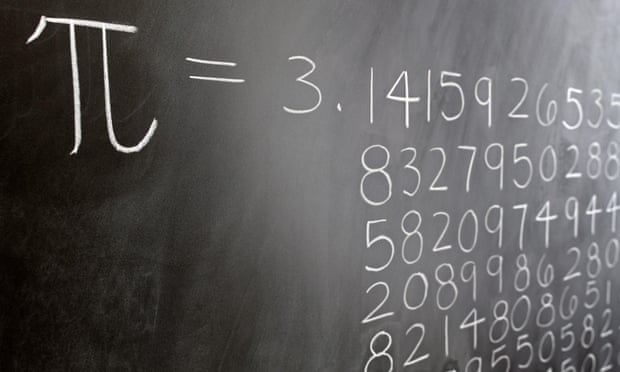
If you saw our video of words derived from numbers earlier this month, you’ll know that March 14 was Pi Day (or rather, the once-in-a-century Rounded-Up Pi Day), because when it’s written out numerically the date3.14.16” forms the first few digits of pi.

Besides our mathematically-themed video, however, over on the HaggardHawks Twitter feed we marked Pi Day with this fairly remarkable fact:


Now. We’re not mathematicians here at HaggardHawks, and frankly the very idea of discussing the irrationality of an approximation of the mathematical constant representing the ratio of the circumference of a circle to its diametzzzzzzzzzzzzzzz…

Only joking, mathematicians, we love you really. But even dusty, bookish old wordsmiths like us can find some interest in mathematics every so often, and the Feynman Point is one of those times. So we thought you might like to know a little bit more about the point behind The Point.

The “Feynman” of the Feynman Point is the American theoretical physicist Richard Feynman. In a lifetime of achievement and accomplishment, Feynman did everything from helping develop the atomic bomb to assisting in the commission that investigated the Challenger disaster in 1986. He was also jointly awarded the 1965 Nobel Prize for Physics for his “fundamental work in quantum electrodynamics”, including his groundbreaking work on quantum path integral formulation challenging the existing notion of a unique quantum trajectory by replacing it with a functional integralzzzzzzzzzz…

Only joking, physicists, we love you as well. But long story short, Richard Feynman was a brilliant scientist—and he was also very interested in π.

According to the story, during a lecture at the California Institute of Technology, Feynman joked to his students that he would one day like to memorize pi up to the point, 762 decimal places in, that there are six consecutive nines. Why? Well, he wanted reach that particular repdigit and then state “...999999, and so on”, implying that the famously irrational π suddenly, 762 places in, becomes nothing more than an infinite chain of 9s.

Regrettably there’s little evidence that Feynman ever actually made that joke (and in fact the earliest account of it credits it to fellow scientist Douglas Hofstader), but it’s Feynman’s name that has ended up being attached to these six consecutive 9s, and its his name that has remained in place ever since.

Incidentally, another six consecutive 9s crop up in the 193,034th–193,039th decimal places of pi. Anyone fancy memorizing up to there? You could get your name in the dictionary if you do...


14 March 2016

10 Words Derived From Numbers

Monday March 14 is Pi Day. That’s because when written out as numbers “March 14” becomes “3.14”, the first few digits of pi, 3.1415926… So in honour of the most mathematical day of the year, in this week’s #500Words video over on the HaggardHawks YouTube channel we’re looking at 10 Words Derived From Numbers.

You probably know a great many more words that fall under this category than you might think, from unicycle, bicycle and tricycle (“one-”, “two-” and “three-wheels” in Latin) to quartet and quintet (from the Latin for “fifth” and “sixth”), hexagon (“six-cornered” in Greek), heptathlon (Greek for “seven-contest”), and October, November and December (from the Latin for “eighth”, “ninth”, and “tenth”, as these were originally the eighth, ninth, and tenth months of the Roman year).

Alongside a handful of words you’ll recognise, however, we’re looking at some much less familiar words (like Septentrion and khamsin), as well as a few numerical word origins that you might not have known—including a part of the body named for the fact that it is typically 12 finger-breadths long, and a time of the day that now means three hours earlier than it used to


25 March 2015

Eleven

A few days ago, we tweeted this:
Which led to this:
It’s a good question—why do we say eleven and twelve, but then thirteen and fourteen? Why not oneteen and twoteen? Or threelve and fourlve?

Unsurprisingly the teen suffix is a derivative of ten. Thirteen is literally “three and ten”, fourteen is “four and ten”, and so on. It’s a fairly ancient formation: thirteen was þreotene right back in Old English, a straightforward compound of þreo, “three”, and tene, a form of “ten”. The same goes for fourteen (derived from Old English feowertyne), and fifteen (Old English fiftene), all the way up to twenty—which was twentig, or literally “two groups of ten”.

But eleven was enleofan in Old English, which took its initial en– from the Old English word for “one”, ane. Twelve, likewise, was twelf, with its initial twe– taken from the Old English “two”, twa. The remaining leofan and –elf parts have noting to do with the “teen” suffix, but instead represent hangovers from some ancient, pre-Old English word, probably meaning “to leave over”, or “to omit”. So eleven was literally the number “left over” after you’d counted up to ten, and twelve was literally “two left over after ten”. 

But why were eleven and twelve given different names from all the other teens? Why weren’t they just ane-tene and twa-tene?

The problem is that we’re now hardwired to think of our numbers decimally—in 10s, 100s and 1000s. There’s a good reason for doing so, of course, because 10 is such an easy number to work with. You can count to 10 using your fingers (which is called dactylonomy, by the way), and calculations involving 10 are effortlessly simple. 79 multiplied by 10, you say? 790. Easy. But this decimal way of thinking is actually a relatively recent invention, spurred on by the development of the metric system in the Middle Ages. Historically, many of our numbering and measuring systems were based around 12, not 10—and hence there are twelve inches in a foot, and two sets of twelve hours in a day. 

It’s a much more complicated number to deal with arithmetically of course (79 multiplied by 12? Give me a minute...) but there’s a very practical reason for counting in terms of 12 rather than 10—because 12 is a much more mathematically productive number. 


A set of 10, for instance, can only be split equally into two sets of five, or five sets of two. A set of 12, however, can be split into 2, 3, 4 or 6. Likewise a set of 20 can only be divided into 2, 4, 5 or 10, but a set of 24 can be divided into 2, 3, 4, 6, 8 or 12. And even 100 has barely half the number of factors (2, 4, 5, 10, 20, 25, 50) than 144 (2, 3, 4, 6, 8, 9, 12, 16, 18, 24, 36, 48, 72). 


12 homemade cookies. Soon to be 0 homemade cookies.

The fact that 12 could be so conveniently divided in so many different ways made it particularly useful, in everyday terms, in dealing with fractions, proportions, allocations, and measurements. It even led to some separate words for a set of twelve (dozen) and a set of twelve twelves (gross) entering our language—and to many ancient number systems, including the one we use today, using a base of 12, not 10. Ultimately twelve, and thereby eleven, earned names distinct from all those numbers above them, and it’s only our modern, decimal-based perspective that makes this seem strange.

Oh—948! Got there eventually...