_
Showing posts with label animals. Show all posts

12 May 2016

10 Old Animal Nicknames

If there’s one subject that crops up fairly regularly on the HaggardHawks Twitter feed, it’s animal nicknames. You might have spotted this tweet about penguins—and the explanation behind it—over on Twitter the other day:


But it’s not just the penguins that have it bad: 


So this week over on the HH YouTube channel, we’re looking at the origins and meanings behind 10 Old Animal Nicknames.


One name that didn’t make the final cut here was mouldwarp, an old English word for a mole. The “mould” of mouldwarp has nothing to do with being mouldy (which is actually an entirely unrelated word), but is instead an ancient English word for loose earth or turned-over soil. Its etymological cousins are words like mull, meaning “ashes” or “crumbling dust”, and mool, the soil used to fill graves.

The “warp” of mouldwarp is a verb, meaning “to toss through the air”, or “to sprinkle”. You can also (should you ever need to) warp a door, which means to throw it open quickly; warp your clothes, which means to remove them equally quickly; and warp someone, which means to suddenly drop them in some kind of situation or scenario—so you could warp them into prison, into bankruptcy, or into peril. Presumably after you’ve closed the door and put your clothes on again, of course.

Put together, that means that mouldwarp literally means “earth-thrower”. Which seems like a perfectly reasonable name for a mole—and a much nicer one than this:


28 April 2016

Penguin


You might have seen this frankly brilliant fact pop up on the @HaggardHawks Twitter feed this week:


Poor old penguins. It can’t be much fun humpling around in sub-zero temperatures avoiding being eaten by seals all day. But then along comes Oliver Goldsmith—whose seven-volume History of the Earth and Animated Nature is the source of that quote—to tell us that eighteenth century sailors called them arse-feet. It’s just not fair really, is it?

Not that it was only the penguins, though. The nickname arse-feet dates back to the sixteenth century, when it was originally another name for the little grebe, and over the centuries it’s been used in reference to a whole host of other species, all of which had one thing in common—the position of their feet noticeably close to their derrieres. Frankly, it gives a whole new meaning to having a boot up the arse. (Shameless plug: there’s more on all this in the HH factbook, Word Drops.)

But if that’s the history of arse-feet, what about penguin?

Well, the word penguin also dates back to the sixteenth century, with the earliest record we know about coming from the logbook of Sir Francis Drake’s Golden Hind. According to Drake’s admiral, Francis Fletcher, as he sailed through the Magellan Strait in 1577: 

[20 August 1577] In these Islands we found great reliefe and plenty of good victualls, for infinite were the number of fowle, which the Welsh men named Pengwin … [The birds] breed and lodge at land, and in the day tyme goe downe to the sea to feed, being soe fatt that they can but goe, and their skins cannot be taken from their bodyes without tearing off the flesh, because of their exceeding fatnes.
Yep, not only did the penguins have to contend with waddling around in sub-zero temperatures and being called arse-feet, but Drake and his crew decided to announce their presence in the Southern Ocean by eating every penguin they could lay their hands on.

But then there’s this:
New found land is in a temperate Climate… There are Sea Guls, Murres, Duckes, wild Geese, and many other kinds of birdes store, too long to write, especially at one Island named Penguin, where wee may driue them on a planke into our ship as many as shall lade her. These birdes are also called Penguins, and cannot flie.
If you know anything about natural history, that quote might strike you as a little odd—penguins are only found in the Southern Hemisphere, so what the dickens were they doing in Newfoundland?

Well, that second quote isn’t from Drake’s logbook, but from a letter, written on 13 November 1778, by a Bristol merchant sailor named Anthony Parkhurst to the famed English geographer Richard Hakluyt. And the penguins Parkhurst is talking about aren’t the same penguins we know today—in fact, the penguins he’s talking about haven’t been seen by anybody for 150 years.

Parkhurst’s Newfoundland penguins were in actual fact great auks—tall, flightless, black-and-white seabirds (whose arses were just as close to their feet) that were once native to much of the North Atlantic. Although the great auk is now extinct (and the story of its slow demise makes for a sobering read, alas) in Drake and Fletcher’s day they were still widely abundant—so abundant, in fact, that as Parkhurst points out they could be driven in huge numbers from “Penguin Island”, along a plank, and onto a ship to provide food for the crew.


Well, this is aukward...

Fletcher’s quote might predate Parkhurst’s by over a year, but it’s thought that the birds Parkhurst wrote about were the original “penguins”—after all, for there to be a place called “Penguin Island” in 1578, we can presume the word penguin was in use in reference to the great auk long before then. Drake’s crew, meanwhile, would have presumably been familiar with the sea birds they knew from back home, and so when they saw remarkably similar flightless black-and-white birds in the equally freezing cold waters of the Southern Ocean in 1577, they either mistook them for the great auks they knew from home, or simply referred to them by the same name, penguin, because they were so similar.

That’s all well and good, of course, but what does the word penguin actually mean? Well, Fletcher’s reference to the birds’ “exceeding fatness” points to one possible theory: that penguin might derive from a Latin word, pinguis, meaning “plump”, “dense”, “fatty”—or pinguid. But a more likely explanation lies with Fletcher’s “Welsh men”. Penguin is thought to derive from pen gwyn, the Welsh for “white head”, and sure enough the great auk had a noticeably bright white patch of plumage between its bill and its eyes. 

So all that means that the original “penguins” weren’t actually penguins, and weren’t from the Antarctic. But their feet were close to their arses...


8 April 2016

Feague


If you’ve been keeping up with our new YouTube series, you might remember possibly the strangest word we’ve ever come across from our Words You Won’t Believe Exist video: the eighteenth century verb feague.


Feague, for those of you who don’t already know (or practise it), means “to put a piece of ginger up a horse’s anus,” with the somewhat predictable outcome of making him appear more lively. If you think that sounds impossibly cruel, then fear not—according to the 1811 edition of Francis Grose’s aptly titled Dictionary of the Vulgar Tongue, it was just as common to replace the ginger with a live eel. A much more sensible idea, I’m sure you’ll agree.

So why on earth—seriously, why? FOR THE LOVE OF GOD WHY?—would anyone want to spend even one microfortnight of their day forcing a piece of ginger up a horse’s arse? 


“You’re going to do WHAT?”

Well, as explained (though, alas, not demonstrated) in our video, if you were selling the horse, then it’s only natural that you would want it to look as frisky and as energetic as possible, to ensure that you got the best price for it. And if there’s one thing guaranteed to make a horse frisky, it’s shoving the spicy root of a herbaceous perennial up its ass. That makes feaguing essentially the 250-year-old equivalent of those tricks estate agents use when prospective buyers stop by. You know how it goes—a bouquet of freshly picked flowers on the table. A fresh pot of coffee brewing in the kitchen. A horse desperately trying to evacuate a live eel from its poop chute in the garden. 

Another fairly cruel means of improving the asking price of your horse incidentally was bishoping, which involved filing down its teeth. Because horse’s teeth continue to grow throughout their lives, shaving them down meant that even a worn out old carthorse could pass as a young colt, and in that sense bishoping was essentially the eighteenth-century equine equivalent of botox. Or six pints of Guinness.


But while bishoping was straightforwardly enough named after a crooked horse salesman named Mr Bishop, feaguing is more of an etymological mystery. 

One theory is that it comes from fake, which besides its more familiar meaning was used in nineteenth century slang to mean “to tamper with something in order to deceive.” That sounds exactly like our horse-enlivening ginger insertion, but the dates don’t match up—in fact, the OED suggests faking in this sense might derive from feaguing, not the other way around.

Another theory is that feague comes from an even earlier sixteenth century word, feak or fyke, meaning “to twitch” or “to be restless.” Twitching and restlessness certainly sounds along the lines of feaguing, but this theory stumbles because by the time feague first began to appear in the language, feak had morphed into a more figurative word, meaning “to be officiously busy,” or “to appear busy, yet accomplish little.” Hey, we’ve all been there.

But then there’s this:

’Slife, this She Devil will ruin me! Alas, madam, she’s merry, she drolls; but come, let’s dance and put these things out of our heads. Come in, Minnim and Crotchet, and fegue your violins away, fa, la, la, la!

That’s a line from The Humorist, a play written in 1671 by the English playwright Thomas Shadwell. Here, “Minnim and Crotchet” are the names of musicians, and when they’re called upon to “fegue their violins,” they’re not being told to put a piece of ginger inside them (nor, for that matter, to put their violins somewhere it’s anatomically unadvisable) but to start playing them, quickly and energetically. 

To feague away was a seventeenth century phrase basically meaning “to set in quick motion,” “to agitate,” or “to work flat out.” It’s thought that it derives from an even earlier sixteenth century word, feg or feagle, meaning “to beat” or “thrash,” which in turn probably comes from an even older German word, fegen, meaning “to clean” or “sweep”, or to busy yourself with housework. 

Feaguing away then seems to be the missing link: it’s easy to see how a word meaning “to busy yourself with housework” could give birth to a phrase meaning “to work quickly,” or “to agitate,” and ultimately “to enliven” or “to make energetic.” The ginger-inserting part, it seems, was just a bit of added spice.


24 February 2016

10 Word Origin Stories That Are Completely Untrue

Often when the origin of a word isn’t known—and, just as often, even when it is—an entirely fictitious story emerges that purports to explain where the word in question came from. Typically, these stories provide neater, funnier, cleverer or more straightforward accounts than any real-life word etymology ever could, and so remain enduring popular—despite, however, being completely untrue… 

This week on the HaggardHawks YouTube channel, out #500Words project is turning its attention to debunking 10 of these word origin myths, from backronyms like posh, cabal and golf to a bird supposedly named for his nesting sites (that in fact takes its name from the colour of its behind) and a bird that Napoleon thought was only good for horse food (that in fact takes its name from a flatulent goblin). You have been warned—here are 10 Word Origins Stories That Are Completely Untrue


5 September 2015

Glasgow magistrate

Earlier this week, this popped up on HaggardHawks:
And, as so often happens with this kind of thing, there’s a brilliant—if a fairly sketchy—story behind it. Unlike a lot of slang expressions, the Glasgow magistrate has found its way into the OED, who have traced it back to 1833. But the OED also cites a 1950 issue of The Scots Magazine, which offers this tentative explanation of how the phrase came about:
Herring were cured there by Walter Gibson, a merchant of Glasgow and Provost of that city in 1688, and it is perhaps because of Provost Gibson that salt herring acquired their nickname of “Glasgow Magistrates.”
Walter Gibson indeed helped to found Glasgow’s lucrative herring industry in the late 1600s, and he did become provost (chief magistrate) of Glasgow in 1688. But is he really the origin of the term? And is the establishment of a herring-curing factory really the best story I could tell you? No. No it’s not.


The problem is that if Gibson were the original Glasgow magistrate, we’d have to accept a century-and-a-half gap between his appointment as provost in 1688 and the earliest record of the phrase in print in 1833. That’s not impossible of course (slang expressions are used relatively rarely in print, after all) but it nevertheless casts doubt over the Walter Gibson theory—and it becomes a lot more doubtful given the other explanation on offer. 

In the revised edition of his Dictionary of Phrase and Fable in 1894, Ebenezer Cobham Brewer included the Glasgow magistrate (alongside the Yarmouth capon and the Billingsgate pheasant) as a nickname for a salted herring. He also offered this brief yet brilliant account as an etymological explanation:
When George IV visited Glasgow, some wag placed a salt herring on the iron guard of the carriage of a well-known magistrate, who formed one of the deputation to receive him.
Where or how Brewer came across this story isn’t clear, but he goes on to explain:
I remember a similar joke played on a magistrate because he said, during a time of great scarcity, he wondered why the poor did not eat salt herrings, which he himself found very appetising.
So is this tale of a local Glaswegian scallywag secreting a herring onto a processional carriage true? 

Well, by name-checking George IV, Brewer is certainly proposing a date that seems to fit with the evidence: George took to the throne in 1820 and reigned for the next ten years, so written evidence dating from around 1833 is perfectly reasonable. There is, however, a problem: King George only visited Scotland once in his ten-year reign—and he never set foot in Glasgow.

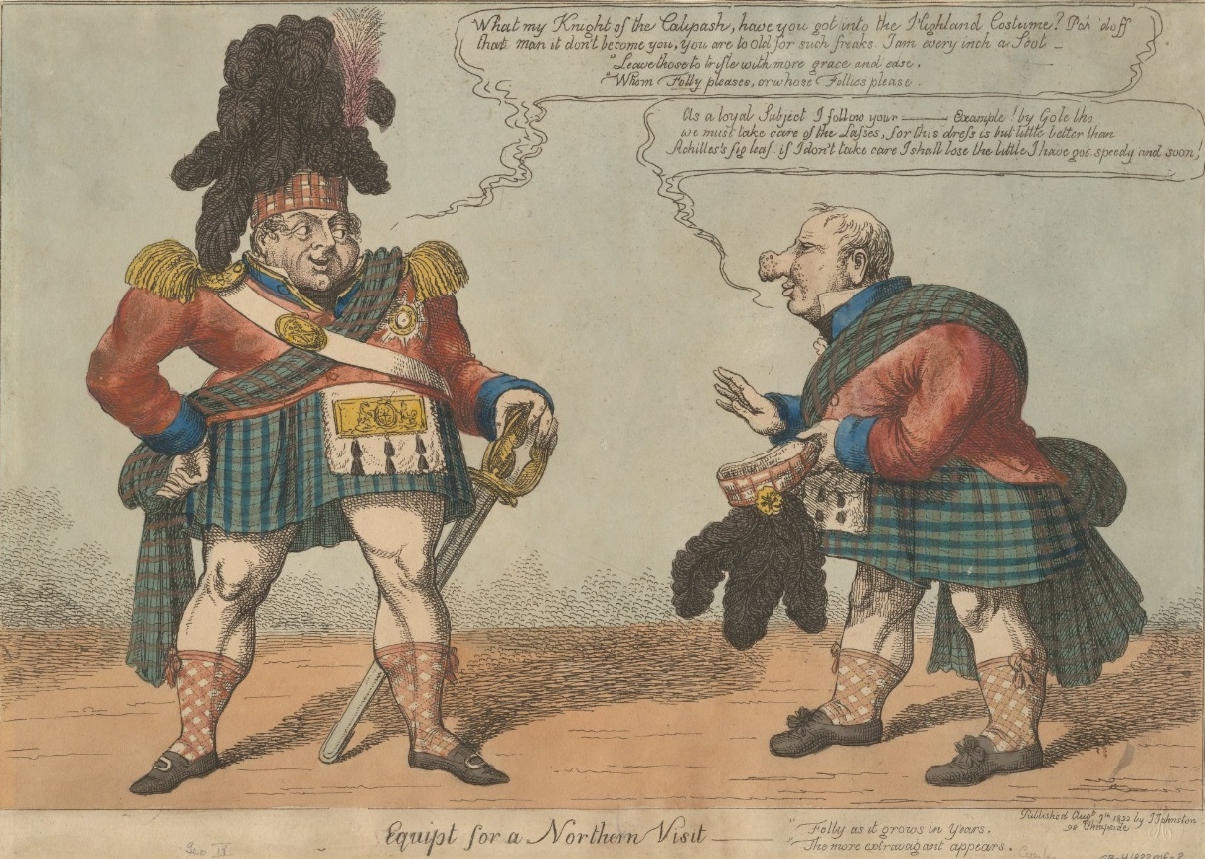
In 1822, George IV became the first Hanoverian monarch—as well as the first reigning monarch in nearly 200 years—to visit Scotland when he stayed in Edinburgh for three weeks in mid August. During that time, the king attended all sorts of predictably glamorous pageants and processions (all stage-managed by Sir Walter Scott, no less) and gamely managed to make a complete fool of himself by opting to wear bright pink stockings under a criminally undersized kilt. At no point, however, did he travel across to Glasgow. 

So does this blow Brewer’s fishy theory out of the water? Perhaps not. It’s thought that some 300,000 Scottish people—one in seven of the entire population at the time—turned out to see the various events put on for the royal visit in Edinburgh in 1822, and a large proportion of those had made the 40-mile trip from Glasgow, reportedly leaving the city all but deserted. 


So could it be that Brewer’s Glaswegian prankster was in fact among the crowds in Edinburgh, rather than his home city? It’s not only plausible, but it’s a much better story... 


11 August 2015

Toad-eater

A few days ago, HaggardHawks tweeted this:
And, well, it’s all just a little too bizarre to leave unexplained... 

There’s an old language myth that claims toad-eater comes from the Spanish mi todita (literally “my little everything”), which is itself a diminutive of toda, the Spanish word for “all”. Todita, so the story goes, was once a jocular title used by well-to-do Spaniards for their closest and most servile assistants or aides, who were only too ready to help their masters out in whatever way necessary, hence the definition above. 

It’s a neat theory—but unfortunately it’s completely untrue. In fact, the true history of the toad-eater is much more interesting, much more literal, and considerably more revolting, than all that.

According to the OED, the earliest record we have of a toad-eater comes from a seventeenth-century diarist named John Rous. Rous kept a diary from 1625-43, during which time he was the Anglican vicar of the village of Santon Downham in Suffolk, England. He recorded a predictably eclectic mix of events from both home and abroad, ranging from the coronation of Charles I in 1625 (described as “very joyous to the well-affected, but to the Papists not very welcome”) to reports of a rebellion in Portugal, Spanish ships returning from the West Indies being attacked by Dutch pirates, and, inevitably, growing unrest across England in the lead-up to what would eventually become the Civil War.

Alongside all the headlines, however, Rous’s diary contains several accounts of local goings-on in and around his own parish—including, in 1629, this account of a conversation with a shopkeeper in the nearby village of Laxfield:
I inquired of him if William Utting the toade-eater … did not once keepe [i.e. stay] at Laxfield; he tould me yes, and said he had seen him eate a toade, nay two.
Rous goes on to explain how “the toade-eater” apparently went about his business:
The man in whose house he kept went to him and … tould him that a friend of his would give a groate [4 pence] to see him eate a toade (thus was the way to see it): he accepted the offer, and went and fetche in, from under blocks, ij toads … He swallowed them downe, but presently he cast them up into his hands, and after some pawse, “Nay,” sayeth he, “I will not loose my groate.” So taking that which came up last (saith he), “thou wentst in first before and shalte doe againe.” When both then were downe, his stomach held them, and he had his groate.
Seemingly, Utting somehow managed to swallow two toads whole (after having already vomited them up once), and thereby won himself the princely some of one groat—or just under £2 (or just over $3) in 2015. But how do we get from this fairly disgusting story to the considerably less disgusting meaning in the tweet above?

Well, back in Rous’s day, toads were widely believed to be incredibly poisonous. Not only that, but their warty skin, their fondness of dark, dank places, and their ability to survive both on land and in water led to an association with black magic and witchcraft; even the Devil’s coat of arms is traditionally said to be decorated with “three unclean spirits like frogs”. To even touch a toad was, frankly, to dice with death—and so to be able to eat one was quite some feat.

Can’t you two get a room?

Rous’s toad-eater, and the many more like him who worked the country fairs and fêtes of Georgian England, knew precisely that. They also presumably knew that toads—or, by any rate, the two species of toad native to Great Britain—aren’t really as poisonous as most people believed: they can secrete a foul-tasting “milk” from glands on their skin when disturbed that contains an impressive battery of unpleasant chemicals, but unless you’re an overly-inquisitive dog or cat, or unless you fully digest the toad and its toxic skin (which toad-eaters seldom did, opting instead to either rely or sleight of hand, or else regurgitate them later), the chances are you’ll escape unharmed. 

Nevertheless, if these toad-eaters could convince people that they were somehow immune to the toad’s toxicity—or, better yet, that they had invented some kind of all-curing antidote or medical procedure—then they could not only put on an impressive show, but make an equally impressive profit.

Based on this presumption, by the late 1600s, quack physicians and itinerant charlatans all across England had begun working with toad-eaters to come up with a brand new sting: in front of an enthralled (and presumably somewhat nauseated) crowd, they would have their assistant eat, or pretend to eat, a live toad, just as William Utting had. Although unharmed, the assistant would then promptly collapse to the floor in feigned agony, whereupon the quack could either make a great show of his miraculous healing powers, or else administer some kind of homemade concoction to his assistant, who would consequently stage an immediate and impressive recovery—leaving his quack associate to sell vials of their bogus cure-all to the assembled crowd.

The original seventeenth century “toad-eater”, ultimately, was nothing more than a con artist’s assistant, and it’s from there that the sense of “someone who corroborates a lie” came about. Over time, however, toad-eater came to be used more loosely for any assistant or subordinate, and in particular one who acts obsequiously or servilely and is only too happy to perform any duty required of him—no matter how unpleasant it might be. 


6 June 2015

Grandmother

When it came to being amazed, those Victorians really knew how to respond:
If ever an old fashioned phrase needed bringing back into circulation, it was this one. But where does a saying as bizarre as this one come from?

The earliest record we have of this beats my grandmother! dates back to 1833, when it first appeared in a comic poem included in an American elocutionary reader, The United States Speaker. The poem, “Logic”, outlines a light-hearted back-and-forth conversation between a young schoolboy—“an Eton stripling”—who has just returned from boarding school, and his uncle, Sir Peter, whom he is visiting:


“Well, Tom, the road; what saw you worth discerning?
How’s all at college Tom: what is’t you’re learning?”
“Learning?—Oh, logic, logic; not the shallow rules
Of Lockes and Bacons, antiquated fools!
But wits’ and wranglers’ logic; for d’ye see
I’ll prove as clear as A, B, C,
That an eel-pie’s a pigeon; to deny it
Is to say that black’s not black;”—“Come, let’s try it?”
“Well, sir; an eel-pie is a pie of fish:” “Agreed.”
“Fish-pie may be a jack-pie:”—“Well, well, proceed.”
“A jack-pie is a John-pie—and ’tis done!
For every John-pie must be a pie-John!”
“Bravo! bravo!” Sir Peter cries,—“Logic for ever! 
This beats my grandmother, and she was clever!”

Tom’s grandmother-beating argument is that the eels in an eel-pie are fish, as are the jacks (an old nickname for a young pike) in a “jack-pie”. Jack is a pet form of John, and “John-pie” when reversed gives “pie-John”— hence, “pigeon”. Ipso facto. Quod erat demonstrandum. Logic forever, indeed.

The poem is unfortunately anonymous, which makes it hard to pin down the precise origin of this beats my grandmother. Its appearance here in an American textbook makes it tempting to presume it’s an American invention, but the reference to Eton College confuses things, as does the fact that the entire “pigeon”/“pie-John” argument is apparently considerably older than this poem might suggest: a reference to it here, for instance, from a book published in London in 1821, suggests that it was already fairly well known even by then.

But regardless of its American or British ancestry, one question remains—why on earth does it beat my grandmother? 

Well, oddly enough, this beats my grandmother! was just one in a long line of bizarre eighteenth-nineteenth century slang expressions that emphatically alluded to the speaker’s grandmother. So all my eye and my grandmother! meant “don’t talk rubbish”. So is your grandmother! was the Victorian equivalent of that schoolyard favourite, “I know you are, but what am I?” And to shoot your grandmother meant to find out a juicy bit of gossip, only to discover that everybody else already knows it. (Shameless plug: there’s more on this here.) 

Some of these expressions even made the leap from everyday colloquial English into hard-copy literature. Dickens, for instance, used the emphasizing expression not even to your grandmother in Our Mutual Friend (1865). Anthony Trollope dismissively used your grandmother! in his novel Phineas Redux (1873), as did Mark Twain in his short story How I Edited An Agricultural Paper Once (1870). And chances are you’ll have heard someone warn not to teach your grandmother to suck eggs—which Henry Fielding used in Tom Jones as far back as 1749.

As well as being the only one of these phrases to still be in use today, this egg-sucking grandma is also the oldest—and as such provides the best clue to the origin of this entire clutch of expressions. It’s earliest record dates all the way back to 1707, but before then, seventeenth-century speakers were telling each other not to teach their grandmothers “to sup sour milk”, “to make milk-kail” (a type of cabbage soup), and even “to grope a goose” (meaning to poke a goose’s rear end to see if it’s ready to lay an egg—which is likely the origin of the egg-sucking grandma).

Some geese: boy, has grandmother got a surprise for you...

The implication of all of these sayings was the same—don’t try to tell an informed, experienced person how to do something they already know how to do. Tellingly, a similar meaning is implied by another expression, you can’t teach an old dog new tricks, which has been found in a list of proverbs dating back to 1636 but is probably much, much older: a book on animal husbandry written in 1534, for instance, advises that “it is harde to make an olde dogge to stoupe [i.e. be compliant]”. The same book also explains the best technique for greasing sheep. Truly, it’s an indispensable read.

The implications in the old dog new tricks and grandma to suck eggs might be different, but there’s only a slight semantic sidestep from “old dog” to “old person”, and hence to “grandmother”—so it’s likely that the one inspired the other, and, eventually, its plethora of later variations. 

And if that doesn’t beat your grandmother, I don’t know what will.


26 May 2015

Feisty

It’s fair to say that some of the words and facts we tweet about are a little unusual. Yes, take a bow monkey-poop, we mean you.

But one of the most unusual we’ve posted in a long time was this nugget of etymological gold (lifted—shameless plug alert—from our new book), which we tweeted earlier this week:

So, hold your nose. We’re going in.

We might have name-checked the Tudors in that tweet, but we’ll get to them in a moment. For now, this malodorous story starts with a tenth-century English monk named Ælfric of Eynsham, who as well as being abbot of Eynsham Abbey in Oxfordshire was also one of the most prolific writers of his day. Ælfric’s output included homilies, sermons, biographies of saints, biblical translations and biblical commentaries, as well as several scholarly works written for students of Latin. Among them was a vast bilingual glossary of Latin and English, which contains the earliest records of a whole host of English words—two of which, feorting and fystinghe defined as “breaking wind”.

Unsurprisingly, the Old English word feorting is the ancestor of the modern English farting, and it’s fair to say that its meaning has lingered on, unchanged, for the last thousand years. Fysting too has survived down into modern English, but unlike feorting it’s no longer found in its original sense—instead, it’s the ancestor of a handful of seemingly innocent English words, including our old friend feisty. So how did we get from a word for “a small windy escape backwards” (as the great Francis Grose defined it in 1785), to a word meaning “lively”, “aggressive”, and “courageous”? Well, the answer lies with those aforementioned Tudors—or rather, with their flatulent dogs.

As Old English wafted into Middle English, fyst was still being used as just another general word for—well, a whiffy crackaret. But by the mid-fifteenth century, fysting had come to be used particularly in reference to foul-smelling dogs, which it can only be presumed had a notable habit of letting one go. In fact, Tudor-period English is filled with so many references to “fysting hounds” and “foisting curs” (literally “farting dogs”) that they’ve earned themselves their own entries in some historical dictionaries.

Hey, don't look at me—I can't smell anything.

Unlike Old English, of course, a lot of literature from the Tudor period still survives, and because of that we’ve even got some idea what kind of dogs these “foisting curs” were. Just take a look at this quote from De Canibus Britannicis, or Of English Dogges, a work by the sixteenth century English physician (and namesake of Caius College, Cambridge), John Caius:
Canis Meliteus … This puppitly and pleasantly curre, (which some frumpingly tearme fysteing hounds), serves ... no good vse except … to succour and strengthen quailing and quammning stomackes, to bewray bawdery and filthy abbominable leudnesse. 
We now know canis Meliteusis as the Maltese, a small white-haired lapdog seemingly once popular with Tudor women (not least because of its apparent ability to “quell filthy abominable lewdness”). But that’s not the Maltese’s only quirk: like a lot of diminutive dog breeds, it also has a gutsy, energetic character, and is quick to snappily defend what it sees as its own territory. 

And it’s this “feisty” nature—helped along by some inopportune Tudor flatulence—that brings us right up to date: by the mid-nineteenth century, feist had become just another nickname for any small dog, and it wasn’t long before the related adjective made its first appearance in print in 1896.

Now, please—someone open a window.