_
Showing posts with label France. Show all posts

8 September 2016

10 First Names Used As Words | 500 Words Ep. 35


You may remember this fact from the HH Twitter feed a while back:
...which led to a bit more explanation here on the blog: the name Rebecca was used (in allusion to a story from the Old Testament) for a series of toll gate protests in Wales in the mid nineteenth century. And it’s that story again that kickstarts this week’s YouTube video, which looks at the origins and meanings behind 10 first names that can be used as words in their own right.


One name that didn’t make the final cut here, however, is John.

John has a number of different uses in English, ranging from a toilet to a signature, a cuckolded husband to an unidentified corpse, and from a policeman to a priest, to the client of a prostitute. Blimey, definitions don’t get much more varied than those. 

In the majority of these cases, it’s the sheer commonality (and, therefore, the familiarity or anonymity) of the name John that is the root of the meaning: John was the most popular male first name in American every year since records began in the nineteenth century through to 1924 (and it remained in the top 10 until 1987), while in the UK 5.8 million men have been named John since 1530, and either it or William held the top spot among British men from the mid-1500s right through to the mid-1900s.

The use of john as another name for a person’s signature, however, owes its origin to John Hancock, the Governor of Massachusetts whose sign-manual gloriously outdoes everybody else’s on the Declaration of Independence (and which you can see—or rather, fail to miss—at the top of this page).

As another name for a toilet, meanwhile, john is probably an alteration of jakes or Jacques, a French borrowing that has been used as a euphemism for the smallest room in the house since the fifteenth century at least. And as another name for a detective, john has its roots in the French word for a policeman, gendarme.

The term gendarme (which itself began life as gens d’armes, or “men of arms”) was originally the name of a mounted soldier or infantryman, and it was in this sense that the word was first borrowed into English in the sixteenth century. It wasn’t until the first formal police forces began to be organized in the 1800s that the word gained its modern sense in its native French—and, for that matter, in English, where it quickly morphed into the humorous form johndarm in early Victorian slang:
“John Darm! Who’s he?” “What, don’t you know?! In Paris he is all the go; Like money here,—he’s every thing; A demigod—at least a king! You cannot fight, you cannot drink, Nor have a spree, nor hardly think, For fear you should create a charm, To conjure up the fiend John Darm! 
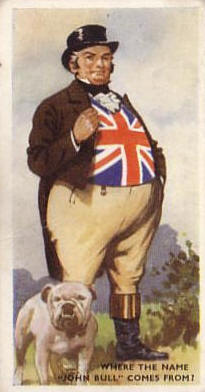
That’s an extract from John Darm, a song first published in 1823 and written by a nineteenth century “writer of verse” named John Ogden, recounting a trip taken by John Bull (the kedge-bellied personification of England and the English) to France. Once there, Bull attends a theatre, gets into a fight with a number of audience members, is arrested by “John Darm”, and thrown into prison. 

The trip ends with the two on better terms, however, with John Bull concluding:

Says I, “To-morrow home I go;
One Frenchman I’d not leave my foe;
John Bull, believe me, meant no harm—
Let’s part in peace—farewell John Darm!”

Ogden’s song (which was apparently a follow up to an earlier comic poem, Mounseer Nongtongpaw, once falsely attributed to Frankenstein author Mary Shelley) provides us with the earliest record of the name john as a nickname for a policeman that we know about. And although the word’s French origins and its connection to the gendarmerie has long since vanished into the haze of language history, the word itself has remained in use to this day.

26 June 2016

10 Chemical Element Names


So a lot of very big things have happened this week. For one, the UK voted to leave the European Union for some reason. Secondly, the shelves on the HH bookcase were starting to sag a bit in the middle, so they were rotated. And thirdly, the four new chemical elements discovered at the start of the year were given their names.


One of those stories is of much higher import than the others, of course, but don’t worry—those shelves will be fine. As for those chemical elements, well, the names chosen were nihonium, moscovium, tennessine and oganasson. Each has a story attached to it: the first three honour their places of discovery, Japan, Moscow and Tennessee respectively, while the last honours Russian-Armenian physicist Professor Yuri Oganessian.

Elsewhere on the periodic table, however, there are another 114 elementary etymologies to tell—although we only had enough time (and bandwidth) to talk about 10 in this week’s video…


Of course Yuri Oganessian and (SPOILER ALERT in case you haven’t watched the video) Vasili Samarsky-Bykhovets aren’t the only eponymous honourees on the periodic table. Elements like einsteinium, curium, bohrium and seaborgium honour some of the most famous names in science. 

Nor are nihonium, moscovium and their neighbours the only geographical namesakes: besides tennessine, America can offer berkelium and californium, as well as americium, while the UK has strontium, which takes its name via the mineral strontianite from the village of Strontian in the Scottish Highlands. And then there’s gallium, element number 31, which uniquely manages to honour both its place of discovery and—if the rumours are trumours—its discoverer.

The father of the periodic table, Dmitri Mendeleev (who has the element mendelevium named after him), predicted the existence of gallium in 1871, but it wasn’t until four years later the snappily-named French chemist Paul Émile Lecoq de Boisbaudran obtained a sample of it from the mineral sphalerite. The metal de Boisbaudran discovered was bright silver and brittle, and melted just above room temperature. He called it gallium, from Gallia, the Latin name for the Roman territory of Gaul, corresponding to modern-day France. But it’s possible he had other ideas in mind.

One of de Boisbaudran’s many, many names, Lecoq, means “the rooster” in French, while the Latin word for “rooster” is gallus. Had de Boisbaudran wryly named gallium after himself? Some fellow scientists at the time accused him of such, but he insisted that the connection was purely coincidental. Even if it was, it’s certainly a very convenient one and makes de Boisbaudran an interesting footnote to the dozens of famous names honoured on the periodic table. 


9 July 2015

Britain

It’s easy to forget that place names—just like surnames, first names, months of the year, and all other proper nouns—are still only words, and as such have their own histories and etymologies. We’ve mentioned quite a few of these before on the @HaggardHawks Twitter feed, from “the wooden temple” in central Asia to the original “white house” in north Africa, to America’s “place of the wild onion” and “the best place to grow potatoes”.

Unfortunately, because place names tend to be particularly ancient, their precise origins and meanings are often very tricky to pin down. Shortfalls and inconsistencies in what little historical evidence is available mean there’s often just as much conjecture and guesswork involved as there is hard fact, and even then some names defy all attempts to explain them. 

For instance, despite being one of the most famous cities in the world, no one really knows what “London” means. Instead, theories range from the relatively sensible—perhaps a long-forgotten Welsh word, meaning something like “river-fort” (llyn-din), or “pool on the river” (llyn-dain)—to the downright bizarre, with one idea even suggesting some kind of reference to Luna, the Roman goddess of the Moon. (Shameless plus: there’s more on that in the new book…)

We tweeted another bizarre place name origin a few weeks ago:
And, well, we thought it might need a bit more explaining.

So. The earliest written record of “Britain” that we know about comes from an Ancient Greek explorer and adventurer named Pytheas of Massalia. Sometime around 325BC, Pytheas circumnavigated and explored the entire British Isles, probably becoming the first person in history to do so. He also travelled high enough into northern Europe to describe the Midnight Sun (probably becoming the first person to do so); crossed the Arctic Circle and spotted the outer fringes of the great northern icecap (probably becoming the first person to do so); and was the first explorer from Mediterranean Europe to reach the Baltic Sea by boat. He was, it’s fair to say, a bit of a dude.

Pytheas’s accounts of his journeys were among the most celebrated geographical texts in antiquity, but unfortunately all of his original writings have long since been lost. Everything we know about his travels now comes from the smattering of quotes, extracts, and discussions that later writers and historians—including the great Roman naturalist Pliny the Elder, who keeps cropping up on here—included in their work. But what has survived is Pytheas’s early use of the word “Britain”, which he recorded more than 2,300 years ago as “Bretannike.

At the time of Pytheas’s visit, Britain would still have been a hodgepodge of different Celtic and pre-Roman tribes and languages. In the far north and west, however, two increasingly dissimilar branches of the ancient Celtic language family were starting to take shape: Goidelic, or “Q-Celtic”, in the far north and northwest (which eventually gave rise to Irish, Manx and Scots Gaelic), and Brythonic, or “P-Celtic”, in the west and southwest (which eventually gave us Welsh, Cornish and Breton). 

The nicknames “P” and “Q” refer to the fact that Brythonic Celtic tended to develop a p sound where Goidelic Celtic tended to have a hard q or k sound, and vice versa. We’re dealing with impossibly ancient words here, of course, but you don’t have to look too far to find evidence that this change took place: pick up an atlas or a road map of the British Isles, and you’ll find Pentire, a peninsula on the north coast of Cornwall, and Kintyre, a peninsula in southwest Scotland. Both names literally mean “headland”; both derive from P-Celtic (penn) and Q-Celtic (keann) words meaning “head”; and both are practically identical, except for their initial p and k sounds. 

But anyway, back to Pytheas. Based on linguistic evidence like this—and based on what little we know of Pytheas’s route—it’s thought that his “Bretannike” must be derived from some early Brythonic or “P-Celtic” word, suggesting that the people he learned it from originated somewhere around modern-day Wales or southwest England. We can only guess at what this original root word might have been, but from what we know about the Celtic languages, the consensus among etymologists and toponymists (that’s place name researchers to you and me) is that its closest modern descendant is probably an old Welsh word, prŷd, essentially meaning “form”, “image”, or “countenance”. 

If this presumption is correct, then the ancient Britons would quite literally have been “the people of the forms”, which, it’s again presumed, is an apparent reference to their supposed fondness for war paint and tribal tattoos. There are, admittedly, several rivalling theories here—and historians are undecided about whether these Iron Age Britons tattooed each other or not—but, etymologically at least, there is a strong argument to suggest Britain is quite literally the home of the “tattooed people”.


And, appropriately enough, Britain is now apparently the most tattooed nation in Europe. Everything really does come full circle. 


_______________________________

Hat tips to David Willbe (@DavidWillbe) and Dr Matt Lodder (@mattlodder) for links to the historical arguments for and against Pictish tattoos. Tatt you very much. (Sorry...) 

25 June 2015

Smellfungus

So. The other day, we tweeted this:
It’s another one of those “seriously?” words:
HaggardHawks make something up? The very idea of it. Well, there was that one time, but that was entirely different. No—seriously, this is true. And not only that, but there’s a brilliant story behind it.

Smellfungus dates back to 1768. For once, we can be absolutely positive about the date of a word, because we know precisely who invented it, when, and why. So no need to play etymological Cluedo here—it was Laurence Sterne, in the Sentimental Journey, aided and abetted (albeit indirectly) by Tobias Smollett.

Smollett was born in Dunbartonshire in Scotland in 1721. A prolific and well-respected writer, perhaps best known for his comic novel The Adventures of Peregrine Pickle (1751), Smollett’s output covered almost every literary genre and influenced many later literary giants, including Dickens, George Eliot, and William Thackeray. Even the normally unforthcoming George Orwell wrote a glowing essay calling him “Scotland’s Best Novelist”.

Wait—what?! Had Orwell not read any Sherlock Holmes?! Disgraceful. But, I digress.

In all, Smollett’s vast back catalogue includes plays, a non-fiction History of England, several volumes of poetry, half a dozen novels, and even English translations of the likes of Voltaire and Cervantes. But in 1766, he added one more genre to his literary checklist when he published his Travels Through France And Italy, an account of a two-year journey he and his wife embarked on from spring 1763 to summer 1765. Stopping off in the likes of Paris, Nice, Cannes, Pisa, Sienna and Rome, to many it would have been the trip of a lifetime—but Smollett, by and large, remained unimpressed.

Of Florence’s magnificent San Lorenzo chapel, for instance, he wrote that it “will, in my opinion, remain a monument of ill taste and extravagance”. The Pantheon left him “much disappointed”, because “after all that has been said of it, [it] looks like a huge cockpit.” He dismissed Michelangelo’s The Last Judgement, painted behind the alter in the Sistine Chapel, as “a mere mob, without subordination, keeping or repose”, and likened it to “a number of people talking all at once”. Even the Vatican itself didn’t escape unscathed:
[Its] relicks of pretended saints, ill-proportioned spires and bellfreys, and the nauseous repetition of the figure of the cross (which is in itself a very mean and disagreeable object, only fit for the prisons of condemned criminals) have contributed to introduce a vicious taste into the external architecture, as well as in the internal ornaments of our temples.
Michelangelo’s Last Judgement: Crap, apparently

Unsurprisingly, when Smollett’s Travels were published, his fairly tactless and hypercritical attitude, as well as the disdainful way in which he wrote about many of the people he encountered (“At Brignolles … I was obliged to quarrel with the landlady and threaten to leave her house before she would indulge us with any sort of flesh-meat”), outraged his contemporaries. But his apparent arrogance and peevishness also made him a prime target for satire—which brings us to Laurence Sterne.

Sterne was born in Ireland in 1713, but spent much of his childhood in England. After graduating from Cambridge, he became the Anglican priest of a small church in rural Yorkshire where he remained for more than twenty years, dabbling in freelance writing in his spare time. In 1759, he self-published his first major work—two volumes of a vast satirical novel, The Life and Opinions of Tristram Shandy, Gentleman—and within months was one of the most famous authors in the country.

Flushed with success, Sterne quit the church and moved to London in 1760. But in the dank and dreary capital his already precarious health quickly deteriorated, so he and his wife left on a rejuvenating trip to the Mediterranean. They arrived in Montpellier in 1763—where, the following November, they were joined by Tobias Smollett.

It’s unclear exactly how much time Smollett and Sterne spent together, but a number of meetings and engagements are recorded in the letters they sent back home to England, before Smollett decided Montpellier’s cool mountain climate wasn’t for him and he continued on to Nice in early 1764. It’s also largely unclear how well the two men got along, but given what happened next, we can presume the pair hadn’t always seen eye to eye.

In 1768, in response to Smollett’s Travels, Sterne published his own Sentimental Journey Through France and Italy. Again, Sterne’s Journey was based around his own tour of the continent, but unlike Smollett his travelogue was also a part-fictionalized follow-up to his earlier novel, Tristram Shandy

Narrated by a genial English reverend named Mr Yorick (Sterne’s literary alter ego), the aptly-titled Sentimental Journey comprises a light-hearted series of comic episodes and romantic encounters, as Yorick travels down through France from Calais and on into Italy. Along the way, he meets a whole host of unusual and whimsical characters—including a glum, overcritical zoilist known only as “Smelfungus”:
The learned Smelfungus travelled from Boulogne to Paris, from Paris to Rome, and so on; but he set out with the spleen and jaundice, and every object he pass’d by was discoloured or distorted. He wrote an account of them, but ’twas nothing but the account of his miserable feelings.
Smelfungus—spelled with only one L by Sterne—is clearly a fairly unsubtle and unflattering caricature of Smollett, right down to his acerbic views on the architecture of Rome:
I met Smelfungus in the grand portico of the Pantheon—he was just coming out of it. ’Tis nothing but a huge cockpit, said he.
Unfortunately for Smollett the Sentimental Journey was an enormous success, even surpassing Tristram Shandy both critically and commercially. Nowadays it’s seen as having helped to establish travel writing as a respected literary genre in its own right—while Sterne’s acerbic lampoon of Smollett as “Smelfungus” gave the English language a whole new word for a carping, unhappy critic. 

Sadly, however, Sterne didn’t live to see any of the influence his novel would eventually have: he died just twenty days after its publication. And as for Smollett, well, his reputation as a glum, unimpressed tourist—“the most embittered and cantankerous Englishman that ever travelled abroad”, according to one account—might now be permanently installed in the language, but more recent commentators on his work have been considerably more understanding. They quite rightly point out that his Travels were written at a particularly difficult time in his life: both he and Sterne were suffering from the aftereffects of tuberculosis, and he and his wife were still reeling from the death of their only child, their 15-year-old daughter Elizabeth, the previous year.

Not only that, but modern readers who are aware of Smollett’s nit-picking are often surprised to discover how much admiration and positivity his Travels contain alongside the famously tactless criticisms. Indeed despite Smollett’s reputation, the Continent must have held some kind of attraction to him—having retired to Italy in his late 40s, he died in Livorno in 1771, and is buried in the Old English Cemetery in Tuscany.


6 June 2015

D-Day

Today marks the seventy-first anniversary of the Normandy Landings—perhaps better known as D-Day. Etymologically, there’s a longstanding myth that the D of D-Day stands for something along the lines of “disembarkation”, “decision”, or “deployment”, or even “Deutschland” or “Doomsday”, but in fact:
So if the D doesn’t standing for anything, why is it there at all?

The fact is that while military operations are being planned, it’s not always clear from the outset when they’ll actually take place. As a result, their future start date—whenever that may be—is simply referred to as “D-Day”, and this title acts as a placeholder until a specific date can be finalized. (Shameless plug: there’s more on this in the new book.) 

If anything, the D of D-Day could be said to derive from the word ‘day’ (indeed the French equivalent is J-Jour, and the exact time an operation takes place is known as H-Hour) but it certainly can’t be said to stand for it.

Not only that, but the term D-Day is also a lot older than most people think. The earliest record we have of its use dates not from the Second World War, but from the First, and an American military order sent out on 7 September 1918:
The First Army will attack at H-Hour on D-Day with the object of forcing the evacuation of St. Mihiel salient.
Saint-Mihiel is a small town in the Meuse department of north-eastern France, that for three days in September 1918 was the site of one of the most important United States military operations of the entire First World War. Under the command of US Army General John Pershing, an enormous body of American Expeditionary troops—including thousands from the newly-formed United States Army Air Service, now the US Air Force—secured a decisive Allied victory over an ill-prepared and chaotic German contingent.

The Battle of Saint-Mihiel lasted from 12-15 September, during which more than half a million US soldiers, alongside 110,000 French troops, fought to secure the strategically significant Saint-Mihiel “salient”—a technical term for a narrow, isolated strip of land projecting from one region into another—in the hope of eventually recapturing the larger French city of Metz. As it happens, the attack on Metz was never realized, and as the German forces continued to crumble the War came to an end just weeks later, on 11 November 1918.

The term D-Day continued to be used intermittently throughout the 1920s and 30s, until it became all but permanently attached to “Operation Neptune”—the military codename of the decisive Normandy Landings—on 6 June 1944. 


10 April 2015

Vespasienne

We tweeted about toilets a lot today. Purely by coincidence, of course. But you know how it is—once you’ve done one, it’s hard not to do another. Though one of the things we’ve tweeted probably needs a little bit more explaining:
Urine tax. It’s all a bit too bizarre to leave open ended like that.

So, first things first: Titus Flavius Vespasian became Roman Emperor in AD69 after a brief period of turbulence—known as The Year of the Four Emperors—that was sparked by the Emperor Nero’s suicide the previous summer. Unfortunately, Nero’s successor, Galba, was assassinated after just seven months on the throne. (There we go talking about toilets again.) Then Galba’s successor, Otho, committed suicide after just ninety days in power, and in turn his successor, Vitellius, was overthrown and executed just eight months after that. Happily, Vespasian’s rule restored some much-needed stability to the Empire after a year of unrest, and he remained in power for the next decade—until he died trying to stand up during a fatal bout of diarrhoea in AD79. But we digress. That’s more than enough potty talk for now.

One of the high points of Vespasian’s rule was the construction of The Colosseum, which he commissioned in AD70, and which was completed one year after his death by his son and successor, Titus. One of the low points of his rule, however, was his introduction of the vectigal urinae, or “urine tax”. And we thought paying 30p to use the toilets at King’s Cross Station was bad. 

In Vespasian’s defence, the urine tax was actually the brainchild of Nero, who first introduced it sometime around AD60. But long after it had been repealed, it was Vespasian’s decision to reintroduce it. So why was he so keen to tax pee?

Well, chemically speaking, because the urea it contains can be used to produce ammonia, urine is actually quite a useful commodity—and the Romans knew it. They used urine to bleach fabric (including their gleaming white togas), to soak animal hides (making it easier to remove the hairs before tanning), and they even mixed it with powdered pumice to make toothpaste to whiten their teeth. 

So with all this potentially lucrative activity going on unchecked, Vespasian sought to levy his vectigal urinae onto anyone whose business involved collecting urine from the sewers and communal cesspools dotted around Rome—not exactly the most pleasant of job descriptions, but the fact that it was even worth taxing in the first place shows just how profitable a living it could be.


Roman togas: didn’t smell as clean as they looked

If you’re still a bit put off by the prospect of siphoning off other people’s urine and boiling your clothes in it, don’t worry—you’re in good company. When Titus, Vespasian’s son, first heard about the urine tax he was so disgusted by it that he complained in person to his father. In response, Vespasian simply held a gold coin up in front of his face, and asked him if he was just as revolted by it. Confused, Titus answered “non olet”, or “it does not smell”, to which Vespasian knowingly replied, “and yet, it comes from urine!” Recorded by the Roman historian Suetonius, this particular anecdote gave rise to an old Latin saying, pecunia non olet—or “cash doesn’t stink”—which is sometimes still used in English today to imply that money remains unaffected by how it’s earned.


But back to toilets—it was Vespasian’s advocacy of the urine tax that ultimately led to his name being attached to public toilets across the Roman Empire, and it’s through that that French public urinals eventually came to be known as vespasiennes

It gives a whole new meaning to the phrase “pay toilet”.