_
Showing posts with label Rome. Show all posts

15 April 2016

Lazy Lawrence


A long-forgotten (but no less useful) expression popped up on the HaggardHawks Twitter feed the other day:


And this isn’t the only proverbially lazy Lawrence to find his way into the dictionary. Long before lazy people had “Lawrence on their backs” there was an earlier expressionLawrence bids wages, that the OED explains was used to imply that “the attractions of idleness are tempting”—or, in other words, doing nothing looks like a lot of fun. Even Lazy Lawrence itself has been used as a nickname for an idling lazybones for centuries, as well as being the name of a mischievous fairy or sprite supposed to induce lethargy or idleness.

So apologies to anyone named Lawrence, but you’re immortalized in the language as a metaphor for laziness. Still, it’s better than being known for a one-year prison sentence or destroying gates, I suppose. But why Lawrence? And why laziness?

Well, one theory is that the connection is purely coincidence, and that Lawrence just has a nice alliterative ring to it—so this could just as easily be “Lazy Linda”, or “Leon bids wages”, or “to have Loretta Lynn on your back”. It’s certainly plausible (well, apart from the Loretta Lynn bit) but needless to say there are a couple of more imaginative explanations on offer. And one of them even involves a barbecued saint, what more could you want?

One theory is that phrases like these refer to St Lawrence’s Day, 10 August. That date puts it bang in the middle of the “dog days” at the height of the summer, when you can expect to endure the hottest, sultriest, most stifling weather of the year—the kind of weather that makes you want to lounge around and do nothing except lounging around doing nothing. The dog days are traditionally said to last anywhere from mid July to early September, and take their name from the tradition—probably started in Ancient Greece, if not Ancient Egypt—that the appearance during the summer months of Sirius, the Dog Star, just above the horizon before sunrise somehow amplified or added to the heat of the Sun. In fact, the so-called “heliacal rising” of Sirius always occurs sometime around August 10–11.


You cannot be Sirius

So is our proverbially lazy Lawrence inspired by the highest hottest heat of high summer? Possibly. But we can’t ignore the fact that there’d be no St Lawrence’s Day without St Lawrence himself. 

Lawrence of Rome was the highest-ranking of seven deacons that served under Pope Sixtus II in the 3rd century AD, whose job it was to oversee the church’s treasury and distribute alms to the poor. Everything was going splendidly for Lawrence until August AD258, when a letter arrived at the Senate from the Roman Emperor Valerian—who was imprisoned in Antioch, having left Rome to fight a war with the Persians—calling for all Christian senators to be stripped of their titles and assets, and for all priests, bishops and deacons to be arrested. If they renounced their faith and agreed to perform a sacrifice to the Roman gods, they would be freed. If they refused, they would be put to death. Valerian, it seems, wasn’t going to let a little thing like being held in prison 2,000 miles away stop him from running his Empire.
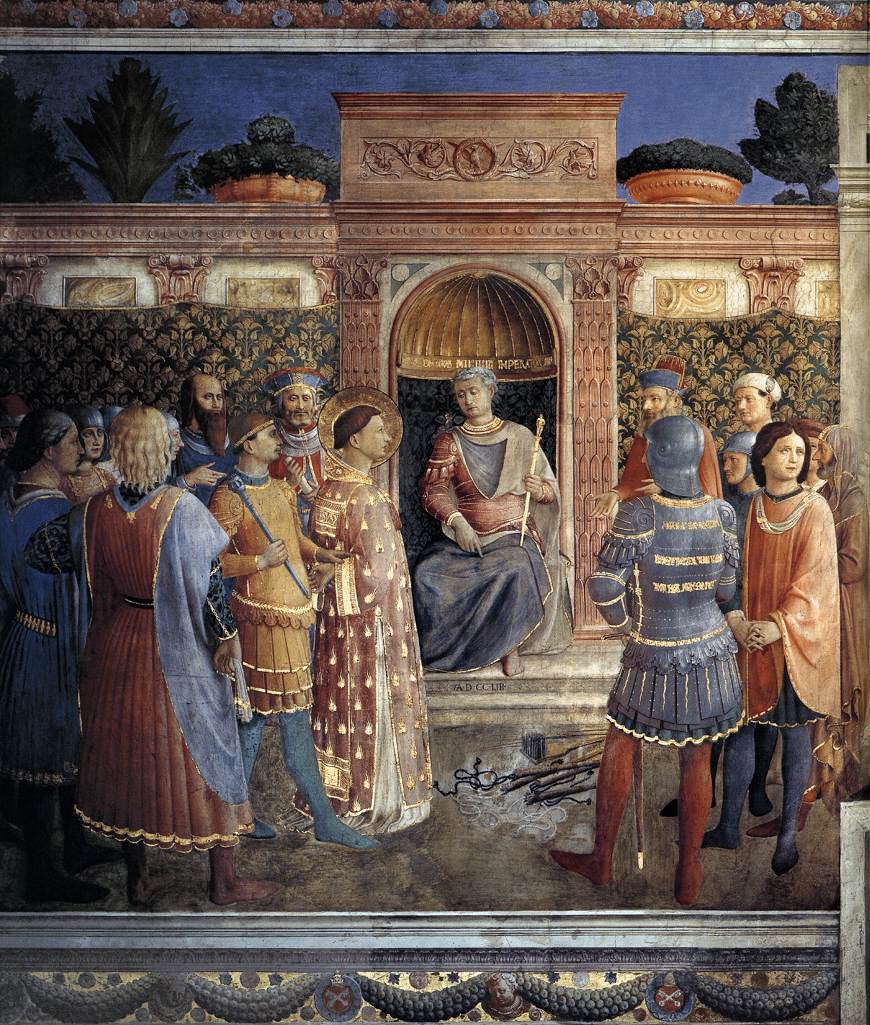
In accordance with Valerian’s orders, the Senate rounded up Pope Sixtus and his seven deacons. All eight refused to comply with the edict, and so, on 6 August 258, they were beheaded—all, that is, except Lawrence. As the archdeacon in charge of the treasury, Lawrence was given a three-day stay of execution to collect together all the church’s wealth and hand it over to the Roman state; instead, he reportedly spent the next three days giving as much of the money away as he could. On August 9, he returned to the Senate with a group of Rome’s poorest, sickest, neediest citizens, and boldly claimed that these were the true treasures of the church. The Prefect of Rome, frankly, was far from pleased.

Whereas Pope Sixtus and his other deacons had been beheaded, Lawrence’s singular act of defiance earned him an especially cruel death: the sentence was passed that he should be roasted to death, suspended on a gridiron above roaring fire.

Baby catching was all the rage in Ancient Rome

There’s some disagreement over whether or not Lawrence was actually burned to death in this way, because some sources claim that the Latin record of his death (assus est, “he was roasted”) should actually have read passus est, “he suffered”. But whether true or not, the question still remains—what does an early Christian martyr’s gruesome execution have to do with laziness?

Well, Lawrence’s death was so notably brutal that it soon became the subject of a macabre bit of folklore that claimed midway through his roasting Lawrence had quipped, “Turn me over, I’m done on this side!” It might sound more Groucho Marx than it does Archdeacon of Rome (and you can make your own mind up as to whether he actually said it or not), but this legend nevertheless apparently inspired a joke that Lawrence was “too lazy” to turn himself over. 

So is this the true origin of our lazy Lawrences? It’s impossible to say for sure, but it’s a good story all the same. And one well worth telling round the barbecue this summer.


27 January 2016

Nose-wipe

This tweet nosed its way onto the @HaggardHawks feed yesterday:


And, in response to a quick query tagged onto it…


…here’s a quick history of nose-wiping—or rather, here’s a quick explanation of why nose-wipe means “to cheat someone”.

In this contextnose-wipe dates back to the early seventeenth century, but an all but identical expression, to wipe someone’s nose, had been in use in English since the late 1500s. Likewise, to play with someone’s nose was an Elizabethan expression meaning “to ridicule someone” or, as the OED eloquently puts, “to make a game of someone”.

Both phrases probably have their roots in Latin, which it’s worth knowing had a specific word for the process of wiping your nose: emungere. That’s an etymological relative of mucus, as well being the origin of a handful of unfamiliar and unsavoury English words like emunctory (“having the function of conveying waste”), emunction (“the act of clearing the bodily passages”), and emunct, a seventeenth century adjective meaning “keen” or “acute” (probably derived from blowing your nose to improve your sense of smell).

In Latin, however, the verb emungere could also be used in a figurative sense, to mean “to cheat” or “deceive”, and in particular “to cheat someone of their money”. It’s from there that the English nose-wipe in the tweet above eventually came from—but why or how did “wiping your nose” come to have lying, swindling connotations?

Well, the clue probably lies in the adjective emunct above: wiping or blowing your nose improves your sense of smell, making it keener or more acute (especially if you’re snottering). The comic writers of Ancient Rome are thought to have picked up on this implication and played on it, using nose-wiped to mean “taken advantage of” or “duped” in the sense that “wiping someone’s nose” would make them keener, more alert—and so less likely to be duped a second time. To have wiped someone’s nose ultimately meant that you had somehow taken advantage of them, but that they had learnt from their costly mistake and were now keen not to fall for the same trick twice…


25 June 2015

Smellfungus

So. The other day, we tweeted this:
It’s another one of those “seriously?” words:
HaggardHawks make something up? The very idea of it. Well, there was that one time, but that was entirely different. No—seriously, this is true. And not only that, but there’s a brilliant story behind it.

Smellfungus dates back to 1768. For once, we can be absolutely positive about the date of a word, because we know precisely who invented it, when, and why. So no need to play etymological Cluedo here—it was Laurence Sterne, in the Sentimental Journey, aided and abetted (albeit indirectly) by Tobias Smollett.

Smollett was born in Dunbartonshire in Scotland in 1721. A prolific and well-respected writer, perhaps best known for his comic novel The Adventures of Peregrine Pickle (1751), Smollett’s output covered almost every literary genre and influenced many later literary giants, including Dickens, George Eliot, and William Thackeray. Even the normally unforthcoming George Orwell wrote a glowing essay calling him “Scotland’s Best Novelist”.

Wait—what?! Had Orwell not read any Sherlock Holmes?! Disgraceful. But, I digress.

In all, Smollett’s vast back catalogue includes plays, a non-fiction History of England, several volumes of poetry, half a dozen novels, and even English translations of the likes of Voltaire and Cervantes. But in 1766, he added one more genre to his literary checklist when he published his Travels Through France And Italy, an account of a two-year journey he and his wife embarked on from spring 1763 to summer 1765. Stopping off in the likes of Paris, Nice, Cannes, Pisa, Sienna and Rome, to many it would have been the trip of a lifetime—but Smollett, by and large, remained unimpressed.

Of Florence’s magnificent San Lorenzo chapel, for instance, he wrote that it “will, in my opinion, remain a monument of ill taste and extravagance”. The Pantheon left him “much disappointed”, because “after all that has been said of it, [it] looks like a huge cockpit.” He dismissed Michelangelo’s The Last Judgement, painted behind the alter in the Sistine Chapel, as “a mere mob, without subordination, keeping or repose”, and likened it to “a number of people talking all at once”. Even the Vatican itself didn’t escape unscathed:
[Its] relicks of pretended saints, ill-proportioned spires and bellfreys, and the nauseous repetition of the figure of the cross (which is in itself a very mean and disagreeable object, only fit for the prisons of condemned criminals) have contributed to introduce a vicious taste into the external architecture, as well as in the internal ornaments of our temples.
Michelangelo’s Last Judgement: Crap, apparently

Unsurprisingly, when Smollett’s Travels were published, his fairly tactless and hypercritical attitude, as well as the disdainful way in which he wrote about many of the people he encountered (“At Brignolles … I was obliged to quarrel with the landlady and threaten to leave her house before she would indulge us with any sort of flesh-meat”), outraged his contemporaries. But his apparent arrogance and peevishness also made him a prime target for satire—which brings us to Laurence Sterne.

Sterne was born in Ireland in 1713, but spent much of his childhood in England. After graduating from Cambridge, he became the Anglican priest of a small church in rural Yorkshire where he remained for more than twenty years, dabbling in freelance writing in his spare time. In 1759, he self-published his first major work—two volumes of a vast satirical novel, The Life and Opinions of Tristram Shandy, Gentleman—and within months was one of the most famous authors in the country.

Flushed with success, Sterne quit the church and moved to London in 1760. But in the dank and dreary capital his already precarious health quickly deteriorated, so he and his wife left on a rejuvenating trip to the Mediterranean. They arrived in Montpellier in 1763—where, the following November, they were joined by Tobias Smollett.

It’s unclear exactly how much time Smollett and Sterne spent together, but a number of meetings and engagements are recorded in the letters they sent back home to England, before Smollett decided Montpellier’s cool mountain climate wasn’t for him and he continued on to Nice in early 1764. It’s also largely unclear how well the two men got along, but given what happened next, we can presume the pair hadn’t always seen eye to eye.

In 1768, in response to Smollett’s Travels, Sterne published his own Sentimental Journey Through France and Italy. Again, Sterne’s Journey was based around his own tour of the continent, but unlike Smollett his travelogue was also a part-fictionalized follow-up to his earlier novel, Tristram Shandy

Narrated by a genial English reverend named Mr Yorick (Sterne’s literary alter ego), the aptly-titled Sentimental Journey comprises a light-hearted series of comic episodes and romantic encounters, as Yorick travels down through France from Calais and on into Italy. Along the way, he meets a whole host of unusual and whimsical characters—including a glum, overcritical zoilist known only as “Smelfungus”:
The learned Smelfungus travelled from Boulogne to Paris, from Paris to Rome, and so on; but he set out with the spleen and jaundice, and every object he pass’d by was discoloured or distorted. He wrote an account of them, but ’twas nothing but the account of his miserable feelings.
Smelfungus—spelled with only one L by Sterne—is clearly a fairly unsubtle and unflattering caricature of Smollett, right down to his acerbic views on the architecture of Rome:
I met Smelfungus in the grand portico of the Pantheon—he was just coming out of it. ’Tis nothing but a huge cockpit, said he.
Unfortunately for Smollett the Sentimental Journey was an enormous success, even surpassing Tristram Shandy both critically and commercially. Nowadays it’s seen as having helped to establish travel writing as a respected literary genre in its own right—while Sterne’s acerbic lampoon of Smollett as “Smelfungus” gave the English language a whole new word for a carping, unhappy critic. 

Sadly, however, Sterne didn’t live to see any of the influence his novel would eventually have: he died just twenty days after its publication. And as for Smollett, well, his reputation as a glum, unimpressed tourist—“the most embittered and cantankerous Englishman that ever travelled abroad”, according to one account—might now be permanently installed in the language, but more recent commentators on his work have been considerably more understanding. They quite rightly point out that his Travels were written at a particularly difficult time in his life: both he and Sterne were suffering from the aftereffects of tuberculosis, and he and his wife were still reeling from the death of their only child, their 15-year-old daughter Elizabeth, the previous year.

Not only that, but modern readers who are aware of Smollett’s nit-picking are often surprised to discover how much admiration and positivity his Travels contain alongside the famously tactless criticisms. Indeed despite Smollett’s reputation, the Continent must have held some kind of attraction to him—having retired to Italy in his late 40s, he died in Livorno in 1771, and is buried in the Old English Cemetery in Tuscany.


4 March 2015

Abracadabra

It’s AD 200, and you’re in Ancient Rome. You’re also suffering from malaria, which your local medicus has informed you has been caused by inhaling the stagnant air of nearby swamps. He’s wrong about that of course, but no matter—he has the perfect cure.

Your doctor is Quintus Serenus Sammonicus, the Emperor’s personal physician and author of De medicina praecepta, “The Rules of Medicine”, an epic third century work of Latin verse in which he outlines many of his most effective remedies. And in chapter 51, he explains his best cure for malaria. 

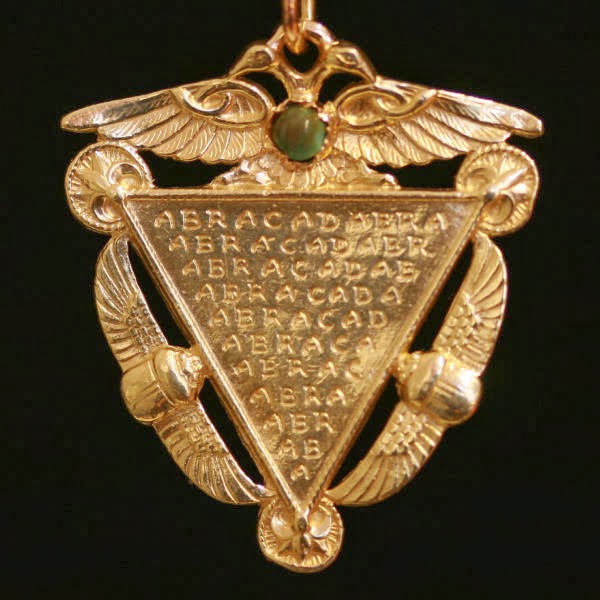
The patient, Sammonicus advises, should be given a piece of parchment, on which is written the word ABRACADABRA. Below that is written ABRACADABR. Below that is ABRACADAB. Then below that is ABRACADA. Then ABRACAD. And so it continues, line by line, until right at the bottom of the parchment is the single letter A.

Better than paracetamol

This inverted triangle of letters should be worn on a string around your neck, like an amulet, and there it’ll act like a funnel channelling the illness out of your body. In a few days, Sammonicus advises, you’ll be back to your usual self. As if by magic. 

As bizarre as all this might sound, this is actually the genuine history of abracadabra. Long before it was commandeered by second-rate magicians, abracadabra was considered a truly magical word, capable of curing ills and precipitating good fortune. But where does it and its magical powers come from? Unfortunately, no one is entirely sure. 

One theory claims it’s an Aramaic invention, in which case it might mean something along the lines of “I create as I speak”, perhaps a line stolen from some early scriptural text. Alternatively, it could be a mangled version of the Hebrew words ab (“father”), ben (“son”) and ruach acadosch (“holy spirit”). Or maybe it’s just a distortion of abecedarius, a Latin word essentially meaning “alphabetical order. Whatever the truth may be, it seems its origins are just as mysterious as its supposed magic powers.

But never mind all that. Back in Ancient Rome, you’re still unwell. So will Sammonicus’s cure actually work? Well, it’s unlikely—it’ll be another 1400 years before doctors begin routinely using quinine to cure malaria. So in the meantime, a little blind faith in an apparently magic word is probably your best hope...