_
Showing posts with label religion. Show all posts

2 July 2016

10 Words To Do With Halves - 500 Words Ep. 25

Ah, how the time flies. It seems like only yesterday HaggardHawks embarked on a series of fifty Top 10 YouTube videos, back when David Cameron was Prime Minister and the UK wasn’t being laughed at by everyone, but here we are! How. The time. Flies.

Unbelievably, we’re already at the halfway point in our series, as this week’s video—looking, appropriately enough, at the meanings and origins of 10 Words To Do With Halves—is the 25th of the 50 in the series. Ladies and gentlemen, we’re officially embarking on the home stretch...


Out of all the halves in the video, however, one word that nearly-but-didn’t make the final cut was Laodicean, a synonym (as Thomas Hardy fans will doubtless know) for half-heartedness or apathy, or else a byword for someone who is indifferent or uninterested in important matters.

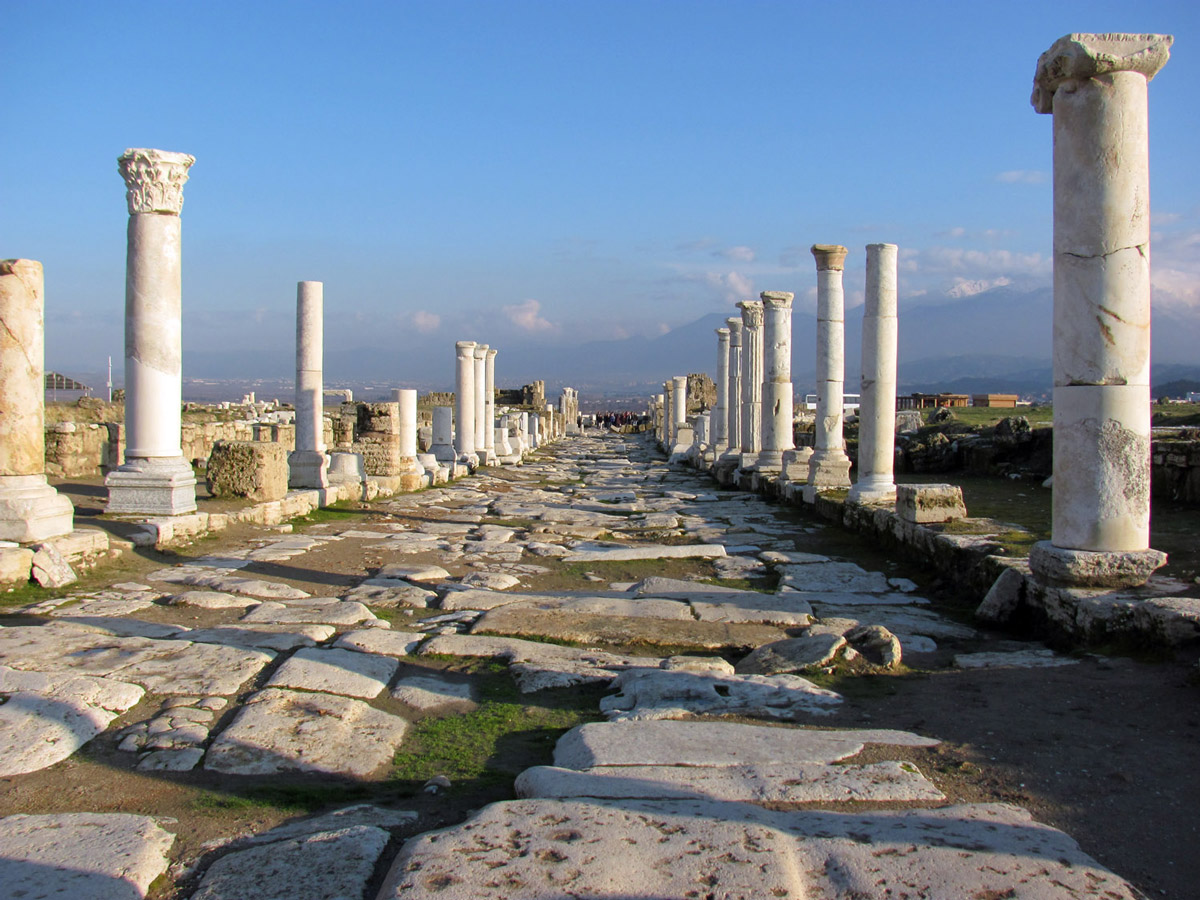
The word derives from Laodicea, a city and region of Ancient Greece now located in modern-day Turkey, whose inhabitants were notorious for their religious indifference. In the Book of Revelation, the Laodiceans were one of seven ancient peoples or Christian churches—alongside those of Ephesus, Smyrna, Pergamum, Thyateira, Sardis and Philadelphia (no, not that Philadelphia)—to whom messages were to be sent to stir them from their apathy. And in his letter to the Laodiceans, the author of the Book of Revelation John of Patmos accused them of being “neither cold not hot.”


“I would thou wert cold or hot,” he exclaimed, “so, then because thou are lukewarm, and neither hot nor cold, I will spew thee out of my mouth”. Good old John of Patmos, such a way with words.

It’s this image of someone or something being “neither cold not hot” in their opinions that led to the adjective Loadicean appearing in English in the early 1600s, as another word for a lukewarm disinterest, or apathy regarding important issues like politics and religion. Likewise, Laodiceanism is another word for unconcern or indifference—one thing John of Patmos certainly couldn’t be accused of. 


3 June 2016

10 Useful Scrabble Words


Chances are that if you like words, you’ll like Scrabble. It’s just so much fun, isn’t it? Waiting the entire game for the letter Q to come up so you can play jonquils and score 500 points, only for your opponent to get it first and play qi on a triple word square and score 501. So. Much. FUN.

Scrabble-related facts crop up on the HH Twitter feed every so often (and there’s a darn sight more where that came from in the fact book Word Drops):

And it’s Scrabble that’s the focus of this week’s HaggardHawks YouTube video—10 indispensably useful Scrabble words, from aa to oxyphenbutazone. Good luck slipping that one into your next game...


One fiendishly useful Scrabble word that didn’t make the final cut here however is euouae. According to the Guinnes Book of Records, that’s the longest vowel-only word in the English language, and is well worth remembering if you’re looking to ditch a superfluity of vowels midway through a game. That being said, there’s some contention over whether or not euouae should actually be permissible in Scrabble play—not to mention whether or not it’s actually a word or not.

The word euouae (pronounced “you-oo-ee”) is an abbreviation used to memorize the pattern of syllables forming the cadence of a Gregorian chant known as the Gloria Patri, “Glory Be to the Father”. The Gloria Patri ends with the line, “In saecula saeculorum, Amen”, literally meaning “in a century of centuries”, or “forever and ever”. Euouae refers to the pattern of tones corresponding to the last six syllables of this line: saeculorum amen.


So strictly speaking, euouae is an abbreviation of a Latin phrase used as a mnemonic device. Does that make it a “word” in the strictest (Scrabble-playing) sense? It’s a tough call, and it’s certainly true that not every dictionary—and not every Scrabble word-list—has admitted it to its pages thus far. 

But when you’re sat in front of a rack of seven vowels, you’ve really got to take what you can get…


15 April 2016

Lazy Lawrence


A long-forgotten (but no less useful) expression popped up on the HaggardHawks Twitter feed the other day:


And this isn’t the only proverbially lazy Lawrence to find his way into the dictionary. Long before lazy people had “Lawrence on their backs” there was an earlier expressionLawrence bids wages, that the OED explains was used to imply that “the attractions of idleness are tempting”—or, in other words, doing nothing looks like a lot of fun. Even Lazy Lawrence itself has been used as a nickname for an idling lazybones for centuries, as well as being the name of a mischievous fairy or sprite supposed to induce lethargy or idleness.

So apologies to anyone named Lawrence, but you’re immortalized in the language as a metaphor for laziness. Still, it’s better than being known for a one-year prison sentence or destroying gates, I suppose. But why Lawrence? And why laziness?

Well, one theory is that the connection is purely coincidence, and that Lawrence just has a nice alliterative ring to it—so this could just as easily be “Lazy Linda”, or “Leon bids wages”, or “to have Loretta Lynn on your back”. It’s certainly plausible (well, apart from the Loretta Lynn bit) but needless to say there are a couple of more imaginative explanations on offer. And one of them even involves a barbecued saint, what more could you want?

One theory is that phrases like these refer to St Lawrence’s Day, 10 August. That date puts it bang in the middle of the “dog days” at the height of the summer, when you can expect to endure the hottest, sultriest, most stifling weather of the year—the kind of weather that makes you want to lounge around and do nothing except lounging around doing nothing. The dog days are traditionally said to last anywhere from mid July to early September, and take their name from the tradition—probably started in Ancient Greece, if not Ancient Egypt—that the appearance during the summer months of Sirius, the Dog Star, just above the horizon before sunrise somehow amplified or added to the heat of the Sun. In fact, the so-called “heliacal rising” of Sirius always occurs sometime around August 10–11.


You cannot be Sirius

So is our proverbially lazy Lawrence inspired by the highest hottest heat of high summer? Possibly. But we can’t ignore the fact that there’d be no St Lawrence’s Day without St Lawrence himself. 

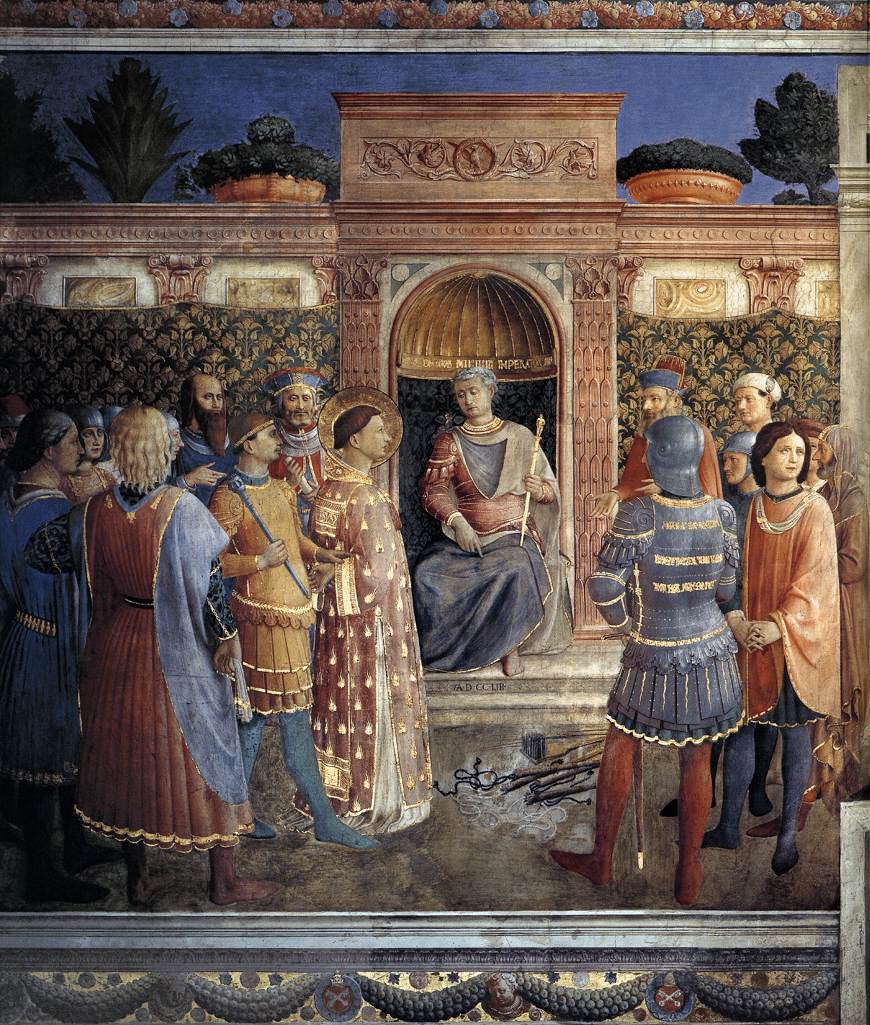
Lawrence of Rome was the highest-ranking of seven deacons that served under Pope Sixtus II in the 3rd century AD, whose job it was to oversee the church’s treasury and distribute alms to the poor. Everything was going splendidly for Lawrence until August AD258, when a letter arrived at the Senate from the Roman Emperor Valerian—who was imprisoned in Antioch, having left Rome to fight a war with the Persians—calling for all Christian senators to be stripped of their titles and assets, and for all priests, bishops and deacons to be arrested. If they renounced their faith and agreed to perform a sacrifice to the Roman gods, they would be freed. If they refused, they would be put to death. Valerian, it seems, wasn’t going to let a little thing like being held in prison 2,000 miles away stop him from running his Empire.

In accordance with Valerian’s orders, the Senate rounded up Pope Sixtus and his seven deacons. All eight refused to comply with the edict, and so, on 6 August 258, they were beheaded—all, that is, except Lawrence. As the archdeacon in charge of the treasury, Lawrence was given a three-day stay of execution to collect together all the church’s wealth and hand it over to the Roman state; instead, he reportedly spent the next three days giving as much of the money away as he could. On August 9, he returned to the Senate with a group of Rome’s poorest, sickest, neediest citizens, and boldly claimed that these were the true treasures of the church. The Prefect of Rome, frankly, was far from pleased.

Whereas Pope Sixtus and his other deacons had been beheaded, Lawrence’s singular act of defiance earned him an especially cruel death: the sentence was passed that he should be roasted to death, suspended on a gridiron above roaring fire.

Baby catching was all the rage in Ancient Rome

There’s some disagreement over whether or not Lawrence was actually burned to death in this way, because some sources claim that the Latin record of his death (assus est, “he was roasted”) should actually have read passus est, “he suffered”. But whether true or not, the question still remains—what does an early Christian martyr’s gruesome execution have to do with laziness?

Well, Lawrence’s death was so notably brutal that it soon became the subject of a macabre bit of folklore that claimed midway through his roasting Lawrence had quipped, “Turn me over, I’m done on this side!” It might sound more Groucho Marx than it does Archdeacon of Rome (and you can make your own mind up as to whether he actually said it or not), but this legend nevertheless apparently inspired a joke that Lawrence was “too lazy” to turn himself over. 

So is this the true origin of our lazy Lawrences? It’s impossible to say for sure, but it’s a good story all the same. And one well worth telling round the barbecue this summer.


25 September 2015

St Lucia

Here’s an intriguing little fact that popped up on @HaggardHawks the other day:
This is actually (shameless plug #1) one of the choicer entries cherry-picked from the Haggard Hawks fact book, Word Drops. And although (shameless plug #2) you can find out more about it (shameless plug #3) in the award-nominated book, maybe all this deserves a bit more explanation here.

On a global scale, the etymologies of country names are a bit of mixed bag. Some are so straightforward that they require no explanation at all (we’re looking at you, United Kingdom). Some are named after their inhabitants (France = “the land of the Franks”), or their colonists or conquerors (Philippines = “islands of Philip II of Spain”). Some are more descriptive (Bahamas = “the shallows”, Bahrain = “two seas”), or more poetic (Luxembourg = “little castle”, Zimbabwe = “land of stones”). And some are just plain weird (Cameroon = “land of shrimp”).

St Lucia takes its name from Lucy of Syracuse, a third-century Italian saint (the patron saint of blindness and throat infections, no less) who was martyred during the Roman Emperor Diocletian’s persecution of the Christians in AD 304. Although the reasoning behind the name is unclear, we nevertheless know that it was chosen by the island’s first European explorers and settlers, the French, who arrived there in the early 1600s—although rumour has it that the island was being used as a base by French pirates long before then. 

But according to the US Department of State, as of 2015 there are 195 countries (defined as “a people politically organized into a sovereign state with a definite territory recognized as independent”) in the world. Is it really true that only 0.51% of them are named after women? 

Unfortunately, yes—although there are a couple of very close calls.

One of the most famous almost-but-not-quites is the Republic of Ireland. Both Ireland and its Irish equivalent Éire derive from Eiru, the name of a goddess of the land and sovereignty in Celtic mythology. On a similar theme, one theory claims that Tunisia takes its name from Tanith, a Phoenician goddess of the moon who, with her husband Baal-Hammon, was the principal deity of the ancient city of Carthage.

But as far as eponymous women on our list of 195 countries go, that really is it: if we exclude all the ancient mythological and supernatural beings, St Lucia really is the only country named after a woman. Although, as a handful of astute followers noted, there is one final possibility:

St Helena is a tiny 50 square-mile volcanic island in the South Atlantic, home to around 4,500 people. It takes its name from St Helena of Constantinople (the patron saint of difficult marriages, should you need one), who was the wife of Constantinus Chlorus, ruler of the Western Roman Empire from AD 293-306. 

Can we add St Helena to our list? Well, the problem here is that St Helena is officially classed as just one-third of a British Overseas Territory known as St Helena, Ascension and Tristan da Cuhna—the collective name for a clutch of British-controlled islands in the South Atlantic Ocean. And so long as we’re limiting our list to independent countries, St Helena just doesn’t fit the bill. 

So it seems St Lucia it seems really is the only country in the world named after a woman. But, hey—it could be worse: 


22 May 2015

Friday-faced

Today’s Word of the Day over at @HaggardHawks has caused a bit of a stir:

Quite right too: Friday is the stepping stone into the weekend (and if you’re reading this in the UK, you’ve got a bank holiday weekend to look forward to as well). So why so Friday-faced?

Well, one theory suggests this comes from nothing more than Friday being a traditionally unlucky day. Among sailors and travellers, it’s long been seen as bad luck to begin a voyage on a Friday (a belief that inspired this brilliant urban myth), and likewise Friday is also seen a traditionally inauspicious day on which to be married: the name Friday derives from that of the pagan goddess of beauty and fertility, Frigga, who would apparently become spitefully jealous of any brides wed on her special day. 

But is general superstition and ill-starred folklore enough to make someone look gloomy? Probably not. Instead, Friday-faced likely derives from the fact that Friday is a traditional day of fasting, penitence, and abstinence, a religious custom born out of the fact that Jesus is said to have died on a Friday. Although today it’s a tradition most closely associated with Catholicism, abstaining on (what is now) the final day of the working week is actually quite a widespread custom


So if you’re Friday-faced, chances are you’re just hungry. But never mind—that’s what weekends are for.