_
Showing posts with label S. Show all posts

31 August 2016

10 Words With Nautical Origins - 500 Words Ep. 34


You might have spotted this little nautical fact over on Twitter the other day:


Yep, your slush fund isn’t quite as wholesome as it might sound. 

But that fact was a neat little précis to this week’s YouTube video, which is exploring the stories behind 10 words with nautical origins.


Another maritime tweet that could have made the final cut here is this one:


Which probably needs a little bit more explanation here on the blog.

So. As a stereotypically piratical exclamation of surprise or infuriation, shiver my timbers! dates back to the late eighteenth century. Although the Oxford English Dictionary credits its earliest print appearance to the English author (and friend of Charles Dickens) Frederick Marryat’s novel Jacob Faithful in 1834, earlier records have since been uncovered—including one in the script of a play, Opposition, staged in London in 1795:

Old Sailor: “Lather me!—Shiver my timbers. if so be he comes athwart me—I'll soon lower his topsails for him—Here’s King George and old England for ever!”

Oddly, the shiver of shiver my timbers! and the trembling shiver you do when cold or frightened aren’t related.

Both date back to the early Middle Ages, but of the two, shivering with cold is something of a mystery. One theory suggests it might derive from ceafl, an Old English word meaning “jaw”, and so might once have specifically referred to chattering teeth. But alas, that’s just a theory and the word’s exact origins are unknown.

The shiver of shiver my timbers! is meanwhile thought to derive from an Old German word, schever, meaning a splinter or chip of wood. That makes it an etymological cousin of words like sheave and shive, while the expression to burst or fly to shivers has been used since the fifteenth century m to mean “to break or shatter into pieces”. Shivering someone’s timbers, ultimately, alludes giving them a shock or cause for concern as terrible as the cracking or splintering of the wooden boards used to construct ships.

What isn’t known, however, is whether the (unfortunately unknown) author of Opposition made up the expression themselves, or whether—like Frederick Marryat, who served in the Royal Navy and invented the Marryat flag code used to pass messages between ships—they had naval experience and simply reused an expression he had heard elsewhere. That’s one nautical question we’ll probably never fathom out.



2 August 2016

10 Words For Other Words


If you’ve been keeping up with the HH “500 Words” YouTube series, you’ll so far have found out about 280 of the 500 words we’re going to look at this year. But this week, we’re turning things around. 

So from hypernyms and hyponyms to holonyms and holophrases, this week’s video is looking at 10 Words for Other Words.


(And for more words like those, then be sure to check out the HH article that inspired it over on Mental Floss.)

One word that didn’t make the final cut here, however, is backronym. We’ve discussed some backronyms on YouTube before—mainly in our 10 Word Origins Stories That Are Completely Untrue video—and it’s a myth-busting topic that’s always worth revisiting.

Backronyms are words or phrases that are widely and mistakenly believed purported to be acronyms. Posh, for instance, is often claimed to stand for “port out, starboard home”, a reference to moneyed cruise ship passengers paying for the best views on both the outward and homeward bound parts of their voyage. Golf too is said to stand for “gentlemen only, ladies forbidden” (or ladies do something else that begins with F). And the distress signal SOS is famously claimed to stand for “save our souls”, or “save our ship”.


“It says, ‘you may have been missold PPI.’”

None of these is true, of course. Posh is simply thought to come from an old slang word for cash or loose change. Golf is probably descended from an old Dutch word for a club, colf or kulf (albeit with perhaps some influence of a Scots word for a stout blow to the head). And the letter combination “SOS” was chosen as a distress signal for no other reason than that its rhythmic and symmetrical combination of dots and dashes [· · · – – – · · ·] is so immediately noticeable. Incidentally, precisely the same combination of dots and dashes could also be used to spell the letters “VTB” in Morse code, but the designation SOS was used because of its own symmetry and memorability.


Before SOS was adopted in the early 1900s, however, the standard telegraph distress signal was “CQD” [– · – ·    – – · –    – · ·]. It’s fair to say that that’s hardly the most recognisable or memorable arrangement of dits and dahs on offer, so why pick that?

Well, on their own the letters “CQ” had long been used as a telegraphic distress signal as they sound identical to the French word “sécu”, an abbreviation of sécurité. The Marconi Telegraph Company simply added a letter D to this to make their first recommended distress signal, CQD. But just like SOS, CQD also fell foul of backronymy and before long myths had emerged claimed that it stood for “come quickly—danger!”, or “come quickly—drowning!”

Problems with interpreting the confusing set of letters “CQD” over a poor signal, however, eventually led to calls for a more immediately recognizable distress signal to be adopted, and so SOS was officially introduced in 1906. 


25 September 2015

St Lucia

Here’s an intriguing little fact that popped up on @HaggardHawks the other day:
This is actually (shameless plug #1) one of the choicer entries cherry-picked from the Haggard Hawks fact book, Word Drops. And although (shameless plug #2) you can find out more about it (shameless plug #3) in the award-nominated book, maybe all this deserves a bit more explanation here.

On a global scale, the etymologies of country names are a bit of mixed bag. Some are so straightforward that they require no explanation at all (we’re looking at you, United Kingdom). Some are named after their inhabitants (France = “the land of the Franks”), or their colonists or conquerors (Philippines = “islands of Philip II of Spain”). Some are more descriptive (Bahamas = “the shallows”, Bahrain = “two seas”), or more poetic (Luxembourg = “little castle”, Zimbabwe = “land of stones”). And some are just plain weird (Cameroon = “land of shrimp”).

St Lucia takes its name from Lucy of Syracuse, a third-century Italian saint (the patron saint of blindness and throat infections, no less) who was martyred during the Roman Emperor Diocletian’s persecution of the Christians in AD 304. Although the reasoning behind the name is unclear, we nevertheless know that it was chosen by the island’s first European explorers and settlers, the French, who arrived there in the early 1600s—although rumour has it that the island was being used as a base by French pirates long before then. 

But according to the US Department of State, as of 2015 there are 195 countries (defined as “a people politically organized into a sovereign state with a definite territory recognized as independent”) in the world. Is it really true that only 0.51% of them are named after women? 

Unfortunately, yes—although there are a couple of very close calls.

One of the most famous almost-but-not-quites is the Republic of Ireland. Both Ireland and its Irish equivalent Éire derive from Eiru, the name of a goddess of the land and sovereignty in Celtic mythology. On a similar theme, one theory claims that Tunisia takes its name from Tanith, a Phoenician goddess of the moon who, with her husband Baal-Hammon, was the principal deity of the ancient city of Carthage.

But as far as eponymous women on our list of 195 countries go, that really is it: if we exclude all the ancient mythological and supernatural beings, St Lucia really is the only country named after a woman. Although, as a handful of astute followers noted, there is one final possibility:

St Helena is a tiny 50 square-mile volcanic island in the South Atlantic, home to around 4,500 people. It takes its name from St Helena of Constantinople (the patron saint of difficult marriages, should you need one), who was the wife of Constantinus Chlorus, ruler of the Western Roman Empire from AD 293-306. 

Can we add St Helena to our list? Well, the problem here is that St Helena is officially classed as just one-third of a British Overseas Territory known as St Helena, Ascension and Tristan da Cuhna—the collective name for a clutch of British-controlled islands in the South Atlantic Ocean. And so long as we’re limiting our list to independent countries, St Helena just doesn’t fit the bill. 

So it seems St Lucia it seems really is the only country in the world named after a woman. But, hey—it could be worse: 


25 June 2015

Smellfungus

So. The other day, we tweeted this:
It’s another one of those “seriously?” words:
HaggardHawks make something up? The very idea of it. Well, there was that one time, but that was entirely different. No—seriously, this is true. And not only that, but there’s a brilliant story behind it.

Smellfungus dates back to 1768. For once, we can be absolutely positive about the date of a word, because we know precisely who invented it, when, and why. So no need to play etymological Cluedo here—it was Laurence Sterne, in the Sentimental Journey, aided and abetted (albeit indirectly) by Tobias Smollett.

Smollett was born in Dunbartonshire in Scotland in 1721. A prolific and well-respected writer, perhaps best known for his comic novel The Adventures of Peregrine Pickle (1751), Smollett’s output covered almost every literary genre and influenced many later literary giants, including Dickens, George Eliot, and William Thackeray. Even the normally unforthcoming George Orwell wrote a glowing essay calling him “Scotland’s Best Novelist”.

Wait—what?! Had Orwell not read any Sherlock Holmes?! Disgraceful. But, I digress.

In all, Smollett’s vast back catalogue includes plays, a non-fiction History of England, several volumes of poetry, half a dozen novels, and even English translations of the likes of Voltaire and Cervantes. But in 1766, he added one more genre to his literary checklist when he published his Travels Through France And Italy, an account of a two-year journey he and his wife embarked on from spring 1763 to summer 1765. Stopping off in the likes of Paris, Nice, Cannes, Pisa, Sienna and Rome, to many it would have been the trip of a lifetime—but Smollett, by and large, remained unimpressed.

Of Florence’s magnificent San Lorenzo chapel, for instance, he wrote that it “will, in my opinion, remain a monument of ill taste and extravagance”. The Pantheon left him “much disappointed”, because “after all that has been said of it, [it] looks like a huge cockpit.” He dismissed Michelangelo’s The Last Judgement, painted behind the alter in the Sistine Chapel, as “a mere mob, without subordination, keeping or repose”, and likened it to “a number of people talking all at once”. Even the Vatican itself didn’t escape unscathed:
[Its] relicks of pretended saints, ill-proportioned spires and bellfreys, and the nauseous repetition of the figure of the cross (which is in itself a very mean and disagreeable object, only fit for the prisons of condemned criminals) have contributed to introduce a vicious taste into the external architecture, as well as in the internal ornaments of our temples.
Michelangelo’s Last Judgement: Crap, apparently

Unsurprisingly, when Smollett’s Travels were published, his fairly tactless and hypercritical attitude, as well as the disdainful way in which he wrote about many of the people he encountered (“At Brignolles … I was obliged to quarrel with the landlady and threaten to leave her house before she would indulge us with any sort of flesh-meat”), outraged his contemporaries. But his apparent arrogance and peevishness also made him a prime target for satire—which brings us to Laurence Sterne.

Sterne was born in Ireland in 1713, but spent much of his childhood in England. After graduating from Cambridge, he became the Anglican priest of a small church in rural Yorkshire where he remained for more than twenty years, dabbling in freelance writing in his spare time. In 1759, he self-published his first major work—two volumes of a vast satirical novel, The Life and Opinions of Tristram Shandy, Gentleman—and within months was one of the most famous authors in the country.

Flushed with success, Sterne quit the church and moved to London in 1760. But in the dank and dreary capital his already precarious health quickly deteriorated, so he and his wife left on a rejuvenating trip to the Mediterranean. They arrived in Montpellier in 1763—where, the following November, they were joined by Tobias Smollett.

It’s unclear exactly how much time Smollett and Sterne spent together, but a number of meetings and engagements are recorded in the letters they sent back home to England, before Smollett decided Montpellier’s cool mountain climate wasn’t for him and he continued on to Nice in early 1764. It’s also largely unclear how well the two men got along, but given what happened next, we can presume the pair hadn’t always seen eye to eye.

In 1768, in response to Smollett’s Travels, Sterne published his own Sentimental Journey Through France and Italy. Again, Sterne’s Journey was based around his own tour of the continent, but unlike Smollett his travelogue was also a part-fictionalized follow-up to his earlier novel, Tristram Shandy

Narrated by a genial English reverend named Mr Yorick (Sterne’s literary alter ego), the aptly-titled Sentimental Journey comprises a light-hearted series of comic episodes and romantic encounters, as Yorick travels down through France from Calais and on into Italy. Along the way, he meets a whole host of unusual and whimsical characters—including a glum, overcritical zoilist known only as “Smelfungus”:
The learned Smelfungus travelled from Boulogne to Paris, from Paris to Rome, and so on; but he set out with the spleen and jaundice, and every object he pass’d by was discoloured or distorted. He wrote an account of them, but ’twas nothing but the account of his miserable feelings.
Smelfungus—spelled with only one L by Sterne—is clearly a fairly unsubtle and unflattering caricature of Smollett, right down to his acerbic views on the architecture of Rome:
I met Smelfungus in the grand portico of the Pantheon—he was just coming out of it. ’Tis nothing but a huge cockpit, said he.
Unfortunately for Smollett the Sentimental Journey was an enormous success, even surpassing Tristram Shandy both critically and commercially. Nowadays it’s seen as having helped to establish travel writing as a respected literary genre in its own right—while Sterne’s acerbic lampoon of Smollett as “Smelfungus” gave the English language a whole new word for a carping, unhappy critic. 

Sadly, however, Sterne didn’t live to see any of the influence his novel would eventually have: he died just twenty days after its publication. And as for Smollett, well, his reputation as a glum, unimpressed tourist—“the most embittered and cantankerous Englishman that ever travelled abroad”, according to one account—might now be permanently installed in the language, but more recent commentators on his work have been considerably more understanding. They quite rightly point out that his Travels were written at a particularly difficult time in his life: both he and Sterne were suffering from the aftereffects of tuberculosis, and he and his wife were still reeling from the death of their only child, their 15-year-old daughter Elizabeth, the previous year.

Not only that, but modern readers who are aware of Smollett’s nit-picking are often surprised to discover how much admiration and positivity his Travels contain alongside the famously tactless criticisms. Indeed despite Smollett’s reputation, the Continent must have held some kind of attraction to him—having retired to Italy in his late 40s, he died in Livorno in 1771, and is buried in the Old English Cemetery in Tuscany.


28 February 2015

Serendipity

When we say that something is serendipitous, we mean that it’s a happy accident. Like finding some money you forgot about in a old coat. Or bumping into a friend somewhere you never normally go. Or, you know, discovering a copy of the Declaration of Independence hidden in the back of a $4 picture frame.

The word serendipity itself was coined by the English author and historian Horace Walpole, in a letter written to his friend (and distant cousin) Horace Mann on 28 January 1754. Mann had recently sent Walpole a much-prized portrait of Bianca Cappello, a sixteenth century Italian noblewomen who had married into the Medici dynasty, and while waiting for the picture to arrive Walpole had stumbled across the Cappello coat of arms in an old book. “This discovery, indeed,” he wrote, “is almost of that kind which I call Serendipity.”

But Walpole hadn’t just made the word up from thin air. Instead, he had taken it from “a silly fairy tale” he had read called The Three Princes of Serendip, whose title characters, he explained, “were always making discoveries, by accidents and sagacity, of things which they were not in quest of.” 

But neither had the fourteenth century writers of Walpole’s “silly fairy tale” invented the name Serendip. In fact, it’s an old name for Sri Lanka, and probably comes from some ancient Sanskrit word meaning “dwelling-place of lions” (although there are several rival explanations).

But if serendipity is a happy accident, what, then, can you call an unhappy accident? Like finding a spider in your old coat pocket. Or bumping into a boring workmate somewhere you never normally go. Or, you know, getting hit by a meteorite while you’re casually napping on the couch

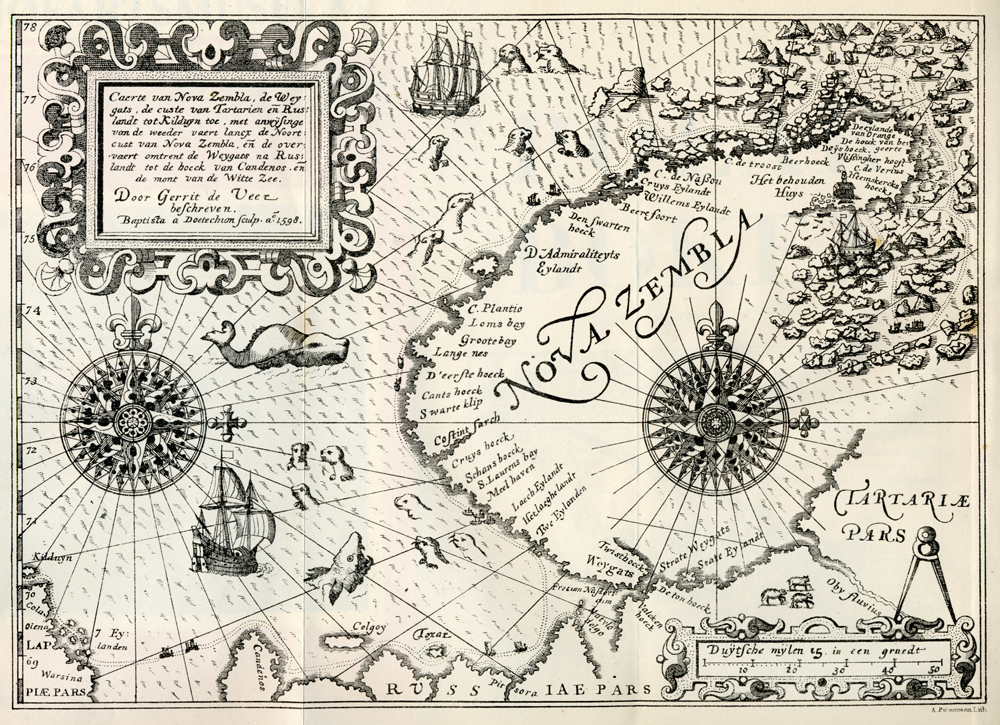
For that, we turn to the English writer William Boyd, who coined the fantastic antonym zemblanity in his 2001 novel Armadillo. Describing the practice of “making unhappy, unlucky and expected discoveries,” Boyd took the word zemblanity from the name of Novaya Zemlya, a bleak and barren Arctic archipelago in the far north of Russia that was once used as a Soviet nuclear testing site—in other words, about as far removed from a tropical island as it’s possible to be.

Novaya Zemlya. So cold even the sea monsters keep their distance.