_
Showing posts with label Greek history. Show all posts

20 July 2016

10 Words For The People You Know - 500 Words Ep. 27


You might have spotted this tweet over on the HH Twitter feed the other day:


Which, as our friends at UWG English pointed out, is probably not the most appropriate word for that kind of person…:


But what about all the other characters that we know and love and love to hate? What other words are hiding out in the dictionary to describe them?

Well, from unknowledgeable critics to penniless friends, this week’s HH YouTube instalment is looking at 10 words for precisely those kinds of people:


One word that didn’t make the final cut here, however, was zoilist:


Just as (spoiler alert if you haven’t watched the video yet...) the ultracrepidarians of this world take their name from a story from Ancient Greece, the carping zoilists have their roots in a fourth-century BC Greek grammarian and literary critic named Zoilus of Amphipolis

Born in what is now Macedonia c.400 BC, Zoilus was one of the most scathing critics of the Greek poet Homer. Despite being the author of both the Iliad and Odyssey and one of the most well respected writers of Ancient Greece, writing two cornerstones of Western literature was not enough, it seems, to impress Zoilus. 

In a long-lost essay called Homeric Questions, Zoilus challenged Homer’s portrayal of the gods, and called out a number of plot holes and inconsistencies in his works: in the Iliad, for instance, Menelaus dies in battle only to be seemingly revived to witness the death of his son several pages later. Other writers might have fallen victim to Zoilus’ criticizing glare of the years, but it was for these criticisms of Homer’s writing that Zoilus was best known—and for which he deservedly the nickname Homeromastix, the “Scourge of Homer”, among his contemporaries. 

Zoilus’s writings have not survived, and as a result it’s unclear just how harsh his criticism really was. But the enduring popularity of Homer’s works has nevertheless led to history being somewhat less kind to his harshest critic. 

Various historical accounts record that Zoilus died having been thrown from a cliff by an angry mob, stoned to death on the island of Chios, or else tossed alive on top of a funeral pyre in Smyrna. Whether any of these gruesome demises ever truly occurred is debateable, but instead it’s likely that they are all just myths and smears rooted in little more than the unpopularity of Zoilus’s opinions—but it’s precisely those opinions that led to Zoilus the zoilist earning a permanent place in the language. 


2 July 2016

10 Words To Do With Halves - 500 Words Ep. 25

Ah, how the time flies. It seems like only yesterday HaggardHawks embarked on a series of fifty Top 10 YouTube videos, back when David Cameron was Prime Minister and the UK wasn’t being laughed at by everyone, but here we are! How. The time. Flies.

Unbelievably, we’re already at the halfway point in our series, as this week’s video—looking, appropriately enough, at the meanings and origins of 10 Words To Do With Halves—is the 25th of the 50 in the series. Ladies and gentlemen, we’re officially embarking on the home stretch...


Out of all the halves in the video, however, one word that nearly-but-didn’t make the final cut was Laodicean, a synonym (as Thomas Hardy fans will doubtless know) for half-heartedness or apathy, or else a byword for someone who is indifferent or uninterested in important matters.

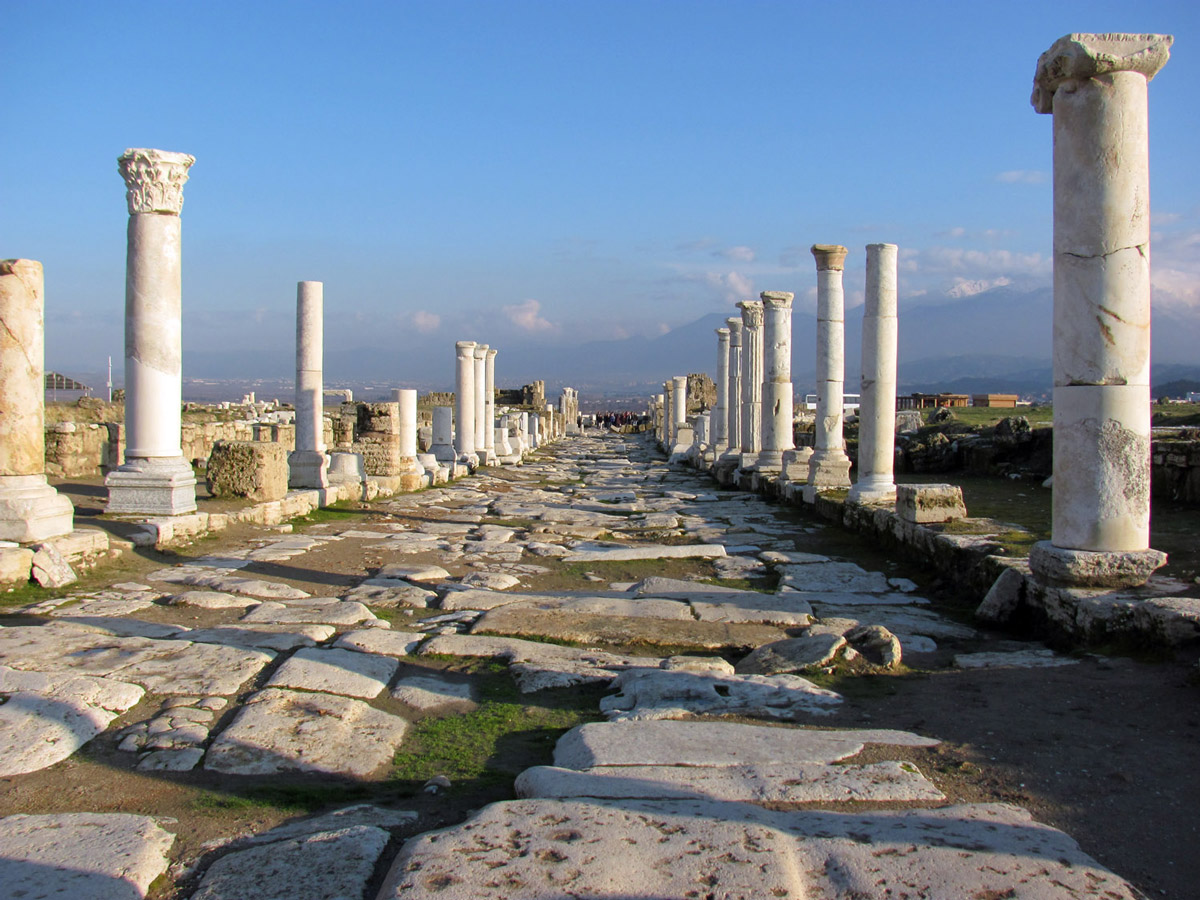
The word derives from Laodicea, a city and region of Ancient Greece now located in modern-day Turkey, whose inhabitants were notorious for their religious indifference. In the Book of Revelation, the Laodiceans were one of seven ancient peoples or Christian churches—alongside those of Ephesus, Smyrna, Pergamum, Thyateira, Sardis and Philadelphia (no, not that Philadelphia)—to whom messages were to be sent to stir them from their apathy. And in his letter to the Laodiceans, the author of the Book of Revelation John of Patmos accused them of being “neither cold not hot.”


“I would thou wert cold or hot,” he exclaimed, “so, then because thou are lukewarm, and neither hot nor cold, I will spew thee out of my mouth”. Good old John of Patmos, such a way with words.

It’s this image of someone or something being “neither cold not hot” in their opinions that led to the adjective Loadicean appearing in English in the early 1600s, as another word for a lukewarm disinterest, or apathy regarding important issues like politics and religion. Likewise, Laodiceanism is another word for unconcern or indifference—one thing John of Patmos certainly couldn’t be accused of. 


17 November 2015

Hyperborean

An intriguing word cropped up on @HaggardHawks the other day:


Which raised this equally intriguing question:

And that equally intriguing question has an equally intriguing answer.

Etymologically, the hyper– of hyperborean is the Greek word for “above” or “over”, as in words like hyperbole, hyperglycaemia and hyperventilate. The borean part simply means “northern” (as in aurora borealis), and it derives from the name of Boreas, the god of the north wind in Greek mythology.


To the Ancient Greeks, consequently, the adjective hyperborean referred to anyone or anything who lived or came from the land “beyond the north wind”—but we can be even more specific than that.

According to Homer’s Iliad, the god Boreas inhabited Thrace, a region in the far northeast of Greece on the Black Sea that today also covers parts of modern-day Bulgaria and Turkey. And beyond Thrace supposedly lay a legendary utopian land known to the Greeks as Hyperborea. There, there was no disease nor famine, and no one ever aged or fell ill. It was a land of utmost perfection, where the sun shone perpetually, twenty-four hours a day. (And where, presumably, everyone had very thick curtains.)

The fact that Hyperborea was a land of perpetual sunlight has led some classicists to believe that it might have been at least in part inspired by stories of the Arctic summer, but it is just as likely that it was a purely fictional invention and nothing more. The Greek poet Pindar, for instance, once wrote that Hyperborea could be reached “neither by ship nor by foot”.

Whether based on a real place or not, it was this mythical land that was the original “extreme north”: the adjective hyperborean originally referred to anyone who dwelt in or came from Hyperborea, and hence came from “above” or “beyond” Thrace. Over time, however, the use of the word became less restrictive and more figurative, and since the early 1600s writers in English have been using it more loosely to refer to anything or anyone of the far north.


12 November 2015

Peripatetic

A pretty perfect P-word popped up on Haggard Hawks the other day:
Which raised this perceptively prompt post-script:
Actually, it’s the other way around. According to the OED (which labels this an “obsolete nonse-word”) the poet Robert Southey coined the word peripateticate in 1793, basing it on the much earlier fifteenth century adjective peripatetic

Nowadays of course you’re most likely to come across the word peripatetic in reference to itinerant or part-time jobs (and in particularly teaching positions) that involve moving from one location to another. But originally it was a noun: spelled with a capital P, a Peripatetic is a follower or advocate of the Ancient Greek philosopher Aristotle. So how the devil are these two meanings connected?

Etymologically, peripatetic brings together two Greek roots: peri, meaning “around” or “about” (as in perimeter and periphery), and pateo, a Greek verb meaning “to walk”, “tread”, or “trample” (which is a distant relative of the word path). So peripatetic literally means “walking around,” and hence peripateticate means “to walk about on foot”.

As for Aristotle, well, if there’s one thing he liked it was a good old cogitate. And what better to do while you’re quietly cogitating to yourself than to wander around a beautiful classical Greek garden, like that at Aristotle’s Lyceum?


The Lyceum: Good for cogitating, less good if it rains
At The Lyceum—the sports-ground-cum-scholarly-gymnasium used as a meeting point and debating area—Aristotle reportedly had a habit of horbgorbling his way around the porticos, corridors, and gardens while he taught his lessons and debated with students, which earned him and his followers the nickname Peripatetikos (literally “given to walking about”). And so when the word Peripatetic first appeared in English in the mid-1400s, it referred exclusively to Aristotelian beliefs and techniques.

Later writers—Southey included—eventually commandeered this word, and used it in more literal senses to mean “a person who wanders”, “an itinerant peddler”, and ultimately “someone who works in various locations”. Not only that, but the plural peripatetics can been used to mean “movements”, “journeys”, or “wanderings”, and Charles Dickens being Charles Dickens, he of course had to go one better and use it in a figurative sense to mean “rambling” or “long-winded”, as he did in Our Mutual Friend in 1865.

But now it’s time to participate in a prompt peripatetication of my own. Aristotle would be pleased as punch. 


9 July 2015

Britain

It’s easy to forget that place names—just like surnames, first names, months of the year, and all other proper nouns—are still only words, and as such have their own histories and etymologies. We’ve mentioned quite a few of these before on the @HaggardHawks Twitter feed, from “the wooden temple” in central Asia to the original “white house” in north Africa, to America’s “place of the wild onion” and “the best place to grow potatoes”.

Unfortunately, because place names tend to be particularly ancient, their precise origins and meanings are often very tricky to pin down. Shortfalls and inconsistencies in what little historical evidence is available mean there’s often just as much conjecture and guesswork involved as there is hard fact, and even then some names defy all attempts to explain them. 

For instance, despite being one of the most famous cities in the world, no one really knows what “London” means. Instead, theories range from the relatively sensible—perhaps a long-forgotten Welsh word, meaning something like “river-fort” (llyn-din), or “pool on the river” (llyn-dain)—to the downright bizarre, with one idea even suggesting some kind of reference to Luna, the Roman goddess of the Moon. (Shameless plus: there’s more on that in the new book…)

We tweeted another bizarre place name origin a few weeks ago:
And, well, we thought it might need a bit more explaining.

So. The earliest written record of “Britain” that we know about comes from an Ancient Greek explorer and adventurer named Pytheas of Massalia. Sometime around 325BC, Pytheas circumnavigated and explored the entire British Isles, probably becoming the first person in history to do so. He also travelled high enough into northern Europe to describe the Midnight Sun (probably becoming the first person to do so); crossed the Arctic Circle and spotted the outer fringes of the great northern icecap (probably becoming the first person to do so); and was the first explorer from Mediterranean Europe to reach the Baltic Sea by boat. He was, it’s fair to say, a bit of a dude.

Pytheas’s accounts of his journeys were among the most celebrated geographical texts in antiquity, but unfortunately all of his original writings have long since been lost. Everything we know about his travels now comes from the smattering of quotes, extracts, and discussions that later writers and historians—including the great Roman naturalist Pliny the Elder, who keeps cropping up on here—included in their work. But what has survived is Pytheas’s early use of the word “Britain”, which he recorded more than 2,300 years ago as “Bretannike.

At the time of Pytheas’s visit, Britain would still have been a hodgepodge of different Celtic and pre-Roman tribes and languages. In the far north and west, however, two increasingly dissimilar branches of the ancient Celtic language family were starting to take shape: Goidelic, or “Q-Celtic”, in the far north and northwest (which eventually gave rise to Irish, Manx and Scots Gaelic), and Brythonic, or “P-Celtic”, in the west and southwest (which eventually gave us Welsh, Cornish and Breton). 

The nicknames “P” and “Q” refer to the fact that Brythonic Celtic tended to develop a p sound where Goidelic Celtic tended to have a hard q or k sound, and vice versa. We’re dealing with impossibly ancient words here, of course, but you don’t have to look too far to find evidence that this change took place: pick up an atlas or a road map of the British Isles, and you’ll find Pentire, a peninsula on the north coast of Cornwall, and Kintyre, a peninsula in southwest Scotland. Both names literally mean “headland”; both derive from P-Celtic (penn) and Q-Celtic (keann) words meaning “head”; and both are practically identical, except for their initial p and k sounds. 

But anyway, back to Pytheas. Based on linguistic evidence like this—and based on what little we know of Pytheas’s route—it’s thought that his “Bretannike” must be derived from some early Brythonic or “P-Celtic” word, suggesting that the people he learned it from originated somewhere around modern-day Wales or southwest England. We can only guess at what this original root word might have been, but from what we know about the Celtic languages, the consensus among etymologists and toponymists (that’s place name researchers to you and me) is that its closest modern descendant is probably an old Welsh word, prŷd, essentially meaning “form”, “image”, or “countenance”. 

If this presumption is correct, then the ancient Britons would quite literally have been “the people of the forms”, which, it’s again presumed, is an apparent reference to their supposed fondness for war paint and tribal tattoos. There are, admittedly, several rivalling theories here—and historians are undecided about whether these Iron Age Britons tattooed each other or not—but, etymologically at least, there is a strong argument to suggest Britain is quite literally the home of the “tattooed people”.


And, appropriately enough, Britain is now apparently the most tattooed nation in Europe. Everything really does come full circle. 


_______________________________

Hat tips to David Willbe (@DavidWillbe) and Dr Matt Lodder (@mattlodder) for links to the historical arguments for and against Pictish tattoos. Tatt you very much. (Sorry...) 

24 June 2015

Archipelago

Earlier this week, HaggardHawks tweeted this:
Aside from giving us the chance to tweet that fantastic NASA spaceshot, again this is one of those weird facts that almost sounds too strange to be true:
“Infuriatingly interesting” might just be the finest compliment we’ve ever received. But our blushes aside—this factoid is indeed completely genuine. And here’s why.

The arch– of archipelago is the same as in words like archangel and archbishop: derived from the Greek word archos, it essentially means “ruler”, “chief”, or “first and foremost”. It’s also the same arch– we have in words like patriarch (in the sense of a “ruling” father, or an earliest ancestor), anarachy (literally “without a leader”), and even archaeology (which is the study, quite literally, of our “first” artefacts).

The –pelago part, meanwhile, comes from the Greek word for the sea, pelagos, which is similarly the origin of a whole bunch of fairly esoteric geographical terms like bathypelagic. Put these two halves together, and you end up with a word that literally means something like “chief sea”.

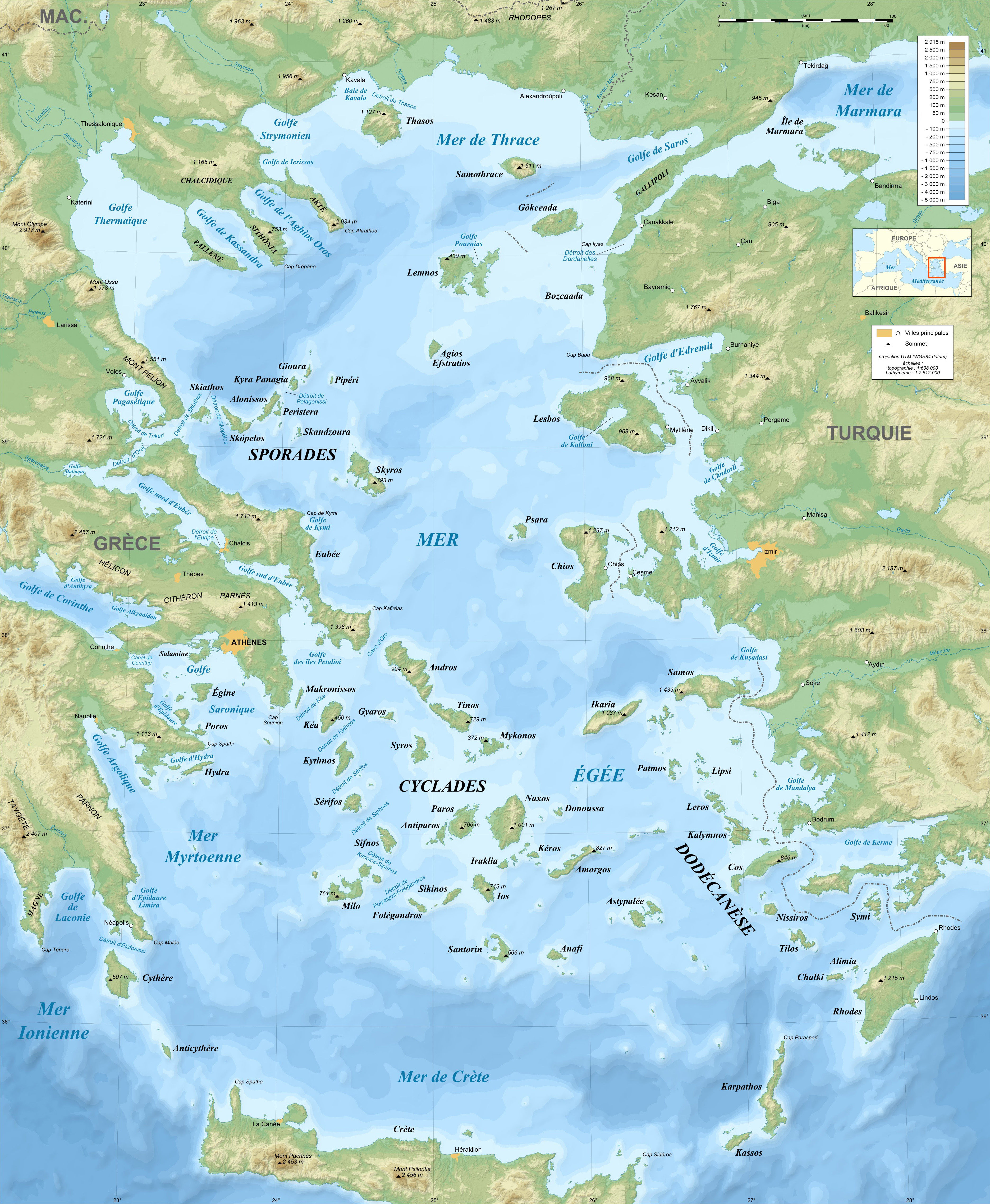
The Aegean was (for obvious geographical reasons) the “chief” sea of the Ancient Greeks, so (for obvious etymological reasons) the word archipelago simply began life as another name for it. This was also the meaning that the word had when it first appeared in English back in 1503—but how did we get from there to the meaning we have today?

If you know your European geography, you’ll know that the Aegean Sea is absolutely full of islands. Well, not exactly full, because then there’d be no water. But there are, nevertheless, quite a few of them:


In fact, from the Adelfoi group in the west to the tiny rocky outcrop of Zourafa, there are almost 2,500 islands in the Aegean Sea that together form one-eighth of Greece’s entire land area and are home to one-seventh of the Greek population. So, yes—that’s a lot of islands. And explorers in the sixteenth century knew it.

Thanks to the Aegean’s notably island-studded appearance on maps and navigational charts, when ever more daring journeys of exploration began to be made in the 1500s and 1600s, its name, archipelago, began to be used as a byword for any newly-discovered patch of water that likewise appeared full of islands. 

So when the English explorer Martin Frobisher’s third voyage to uncover the Northwest Passage in 1578 led him into the frozen, island-strewn Canadian Arctic, his lieutenant George Best (no, not that George Best), appropriately noted that:
These broken landes and ilandes, being very many in number, do seeme to make there an Archipelagus, which as they all differ in greatnesse, forme, and fashion, one from another, so are they in goodnesse, couloure, and soyle [soil] muche unlike.
By the 1600s, however, this meaning had altered so that archipelago no longer referred to an island-strewn stretch of water, but to the islands themselves—as in this English translation of the Portuguese explorer Fernão Mendes Pinto’s journey to southeast Asia:
For then he might have means, with less charge, to shut up the Straights of Cincapura [Singapore] … and so stop our Ships from passing to the Seas of China … and the Molucques; whereby he might have the profit of all the Drugs which came from that great Archipelague.
Pinto’s account was translated into English in 1633, and the meaning of archipelago his remained unchanged ever since. 


30 May 2015

Amethyst

Once upon a time, Bacchus, the louche Greek god of wine and debauchery, was pursuing a fair young maiden named Amethyste, who had caught his beer-goggled eye. Amethyste, however, was sober as a judge and had no intention of giving in to Bacchus’s bleary advances, so she fell to her knees and prayed to the gods themselves to keep her chaste. 

The gods, in their infinite wisdom, responded by keeping Amethyste safe in the only sensible way they knew how—namely by transforming her into a large slab of white quartz. (This is fiction, remember.) 

But Bacchus had had such a skinful back at the grape harvest that even a bare slab of white quartz still looked pretty alluring, so in one final attempt to woo Amethyste—and in a perfect demonstration of the kind of thinking that seems utterly logical when you’re drunk—he poured his wine all over the quartz. 

Unfortunately that had no effect at all other than to stain the quartz a deep, rich purple colour, and he was forced to retire, frustrated and unsatisfied. Amethyste’s chastity, meanwhile, remained in tact. (Well, it would do wouldn’t it, because she was now made entirely of quartz.) But, anyway—THE END.

The story of Bacchus and Amethyste, of which this is a fairly accurate précis, was written in the sixteenth century by the French Renaissance poet Rémy Belleau. Although Bellaeu’s tale is not an original Greek myth, it’s nevertheless inspired by an Ancient Greek belief that amethyst stones could prevent drunkenness; drinking from a cup made from or decorated with amethyst, you would simply never get drunk. 


I could have done with one of these at New Year

This peculiar belief was even reflected in the word amethyst itself:
Etymologically, amethyst comes from the Greek word amethystos, which is in turn based around the Greek word for “wine”, methys. The initial a– of amethyst is a negative- or opposite-forming suffix (like un- or non- in English today), and so altogether amethyst effectively means “not drunk” or “not intoxicated”.

But where did this superstition come from? Well, admittedly, no one is entirely sure, but it’s probably the amethyst’s rich, wine-like purple colour that first led to its association with booze, and from there it’s just a quick hop, stagger and jump to the idea that such a dazzling precious stone could have corresponding magic powers. 

Versions of this superstition are found dotted throughout Greek literature, with even Plato seeming to get in on the act in one of his Epigrams:
The stone is an amethyst: but I, the tippler Dionysus, say, “Let it either persuade me to be sober, or let it learn to get drunk.”
But even by the days of the great Roman scholar Pliny the Elder, this idea was already ancient history: in his Natural History, Pliny dismissively states that “the falsehoods of the magicians would persuade us that these stones are preventative of inebriety.” After all, it’s an easy enough hypothesis to test out. And here at HaggardHawks HQ, we’d be more than happy to volunteer.