_
Showing posts with label Chaucer. Show all posts

19 August 2016

10 Words That Sound Rude (But Really Aren’t) - 500 Words Ep. 32


A few days ago, HH tweeted this:


It’s one of those words that, if you’re not careful, could be taken in a very, very questionable direction. But there are plenty of words that don’t even have to be mispronounced to raise eyebrows—they’re just straight-up dirty. Or, at least, that’s how it might seem.


Peniaphobia, for instance, is nothing more than the fear of poverty and destitution. Pissasphalt is a type of bitumen. A tittynope is a crumb or portion of something, left over after all the rest has been used. A cockchafer is a beetle. A cock-bell an icicle. In fact, whether you’re talking about assart or spunk-water (you can thank Tom Sawyer for that one), there are quite a few words in the English language that sound rude, but really—genuinely—aren’t.

So brace yourselves, because it’s 10 of those that are the subject of this week’s YouTube video:


If you haven’t had your fill, there are nearly 100 words like these for your perusal over on Mental Floss, any one of which could have made the final cut here. One word that didn’t, however, and that perhaps needs a little more explanation, is this:


The key to this word (and others like it) is that sluttish originally meant just “untidy” or “slovenly”, while labelling someone (of either sex—Chaucer describes a man as sluttish in the Canterbury Tales) as a slut once simply implied that they were messy or disorganised.

But by the end of the fifteenth century that meaning had begun to broaden. Now it was people’s characters and morals—and, wholly unfairly, women’s morals in particular—that were being described as sluttish, if they were loose or disreputable, and it’s from there that the word’s modern connotations eventually emerged.


The older use of slut and sluttish to mean “untidy” survived right through to the early 1900s, giving the word coverslut more than enough time to emerge in the language in the mid-1600s. Essentially, it referred to nothing more than a garment warn to disguise untidy clothes underneath, or to protect your clothes from messy work or chores. So despite appearances, it was really nothing more than an apron.


5 August 2016

10 Rhymable Unrhymable Words - 500 Words Ep. 30


A little while ago, this fact cropped up on the HH Twitter feed:


It ended up sparking quite a debate about whether carpet actually did have a rhyme, with everything from trumpet to market thrown into the mix. But, no. Seriously. Nothing rhymes with carpet. And nor does nothing, for that matter. In fact nothing rhymes with nothing either (depending on your accent, of course), but at the risk of tumbling into existential vortex, let’s just move on. 

Rhymes—and in particular words that purport not have any rhymes but actually do—are the focus of this week’s YouTube video, the 30th in the 500 Words series we’re running every week this year:


But following on both from this week’s episode, and from the misnomers episode from a couple of weeks back, one question we want to answer: what came first, orange or oranges? (Shameless plug: there’s more on this in the HH factbook, Word Drops—which is now available Stateside too…)

Chicken-and-egg language questions like this crop up on HH every so often (case in point below), but what about orange vs. oranges?


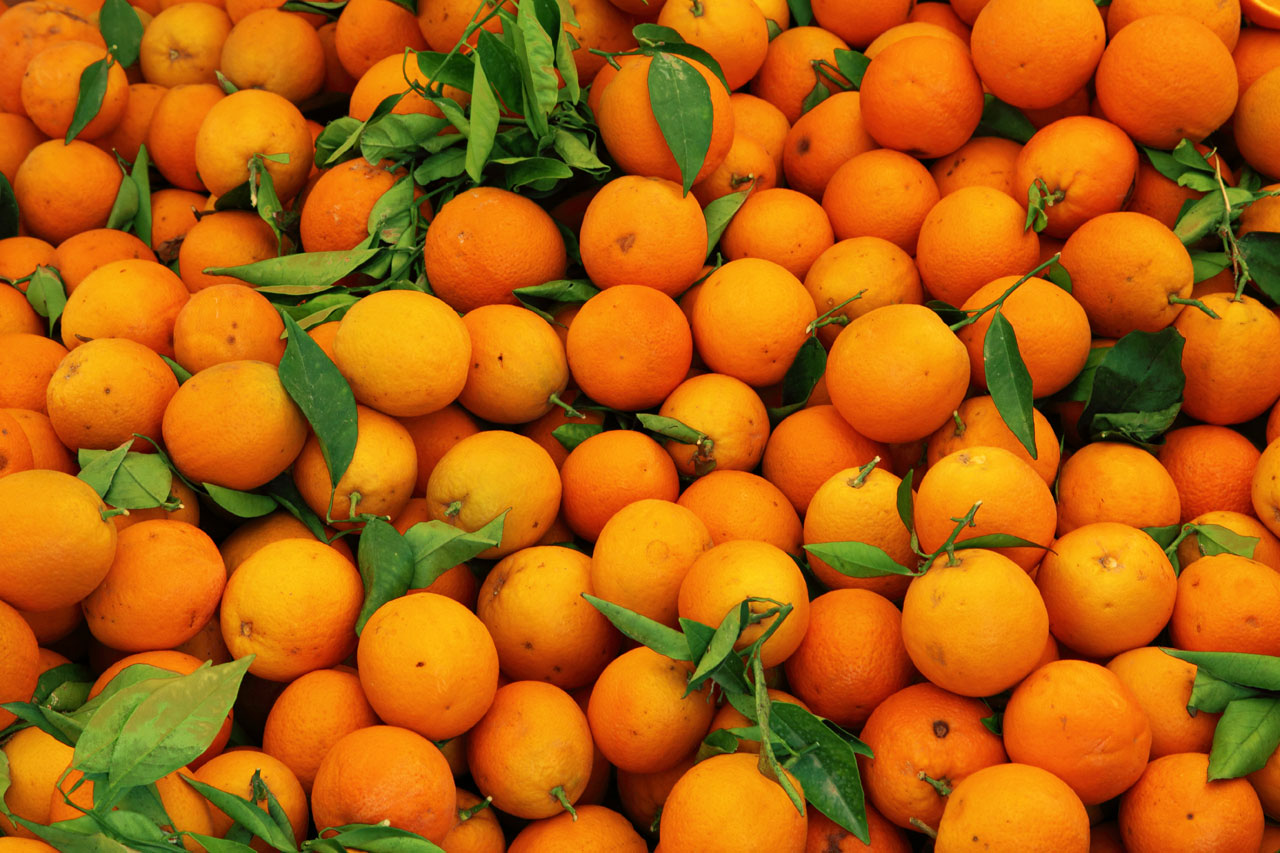
Well, the fact is that there was no word for the colour orange in the English language until oranges first began to be imported into England with any regularity in the early Middle Ages. Before then, anything orange coloured simply had to be described in terms of red and yellow, as in this description of a fox from Chaucer’s Nun’s Priest’s Tale:

His colour was bitwixe yelow and reed, 
And tipped was his tayl and both his eeris 

[His colour was between yellow and red, 
and tipped was his tail and both ears.]

The earliest record of the word orange—which derives at length from the Sanskrit word for the orange tree, naranga—comes from the Sinonoma Bartholomei, a fourteenth century Latin herbal, which listed all the plants known to have medical applications. And there, on page 15, “orenge” was listed as the English equivalent of the Latin “Citrangulum pomum”, or “citrus fruit”.

The colour orange didn’t appear until around a century and a half later. In 1557, orange cloth was listed in a legal document, collected in the so-called Statutes at Large in the late sixteenth century, that prohibited the selling of all fabrics except those of a certain set of colours:

And moreover, be it enacted by the authority aforesaid that no person nor persons … shall sell or put to sale within the realm of England any coloured cloth of any other colour or colours than are hereafter mentioned, that is to say, scarlet, red, crimson, morrey, violet, pewke, brown, blue, black, green, yellow, blue, orange, tawny, russet, marble grey, sad new colour, azure watchet, sheeps colour, lion colour, motly, iron grey, friers grey, crane colour, purple, and old medley colour, most commonly used to be made above and before twenty years past.

Thank goodness “sheeps colour” made the final cut, frankly. And same goes for the “sad new colour”, otherwise I’d have nothing left to wear. But Chaucer’s foxes and sartorial rules and regulations aside, it’s clear that in this particular chicken-and-egg situation, it was the chicken that came first: the bright orange fruits gave the colour orange its name, not vice versa

All in all, it’s a colourful little story. 


8 June 2016

10 Colour Names

A few weeks ago, this intriguing factoid popped up on the HH Twitter feed:


It’s an interesting story, which we touched on again in this week’s YouTube video, all to do with the names and etymologies of 10 colours—including the perfect word to describe the perfect colour of a perfectly ripe banana (spoiler alert: it’s not yellow), to the reason why magenta is called magenta, and what connects a Tudor folk dance to a bowl of porridge and to a pile of goose droppings. Truly, it’s an embarrassment of riches.


But back to oranges. Yes, that fact above is completely true: the earliest record of an orange in the English language comes from the early 1400s; the earliest record of something being described as orange in colour, dates from as relatively recently as 1557. But things have been orange coloured since—well, forever. 

Take foxes, for instance. They and their orangey-brown fur have been around ever so slightly longer than the English language (a few hundred thousand years, give or take), which meant that writers in pre-orange-importing times had to get creative when it came to describing what colour they were. As in this line, from Chaucer’s Nun’s Priest’s Tale:

His colour was bitwixe yelow and reed,
And tipped was his tayl and both his eeris 
With blak, unlyk the remenant of hise heeris;
His snowte smal, with glowynge eyen tweye.
 
  
[His colour was between yellow and red,
And tipped was his tail and both his ears
With black, unlike the remainder of his hair;
His snout small, with two glowing eyes.]
With no word for the colour orange, Chaucer—writing in the 1390s—had to resort to describing the fox in terms of yellow and red. And things stayed like that for another century-and-a-half, until a connection between the colour orange and it’s corresponding fruit was made, and the English language finally gained a separate name for the second colour of the rainbow. (Shameless plug #4,229: there’s more on this in the HH factbook, Word Drops.)

So that’s that. But, just when you think English and it’s colours are all sorted, you find out this:


17 March 2016

I, Part II

Last year on the HaggardHawks blog, we looked at why the lower-case letter i—and its alphabetical cousin j, for that matter—has a dot above it. Turns out it had something to do with stopping intelligent people being mistaken for their knees. But this week in our noticeably infrequent series of Questions About The Language You Never Even Thought About, we’re posing another I-related conundrum: why do we capitalize the pronoun I?

After all, none of the other English pronouns—including all the other first person pronouns, like me, mine, my and myself—is capitalized, unless you happen to be God or He Who Should Not Be Named. Nor was I’s ancestor, the Old English word ic, written with an uppercase letter. And the translated equivalent of I in most other languages is usually left in lowercase, like the French je, Spanish yo, Italian io, and German ich.


Speaking of German, it of course capitalizes all of its nouns, like Mann and Frau, Apfel and Orange, Kapitalbuchstaben and Kleinbuchstaben. That’s something that English reserves only for its proper nouns (John Smith, Australia, the Cabinet, Sister Act), unless you happen to have some kind of point-making rhetorical effect in mind, as in “He doesn’t just think he’s the bee’s knees, he thinks he’s The Bee’s Knees”.

German does however capitalize the formal form of its second person pronoun, Sie, “you”, along with all its derivate case forms like Ihr, “your”. That’s part of a linguistic phenomenon known as the T-V Distinction, which has nothing to do with how much better than terrestrial television Netflix is, but rather the way in which some languages like to show polite respect by altering the pronouns used to refer to people you don’t know very well or hold in high regard. It’s the same reason why French speakers will politely ask you to respondez s’il vous plaît, unless they know you particularly well (in which case résponds s’il te plaît will do just fine). Same goes for voulez-vous coucher avec moi, çe soir, but you really shouldn’t be saying that to someone you don’t hold in high regard.


So is this what’s happening in English? Do we think so highly of ourselves that we’ve grown accustomed to capitalizing our first person pronoun? Some etymologists have suggested so, and have even theorized that there’s a latently egocentric, psychological reason behind uppercase I. But if that’s the case, why hasn’t that filtered down to the likes of me and myself, or we and ourselves? And why is it only English speakers who are self-centred enough to capitalize ourselves while other languages are not? Don’t answer that.

So perhaps there’s something more pragmatic going on. An alternative theory claims that because the pronoun I occurs so frequently in sentence-first position, it’s only natural that it would eventually become capitalized. It’s a plausible idea, but does I really occur enough times in sentence-initial position to permanently alter its form in every other context? And again, why hasn’t the same thing happened to all the other pronouns?

Instead the most likely explanation of how we ended up with capital I is a surprisingly practical one, instigated by the fact that around the time capital-I first began to appear in English texts—in the Middle English period, roughly 700-800 years ago, so Chaucer’s Canterbury Tales provides much of its early evidence—there was a phonological change also taking place.

At that time, many dialects of English were busy reducing the Old English word for Iic or ich, which was pronounced a bit like “itch” but without the T—to a single “i” sound, making the Cs and Hs normally used to spell it no longer necessary. In written English, however, a single lowercase letter i can look a little lost on its own, and in a densely handwritten document it’s easy to imagine just how easily a solitary pint-sized stroke, even with or without its dot, might be misread, overlooked, or even dismissed as a smudge or dash.

As a result, early Middle English scribes began making their single letter Is a little bigger, so that they could stand a little prouder and little more robust on the line of text. And over time, that became the standard and gave us the pronoun capital I. And that’s The Truth—or at least, the Best Theory We Have.