_
Showing posts with label politics. Show all posts

2 July 2016

10 Words To Do With Halves - 500 Words Ep. 25

Ah, how the time flies. It seems like only yesterday HaggardHawks embarked on a series of fifty Top 10 YouTube videos, back when David Cameron was Prime Minister and the UK wasn’t being laughed at by everyone, but here we are! How. The time. Flies.

Unbelievably, we’re already at the halfway point in our series, as this week’s video—looking, appropriately enough, at the meanings and origins of 10 Words To Do With Halves—is the 25th of the 50 in the series. Ladies and gentlemen, we’re officially embarking on the home stretch...


Out of all the halves in the video, however, one word that nearly-but-didn’t make the final cut was Laodicean, a synonym (as Thomas Hardy fans will doubtless know) for half-heartedness or apathy, or else a byword for someone who is indifferent or uninterested in important matters.

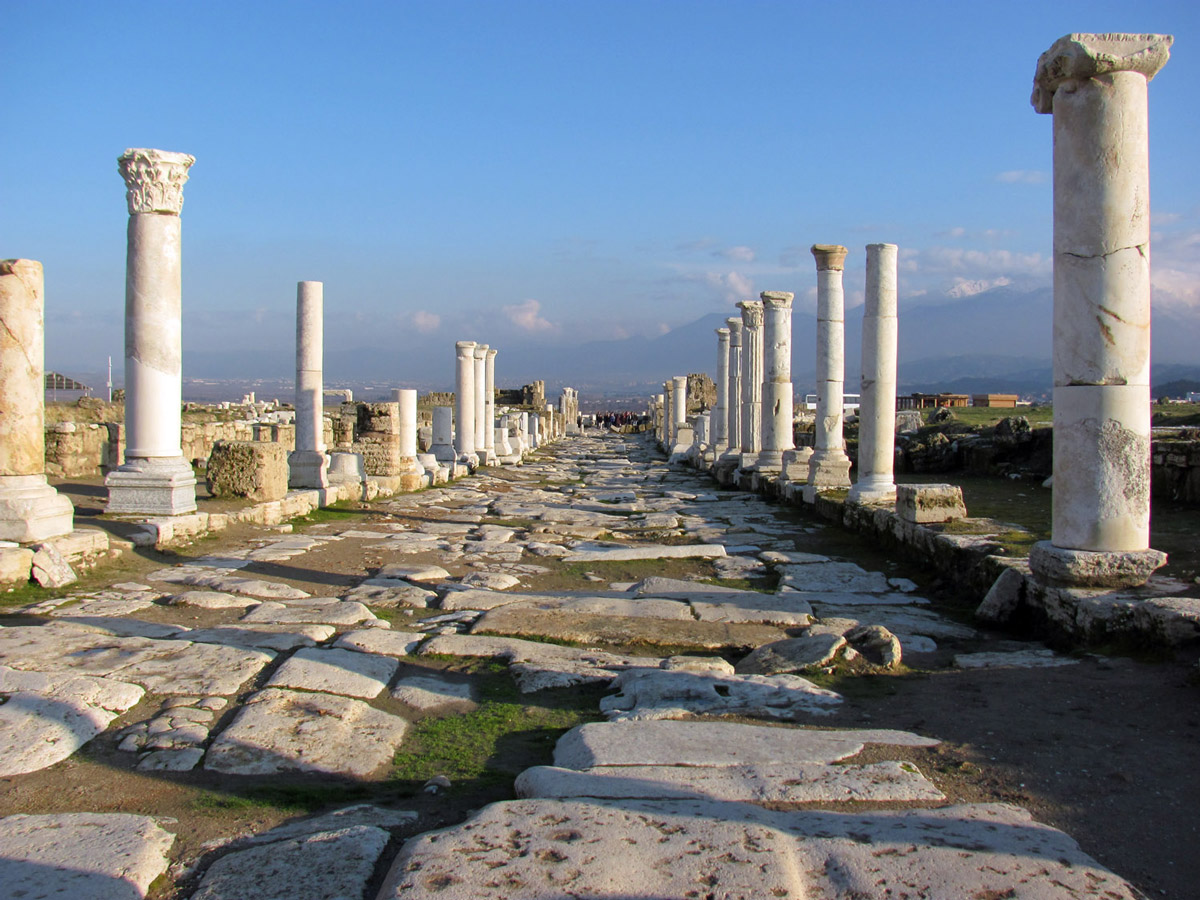
The word derives from Laodicea, a city and region of Ancient Greece now located in modern-day Turkey, whose inhabitants were notorious for their religious indifference. In the Book of Revelation, the Laodiceans were one of seven ancient peoples or Christian churches—alongside those of Ephesus, Smyrna, Pergamum, Thyateira, Sardis and Philadelphia (no, not that Philadelphia)—to whom messages were to be sent to stir them from their apathy. And in his letter to the Laodiceans, the author of the Book of Revelation John of Patmos accused them of being “neither cold not hot.”


“I would thou wert cold or hot,” he exclaimed, “so, then because thou are lukewarm, and neither hot nor cold, I will spew thee out of my mouth”. Good old John of Patmos, such a way with words.

It’s this image of someone or something being “neither cold not hot” in their opinions that led to the adjective Loadicean appearing in English in the early 1600s, as another word for a lukewarm disinterest, or apathy regarding important issues like politics and religion. Likewise, Laodiceanism is another word for unconcern or indifference—one thing John of Patmos certainly couldn’t be accused of. 


14 April 2016

10 Words From Johnson’s Dictionary


The great Samuel Johnson’s Dictionary of the English Language was first published 261 years ago today, on 15 April 1755. Its two volumes defined a total of 42,773 words, illustrated by 114,000 literary quotations (the majority from Shakespeare), and unlike dictionaries today, it was infused throughout with Johnson’s own personality and humour. 

Words that he personally disliked or thought unimportant were omitted (so out went recent French loanwords like champagne and bourgeois), as was the letter X, which he bluntly explained in a note on page 2,308 “begins no word in the English language.” The definitions too were full of Johnson’s wit and wisdom:


And who, of course, could forget this:


Or, indeed, this:


Johnson was paid the princely sum of 1,500 guineas (equivalent to more than £200,000 today) to compile the work, which he did so single-handedly over nine years, with assistants only ever brought in to reproduce pages and copy out quotations. It was, frankly, a monumental achievement and remained the standard English dictionary for the next 150 years.

So in honour of the anniversary of Johnson’s wonderful contribution to our language, this week on the HH YouTube channel we’ve picked 10 long-forgotten words from his dictionary that deserve to be revived:


As explained in the video, that doesn’t mean that Johnson is personally responsible for coining these words (although it’s thought that a number of his entries were his own invention), nor that his dictionary provides us with their earliest written record. Instead, these are just words that were included in his Dictionary but which have long since disappeared from the language—and more than deserve to be recovered.


17 March 2016

10 Words Derived From Irish

March 17 is St Patrick’s Day, so in honour of that this week on the HaggardHawks YouTube channel we’re looking at 10 Words Derived From Irish.

A full list of words the English language owes to Irish would range from the fairly obvious (leprechaun, banshee) to the fairly surprising (trousers, Tory, slob), with a few etymological question marks thrown in for good measure. One of these is hooligan, which we’ve looked at on the blog before, and another, which we’ve included in the video, is kibosh.

People have been bringing things to a halt by putting the kibosh on them since the early nineteenth century. Although we’ve included it here in our list of ten Irish words, the theory that it derives from an old Irish expression, caidhpín bháis, for an judge’s black “cap of death” is by no means conclusive—competing theories variously attribute the word to everything from Yiddish to Scots, while others suggest it is and always has been a purely English word.

So if not derived from Irish, why do we put the kibosh on things? Well one theory is that the ki- of kibosh is the same as in words like kersplash! and kaboom!—in other words, it’s just there to emphasise the “bosh” (i.e. the stout hit or blow) that comes after it. Or perhaps kibosh is derived from an even earlier sound-alike, like caboshed (a heraldic term for an animal shown on a coat of arms from the neck up only), kye-boots (a Scots English word for a dairy cow’s shackles), or even courbache (the French name for an Arabian rhinoceros-hide horsewhip). Or maybe it’s from the Yiddish word for “eighteen coins”, which might once have been a slang word for a throwaway amount of money? (Shameless plug: there’s a bit more on that in the HaggardHawks factbook...)

In truth, etymologists aren’t entire surely, but we’re signing up to the Irish theory here—alongside nine other fascinating Irish etymologies… 


31 July 2015

Rebecca

Yesterday, HaggardHawks tweeted this fairly peculiar definition: 
In fact, Rebecca is just one of a handful of first names that you can use as a word in its own right. A George, for instance, is a loaf of brown bread. Abigail is an old nickname for a lady’s maid. A Robert is a restaurant waiter (inspired by a series of cartoons from the late 1800s). Peter can be used as a verb to mean “to blow open a safe” (because St Peter held the keys to Heaven). And as for John—well, he can be a nickname for anything from your signature (thanks to John Q Hancock) to the client of a prostitute.

But what’s the story behind Rebecca? Well, if you know your British history—and a hat-tip to @Evansianl, who got it spot on—you’re probably way ahead of us:


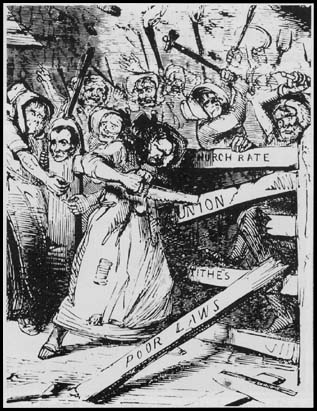
The Rebecca Riots were a series of disturbances in the early 1840s prompted by the increasing exploitation and worsening prospects of the local farming communities in Wales. In the years leading up to the riots, farmers had had to contend with several seasons of bad weather and failed crops, poor financial returns on their produce, increased rents from landowners, and the on-going enclosure of common land. On top of that, farmers (who were already paying 10% of their profits to the local church) were then faced with the newly-amended Poor Law Act of 1834, which increased taxes and began channelling more and more public money into the controversial workhouse system

Enough was understandably enough. And in southern Wales, local farmers began taking their frustration out on what they saw as the embodiment of all their woes: the local tollgates.

“Down with this sort of thing.”

By the early nineteenth century, there were already 30,000 miles of toll roads and 8,000 toll gates in Britain, each of which was overseen by a local body of landowners and businessmen called a turnpike trust. On paper, the idea was simple enough—the money the toll roads raised would go towards the upkeep and repair of the roads themselves. But in practice, it often proved hopelessly flawed. 


The turnpike trusts were left largely to their own devices; they could charge however much they wanted, and could introduce however many tollgates on their land as they wished. Before long, many were taking full advantage of the loopholes in the system: by the 1830s, Carmarthen in south Wales was completely encircled by tollgates, leaving no free route into or out of the town. The gates, it seemed, had to go.

On 13 May 1839, an angry crowd rallied together and destroyed the tollgate in the tiny hamlet of Efailwen, 20 miles west of Carmarthan. This initial protest quickly sparked others, and soon tollgates all across south Wales were being attacked and destroyed by groups of locals fed up with the extortionate prices they were being forced to pay. The protests rumbled on for several months, reaching a peak in 1842 when a combination of an unexpectedly successful harvest and a cut in the taxes imposed on imported meat led to the prices of corn and cattle collapsing.

Within a year, however, it was all over. As the protests had grown ever more violent (a young woman working at a tollgate in Hendy, near Llanelli, was shot and killed in 1843), a diplomatic solution was quickly sought, and the Turnpikes Act of 1844 slashed the toll rates, and amalgamated all the turnpike trusts into one regulated body.

That’s all well and good, of course, but one question remains: why “Rebecca”?

Well, to answer that we need to turn to the Bible. Rebecca was the name of Isaac’s wife, and in the Book of Genesis we’re told that before leaving her family home to go and marry him, Rebecca’s mother gave her a blessing:
And they blessed Rebekah, and said unto her, Thou art our sister, be thou the mother of thousands of millions, and let thy seed possess the gate of those which hate them. 
Clearly, it was the words “let thy seed possess the gate of those which hate them” that gave the Rebecca Riots their name—and inspired the protesters in more ways than one: if you noticed that some of the befrocked protestors shown in the picture above looked, well, less than ladylike, that’s because they quite literally are.

As the protests picked up pace across south Wales, any gate-destroying farmers not wanting to be identified began disguising themselves in women’s clothing. These “Rebeccas” soon became the figureheads of the “Rebecca Riots”, with the leader of each protest even taking on the role of “Rebecca” in a bizarre role play before each gate was destroyed.

As strange as all that might sound, it’s worth bearing in mind that the Rebecca Riots grew out of genuine hardship and sense of frustration, and led to a change in the law that, although not perfect, nevertheless improved conditions for hundreds of the poorest people involved. Today, they are quite rightly seen as one of the most important movements in British social history.