_
Showing posts with label names. Show all posts

8 September 2016

10 First Names Used As Words | 500 Words Ep. 35


You may remember this fact from the HH Twitter feed a while back:
...which led to a bit more explanation here on the blog: the name Rebecca was used (in allusion to a story from the Old Testament) for a series of toll gate protests in Wales in the mid nineteenth century. And it’s that story again that kickstarts this week’s YouTube video, which looks at the origins and meanings behind 10 first names that can be used as words in their own right.


One name that didn’t make the final cut here, however, is John.

John has a number of different uses in English, ranging from a toilet to a signature, a cuckolded husband to an unidentified corpse, and from a policeman to a priest, to the client of a prostitute. Blimey, definitions don’t get much more varied than those. 

In the majority of these cases, it’s the sheer commonality (and, therefore, the familiarity or anonymity) of the name John that is the root of the meaning: John was the most popular male first name in American every year since records began in the nineteenth century through to 1924 (and it remained in the top 10 until 1987), while in the UK 5.8 million men have been named John since 1530, and either it or William held the top spot among British men from the mid-1500s right through to the mid-1900s.

The use of john as another name for a person’s signature, however, owes its origin to John Hancock, the Governor of Massachusetts whose sign-manual gloriously outdoes everybody else’s on the Declaration of Independence (and which you can see—or rather, fail to miss—at the top of this page).

As another name for a toilet, meanwhile, john is probably an alteration of jakes or Jacques, a French borrowing that has been used as a euphemism for the smallest room in the house since the fifteenth century at least. And as another name for a detective, john has its roots in the French word for a policeman, gendarme.

The term gendarme (which itself began life as gens d’armes, or “men of arms”) was originally the name of a mounted soldier or infantryman, and it was in this sense that the word was first borrowed into English in the sixteenth century. It wasn’t until the first formal police forces began to be organized in the 1800s that the word gained its modern sense in its native French—and, for that matter, in English, where it quickly morphed into the humorous form johndarm in early Victorian slang:
“John Darm! Who’s he?” “What, don’t you know?! In Paris he is all the go; Like money here,—he’s every thing; A demigod—at least a king! You cannot fight, you cannot drink, Nor have a spree, nor hardly think, For fear you should create a charm, To conjure up the fiend John Darm! 
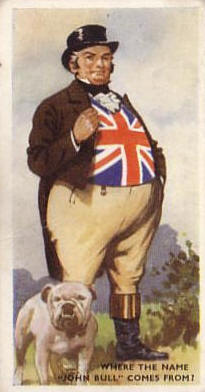
That’s an extract from John Darm, a song first published in 1823 and written by a nineteenth century “writer of verse” named John Ogden, recounting a trip taken by John Bull (the kedge-bellied personification of England and the English) to France. Once there, Bull attends a theatre, gets into a fight with a number of audience members, is arrested by “John Darm”, and thrown into prison. 

The trip ends with the two on better terms, however, with John Bull concluding:

Says I, “To-morrow home I go;
One Frenchman I’d not leave my foe;
John Bull, believe me, meant no harm—
Let’s part in peace—farewell John Darm!”

Ogden’s song (which was apparently a follow up to an earlier comic poem, Mounseer Nongtongpaw, once falsely attributed to Frankenstein author Mary Shelley) provides us with the earliest record of the name john as a nickname for a policeman that we know about. And although the word’s French origins and its connection to the gendarmerie has long since vanished into the haze of language history, the word itself has remained in use to this day.

12 May 2016

London


A few weeks ago over on the HaggardHawks YouTube channel, we looked at the origins of 10 city names, covering everywhere from Chicago (“a place to grow wild onions”) to Funafuri, the capital of Tuvalu (“banana-woman”).


But one city that didn’t make the final cut was the largest city in the UK and the second largest city in Europe. The home of Britain’s smallest police station. The world’s oldest underground network. Two of the world’s best universities. And a woman with a pig’s face. Yep, we’re talking about London. 

So why—to resurrect our occasional series of Questions About The Language You Never Even Thought About—is London called “London?”

In terms of etymology (or rather toponymy, to give the study of place names its proper name), London is something of a mystery. Actually, that’s putting it mildly—over the past few hundred years, a number of linguists, scholars and geographers have put their heads together and come up with little more than a mutual discrediting of each other’s theories and one gigantic Buckingham Palace-sized question mark. Why is London called “London”? The short answer at least is that no one really knows.

That’s partly to do with a lack of written evidence. It’s also partly to do with the fact that we’re dealing with exceptionally old words and word elements, the barest bare bones of the language. And partly it’s because London is such a unique name—it really just doesn’t look like any other ancient word or word element that we know about, which makes working out what it might mean an especially tricky business. But just because we don’t have a definitive answer, doesn’t mean that we don’t have any answer at all.

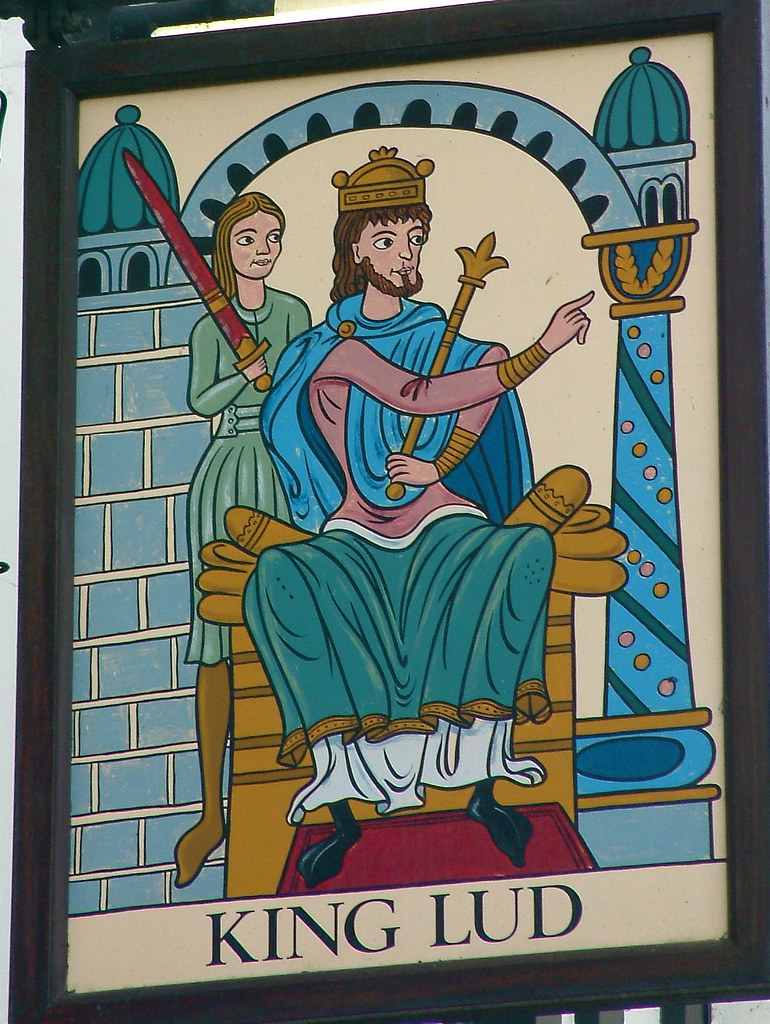
By far the oldest explanation on record is that of the twelfth century Welsh scholar and historian Geoffrey of Monmouth. In his History of the Kings of Britain (c.1135), Monmouth claimed that London was founded by and named in honour of a pre-Roman king of Britain named Lud, who built the city on the site of an even more ancient city called “New Troy” that had been founded by Brutus, grandson of Aeneas, in 1100BC. It’s a nice story alright. It’s just a shame it’s complete rubbish.


Geoffrey of Monmouth probably based his mythical tale of King Lud on that of a legendary figure from Welsh folklore called Lludd Llaw Eraint, or “Lud Silver-Hand”, who is said to have saved Wales from a plague of dragons and a magical giant who had the power to send people to sleep by playing music; to escape the giant’s soporific tunes, Lud dipped his head in a bucket of water. 

Oddly enough, it’s likely that none of that ever actually happened, which makes the idea that London is named after a dragon-slaying monarch with his head in a bucket somewhat implausible. Oh, and linguistically it’s highly unlikely that a word like Lud would morph into something like “Lond”. But still—dragons and giants. That’s probably all the proof you need there.


...and over there is the bucket I put my head in.

As unlikely as Geoffrey of Monmouth’s theory might be, he nevertheless might’ve been onto something by suggesting that London was named after or in honour of someone—but precisely who that “someone” was is another question.

For a while, one popular theory was that London was founded by or named in honour of someone called Londino or Londinos, a hypothetical name supposed to derive from an old Celtic word meaning “wild” or “fierce”. But there’s no historical precedent for that name whatsoever, and (without getting into too much detail) phonologists tend to agree that a Celtic word beginning lond– would give you a modern English word pronounced something like “loaned”, not like the “lund” of London. So despite being more than century old, this theory is now widely discredited. 

Alternatively it might not be the Lond– part of London that’s taken from someone’s name, but rather the –don. It’s been suggested that London might once have been called Lunadin, Luandan or Lan Dain, an ancient name meaning something like “moon temple of the goddess Diana”. Sir Christopher Wren certainly believed that he had unearthed a Roman temple dedicated to Diana when he rebuilt St Paul’s Cathedral, but again the linguistic and historical evidence just isn’t there to back this theory up.


So if it’s not an honorific name, how about a geographical one? 

Another theory is that London was originally llyn din, or llyn dain, both Welsh-inspired names literally meaning “lake-fort” or “pool of the river” respectively (the “lake” and “pool” in question possibly being the widening, deepening part of the river Thames)They’re both plausible theories, but linguistically a word like llyn would be expected to produce a modern name like Lindon-with-an-I, not London-with-an-O. 

And London has almost always been London-with-an-O: the earliest records we have of it are all from ancient Roman Latin documents and inscriptions that refer to it as Londinium or Londinion. The people of London themselves were the Londiniensi—a word taken from a stone tablet dating from around AD 150 that was unearthed at an archaeological dig in Southwark in 2002, and which provides us with the earliest known evidence of the name “London” that we have. And for the Romans to have spelled their “London” with an O (or a U, as they sometimes did) casts doubt on those Welsh-origin theories. 

Instead, we might have to look even further back in time.


Bring on the wall!

In 1998, Professor Richard Coates—then President of the English Place-Name Society—put forward perhaps the most convincing argument for the origin of the word London yet: Plowonida. If you think Plowonida sounds more like something you’d use to treat athlete’s foot rather than the origin of one of the most famous cities in the world, you’ve got a point. But the reason this looks so unfamiliar—and so unlike the modern name “London”—is because we’re dealing with impossibly old pre-Celtic language.

In Coates’ theory, Plowonida would have started life as a hydronym (a river name) referring to the part of the Thames on which London was founded. It combines (brace yourselves, we’re going even further back in time here) two Proto-Indo-European word roots meaning “to flow”, plew– and nejd–, whose descendants are found in river names all across Europe. In combination, it’s theorized that these two elements might have referred to the first noticeably deep, fast-flowing part of the Thames, where it was impossible to ford or cross on horseback.

Knowing what we know about pre-Celtic language, calling the river itself Plowonida would have given the town or village that stood on the banks of the river the name Plowonidonjon, which over centuries of simplification and alteration would have become a Celtic name along the lines of Lūndonjon, then the Latin name Londinium, and ultimately the modern English name “London”If Coates’ theory is correct, that would mean the name “London” could be interpreted as something like “the town at the unfordable part of the river”—which is a considerably better theory that “the town of the king who put his head in a bucket”.


15 April 2016

Lazy Lawrence


A long-forgotten (but no less useful) expression popped up on the HaggardHawks Twitter feed the other day:


And this isn’t the only proverbially lazy Lawrence to find his way into the dictionary. Long before lazy people had “Lawrence on their backs” there was an earlier expressionLawrence bids wages, that the OED explains was used to imply that “the attractions of idleness are tempting”—or, in other words, doing nothing looks like a lot of fun. Even Lazy Lawrence itself has been used as a nickname for an idling lazybones for centuries, as well as being the name of a mischievous fairy or sprite supposed to induce lethargy or idleness.

So apologies to anyone named Lawrence, but you’re immortalized in the language as a metaphor for laziness. Still, it’s better than being known for a one-year prison sentence or destroying gates, I suppose. But why Lawrence? And why laziness?

Well, one theory is that the connection is purely coincidence, and that Lawrence just has a nice alliterative ring to it—so this could just as easily be “Lazy Linda”, or “Leon bids wages”, or “to have Loretta Lynn on your back”. It’s certainly plausible (well, apart from the Loretta Lynn bit) but needless to say there are a couple of more imaginative explanations on offer. And one of them even involves a barbecued saint, what more could you want?

One theory is that phrases like these refer to St Lawrence’s Day, 10 August. That date puts it bang in the middle of the “dog days” at the height of the summer, when you can expect to endure the hottest, sultriest, most stifling weather of the year—the kind of weather that makes you want to lounge around and do nothing except lounging around doing nothing. The dog days are traditionally said to last anywhere from mid July to early September, and take their name from the tradition—probably started in Ancient Greece, if not Ancient Egypt—that the appearance during the summer months of Sirius, the Dog Star, just above the horizon before sunrise somehow amplified or added to the heat of the Sun. In fact, the so-called “heliacal rising” of Sirius always occurs sometime around August 10–11.


You cannot be Sirius

So is our proverbially lazy Lawrence inspired by the highest hottest heat of high summer? Possibly. But we can’t ignore the fact that there’d be no St Lawrence’s Day without St Lawrence himself. 

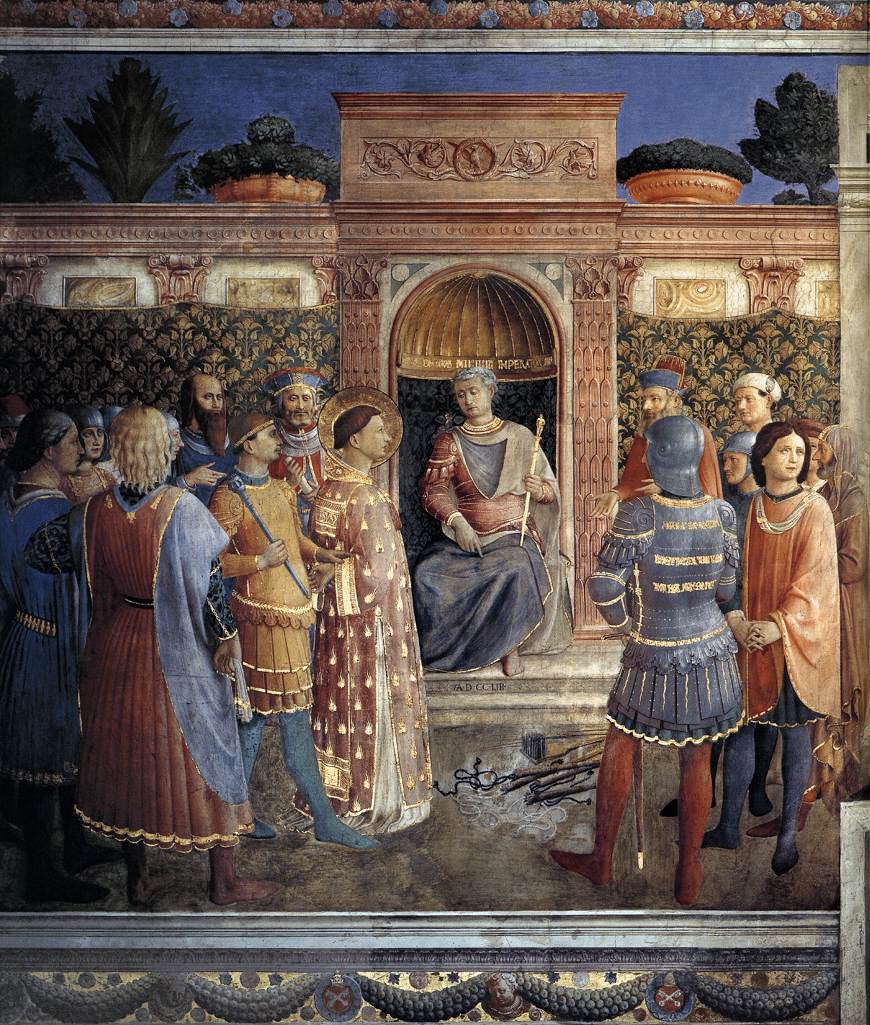
Lawrence of Rome was the highest-ranking of seven deacons that served under Pope Sixtus II in the 3rd century AD, whose job it was to oversee the church’s treasury and distribute alms to the poor. Everything was going splendidly for Lawrence until August AD258, when a letter arrived at the Senate from the Roman Emperor Valerian—who was imprisoned in Antioch, having left Rome to fight a war with the Persians—calling for all Christian senators to be stripped of their titles and assets, and for all priests, bishops and deacons to be arrested. If they renounced their faith and agreed to perform a sacrifice to the Roman gods, they would be freed. If they refused, they would be put to death. Valerian, it seems, wasn’t going to let a little thing like being held in prison 2,000 miles away stop him from running his Empire.

In accordance with Valerian’s orders, the Senate rounded up Pope Sixtus and his seven deacons. All eight refused to comply with the edict, and so, on 6 August 258, they were beheaded—all, that is, except Lawrence. As the archdeacon in charge of the treasury, Lawrence was given a three-day stay of execution to collect together all the church’s wealth and hand it over to the Roman state; instead, he reportedly spent the next three days giving as much of the money away as he could. On August 9, he returned to the Senate with a group of Rome’s poorest, sickest, neediest citizens, and boldly claimed that these were the true treasures of the church. The Prefect of Rome, frankly, was far from pleased.

Whereas Pope Sixtus and his other deacons had been beheaded, Lawrence’s singular act of defiance earned him an especially cruel death: the sentence was passed that he should be roasted to death, suspended on a gridiron above roaring fire.

Baby catching was all the rage in Ancient Rome

There’s some disagreement over whether or not Lawrence was actually burned to death in this way, because some sources claim that the Latin record of his death (assus est, “he was roasted”) should actually have read passus est, “he suffered”. But whether true or not, the question still remains—what does an early Christian martyr’s gruesome execution have to do with laziness?

Well, Lawrence’s death was so notably brutal that it soon became the subject of a macabre bit of folklore that claimed midway through his roasting Lawrence had quipped, “Turn me over, I’m done on this side!” It might sound more Groucho Marx than it does Archdeacon of Rome (and you can make your own mind up as to whether he actually said it or not), but this legend nevertheless apparently inspired a joke that Lawrence was “too lazy” to turn himself over. 

So is this the true origin of our lazy Lawrences? It’s impossible to say for sure, but it’s a good story all the same. And one well worth telling round the barbecue this summer.


10 February 2016

Uranus

Before we begin, let’s get a few things out of the way. The noxious atmosphere around Uranus could kill a man. Uranus has a circumference of 100,000 miles. Scientists are looking at a black hole near Uranus. What are those two circular objects either side of Uranus? Ass-teroids, of course. If you got through that without laughing, then we’re good to go.

So. The other day, one of those stop-you-in-your-tracks facts cropped up on the @HaggardHawks Twitter feed:


But this really is too bizarre a fact to leave unexplained:


…so your wish is my command.

The discovery of Uranus (stop sniggering, you at the back) is credited to the German-born English astronomer William Herschel in 1781. Although it had been observed by scientists and astronomers for centuries, Uranus had always been mistaken for a star, and right up to Herschel’s discovery it was still being classed as 34 Tauri, a minor star in the constellation Taurus. Even Herschel himself initially believed he had spotted a comet rather than a planet, after noting that an object he had been looking at from his observatory in Bath had changed position in the sky over a series of nights.

Herschel announced his discovery in March 1781. As word of his new “comet” spread, astronomers all across Europe began to take note and observe it themselves. Soon, enough data had been compiled to plot its apparent trajectory—which, to everyone’s surprise, appeared to be an almost perfect circular orbit around the Sun. Herschel’s discovery was no comet.

Full colour photo of Uranus. Stop laughing.

By 1783, it had become universally acknowledged that Herschel’s discovery must surely be a planet—moreover, it was the first planet ever discovered by telescope, and the first new planet added to our Solar System in modern history. It was a truly monumental discovery, and one that earned Herschel an annual salary of £200 (equivalent to £27,000/$40,000 today) from King George III (on the condition that he move his observatory from Bath to Windsor, to be closer to the royal household), as well as the never-to-be-repeated title of Court Astronomer to The King.

But with the existence of a new planet confirmed, a pressing question soon emerged: what on Earth should it be called?

The Astronomer Royal, Nevil Maskelyne, wrote to Herschel asking him “to do the astronomical world the favour” and “give a name to your planet,” which, he continued, “is entirely your own, [and] which we are so much obliged to you for the discovery of.” In honour of his new financial patron, Herschel plumped for the only name he saw fit: Georgium Sidus, or “George’s Star.” He wrote to the Royal Society:

In the fabulous ages of ancient times the appellations of Mercury, Venus, Mars, Jupiter and Saturn were given to the Planets, as being the names of their principal heroes and divinities… The first consideration of any particular event, or remarkable incident, seems to be its chronology: if in any future age it should be asked, when this last-found Planet was discovered? It would be a very satisfactory answer to say, “In the reign of King George the Third”.

The seventh planet from the Sun, ultimately, was to be called George. But the response to Herschel’s suggestion was far from encouraging.

Outside of Europe, astronomers were wary of using a such an explicitly “British” name, especially given that it had taken an international collaboration to prove its status as a planet. Consequently, despite Maskelyne specifying that Herschel’s discovery and his choice of name were “entirely his own”, George failed to gain any widespread use or permanency. The name Georgium Sidus effectively became a placeholder, and over the years that followed astronomers across Europe began utilising and pitching their own choices and suggestions.

One popular choice was simply Herschel, a name honouring its discoverer. The Swedish astronomer Erik Prosperin ironically opted for Neptune (now the name of the eighth planet, discovered in 1846). But eventually a clear choice emerged—namely the German astronomer Johann Elert Bode’s suggestion, Uranus.

Bode had been one of the European astronomers who had calculated Uranus’ orbit, lending weight to the idea that Herschel’s discovery was a planet not a star. He suggested the name Uranus as it not only maintained the classical and mythological theme set out by the other six planets, but fittingly Uranus was the Greek god of the sky. Moreover, just as Saturn had been the father of Jupiter, Uranus was the father of Saturn, thereby creating a mythological family tree in the heavens.

Bose’s choice quickly gained momentum, and was reinforced by the German chemist Martin Klaproth in 1789, who named his famous discovery—the chemical element uranium—in support of Bose’s suggestion.

Out of deference to Herschel, however, it took another 60 years for the name Uranus to be universally acknowledged by the scientific community, when, in 1850, the official astronomical almanac published by the Royal Greenwich Observatory in London finally abandoned Herschel’s Georgium Sidus and in favour of Uranus.


21 January 2016

Lek


If you’ve been keeping up with the new HH YouTube channel, chances are you’ve already seen the second video in our new #500Words project, which went online yesterday. Looking at the meanings and origins of 10 Words Spelled Q Without U, this time around one of the words included the qindarka or qintar, the name of a monetary unit used in Albanian:


Qindarka itself essentially means “a little part of 100” in Albanian—which, let’s face it, isn’t the most original name for a coin equal to 1 one-hundredth of something. But it’s what the qindarka is 1/100th of that’s more interesting. 

As mentioned in the video, the principal unit of currency in Albania is the Albanian lek, which takes its name from Alexander the Great. According to the history books, Alexander was born in Pella in Macedon (now in modern-day Greece) in 356BC. 


But in Albania, there’s an uncorroborated (and somewhat controversial) theory that Alexander—along with the likes of Aristotle, Pyrrhus, and Alexander’s father Phillip II—was born in Illyria, the region of ancient Europe that corresponds today to the Balkans peninsula and modern-day Albania. Was Alexander the Great really Albanian? Well, it’s doubtful. But the theory is nevertheless commemorated by the name of the Albanian currency.

But what about the rest of the world? Are there any more etymological gems jangling around the pockets and wallets of other countries?

Admittedly, the vast majority of world currencies take their names from fairly bland or predictable roots. Many refer to weights and measures, like the pound, which once referred to the value of one pound of silver, and the lira, which in turn takes its name from libra, the Latin word for “pound”. 


Likewise, both shekel and peso literally mean “weight” in Hebrew and Spanish (peso derives from the same etymological root as pendant, in the sense of something being weighed on a balance or set of scales), while more obscure entries in this category include the Kazakhstani tenge (which literally means “a set of scales”), and the Mauritanian ouguiya, which takes its name via French and Arabic from the Latin word for “ounce”, uncia. The Ukrainian hryvnia too is named for an ancient local unit of weight once used to measure precious metals.

Like the qindarka, other currencies have straightforward numerical roots, referring to fractions or portions of something larger. Dinar, the name of the main unit of currency in 11 different countries, is derived from the Latin denarius, literally “a tenth part.” Similarly, the cent, centime, and centesimo all have names referring to a fraction of 1/100th.

Some names are even less inspired: the Afghanistan afghani is divided into 100 smaller units called pul, which literally means “money”. The taka of Bangladesh takes its name from a local Bangla word meaning “cash”. The Vietnamese đồng and the manat of Azerbaijan and Turkmenistan also just mean “money”, while the ngultrum of Bhutan has a Dzongkha name literally meaning “money pieces.” The Japanese yen, Korean won and Chinese yuan all mean “round”, while the yuan has also been known as the renmimbi since 1949—which literally means “the people’s currency”

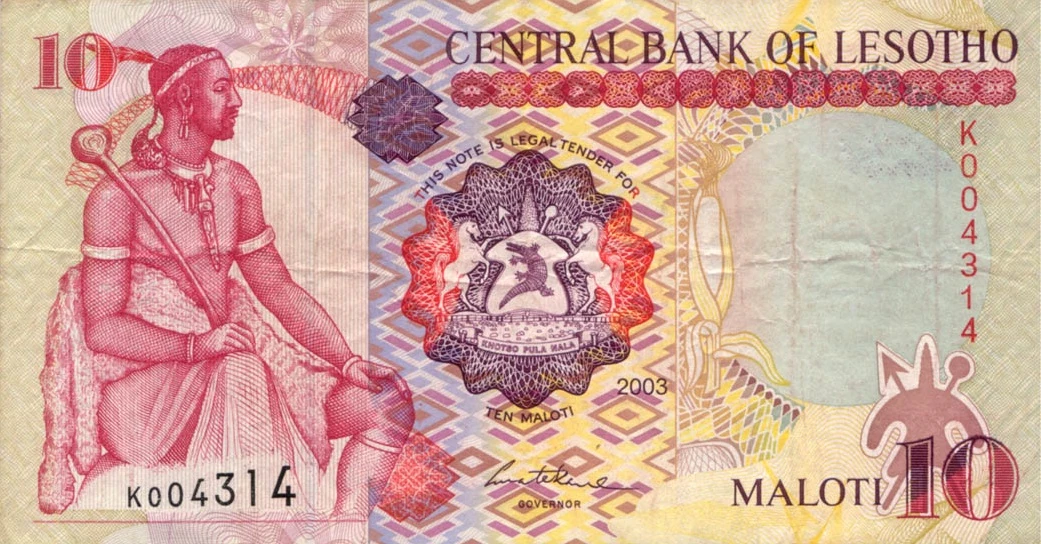
More imaginatively, some monetary units have geographical names, and refer either to their home country or to some notable feature therein. The loti of Lesotho, for instance, is named after the country’s Maloti Mountains. The Eritrean nakfa is named for the town of Nakfa that served as a based during the country’s fight for independence. And the kwanza, the unit of currency in four African countries, is thought to take its name from the River Cuanza that flows through Angola. 


By far the most famous geographical name, however, is the dollar, which traces its name back to the tiny Bohemian spa town of Joachimstal, now in the Czech Republic: the high-quality silver that was mined there was once used to make coins known as joachimstaler, which quickly shorted to thaler, and finally ended up in the New World as dollar via the colonial Dutch and Spanish. Incidentally, because these early coins were originally quite weighty, the colonial dollar was nicknamed the gourde in the 18th century slang, a name derived from a French word meaning “stupid” or “dull”—it lives on in the name of the currency of Haiti.

Like the dollar, some currencies take their names from their component metal or their means of manufacture. Ruble is thought to come from a Russian word meaning “to chop” or “hew,” possibly because the coins once had to be hewn from solid blocks of metal. The piaster or piastre—1/100th of an Egyptian, Lebanese, Sudanese or Syrian pound—takes its name from an Italian word, piastra, for a thin piece of metal. The Indian rupee, Indonesian rupiah, and Ethiopian birr all have names meaning “silver,” while the Kyrgyzstani and Uzbekistani som take their name from local words meaning “pure”, as in “pure gold”.

Stamps of royal authority are behind the names of the Czech koruna and all the various Scandinavian krones and krónas, all of which take their name from local words meaning “crown”. The Brazilian real, the Mauritanian ariary, and the rial of Iran, Yemen and Oman likewise mean “royal.”

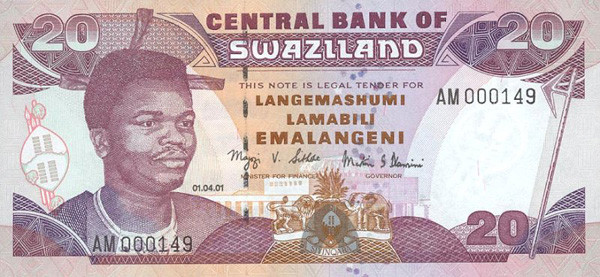
Many of the world’s krones and rials are stamped with crowns, and likewise some currencies take their names from the images that once decorated them. As well as the term sterling (literally a “little star”, a mark once stamped on pound-sterling coins) the Russian kopeck once bore a picture of a mounted knight, and derives from a Russian word meaning “lance”. The Hungarian forint (as well as the English and Dutch florin) derives from a coin once minted in Tuscany that was marked with a lily, and so was named for the Italian word for “little flower,” fiorino. The Bulagrian lev similarly means “lion,” and the Portuguese escudo (now replaced by the euro) means “shield”. Perhaps best of all in this category, however, is the Swaziland lilangeni, whose name simply means “a member of the royal family”.


Another currency replaced by the euro was the Greek drachma, whose name literally meant “handful”, or “as much as can be seized in one hand”. The dirham, used in both Morocco and the United Arab Emirates, is its etymological descendant. Along a similar path, the Georgian lari has a name literally meaning “hoard.” Former currencies are also name-checked in Ghana and the Pacific nation of Vanuatu, whose monetary units—the Ghanaian cedi and the Vanuatu vatu—mean “cowry shell” and “stone” respectively, both referring to items once used locally as money. (The cedi, incidentally, is divided into 100 pesewas, which literally means “a penny’s worth of gold dust”.) Similarly, the Guatemalan quetzal takes its name from the fact that the feathers of the tropical quetzal bird were also once so prized that they were used locally as money.

The lek also isn’t the only currency named in honour of someone. The Costa Rican colón, for instance, is named after Christopher Columbus. The Honduran lempira is said to take its name from a native local chief. The Tajikistani somoni is named in honour of the country’s founder, Ismail Samani, and the Venezuelan bolivar is named after Simón Bolívar.


Lastly, amongst the best of the world’s currency etymologies, are the dobra of São Tomé, which takes its name from a Portuguese word meaning “to fold” (which gives a whole new meaning to “folding money”), and the Zambian kwacha, which has a local Nyanja name meaning “dawn”—a reference to a former slogan of Zambian nationalism that promised a “new dawn of freedom.” In turn, it’s divided into 100 subunits called ngwee, which literally means “bright”.

Best of all however, is the Botswana pula, whose name was chosen by a public contest and literally means “rain” in the local Setswana language—in a country in which the Kalahari Desert accounts for 70% of the available land, rain, it seems, is just as valuable as money.