

A long-forgotten (but no less useful) expression popped up on the HaggardHawks Twitter feed the other day:
‘To have Lawrence on your back’ is an old 18th century expression meaning ‘to act lazily’ or ‘to not pull your weight’.— Haggard Hawks (@HaggardHawks) 14 April 2016
And this isn’t the only proverbially lazy Lawrence to find his way into the dictionary. Long before lazy people had “Lawrence on their backs” there was an earlier expression, Lawrence bids wages, that the OED explains was used to imply that “the attractions of idleness are tempting”—or, in other words, doing nothing looks like a lot of fun. Even Lazy Lawrence itself has been used as a nickname for an idling lazybones for centuries, as well as being the name of a mischievous fairy or sprite supposed to induce lethargy or idleness.
So apologies to anyone named Lawrence, but you’re immortalized in the language as a metaphor for laziness. Still, it’s better than being known for a one-year prison sentence or destroying gates, I suppose. But why Lawrence? And why laziness?
Well, one theory is that the connection is purely coincidence, and that Lawrence just has a nice alliterative ring to it—so this could just as easily be “Lazy Linda”, or “Leon bids wages”, or “to have Loretta Lynn on your back”. It’s certainly plausible (well, apart from the Loretta Lynn bit) but needless to say there are a couple of more imaginative explanations on offer. And one of them even involves a barbecued saint, what more could you want?
One theory is that phrases like these refer to St Lawrence’s Day, 10 August. That date puts it bang in the middle of the “dog days” at the height of the summer, when you can expect to endure the hottest, sultriest, most stifling weather of the year—the kind of weather that makes you want to lounge around and do nothing except lounging around doing nothing. The dog days are traditionally said to last anywhere from mid July to early September, and take their name from the tradition—probably started in Ancient Greece, if not Ancient Egypt—that the appearance during the summer months of Sirius, the Dog Star, just above the horizon before sunrise somehow amplified or added to the heat of the Sun. In fact, the so-called “heliacal rising” of Sirius always occurs sometime around August 10–11.
 |
| You cannot be Sirius |
So is our proverbially lazy Lawrence inspired by the highest hottest heat of high summer? Possibly. But we can’t ignore the fact that there’d be no St Lawrence’s Day without St Lawrence himself.
Lawrence of Rome was the highest-ranking of seven deacons that served under Pope Sixtus II in the 3rd century AD, whose job it was to oversee the church’s treasury and distribute alms to the poor. Everything was going splendidly for Lawrence until August AD258, when a letter arrived at the Senate from the Roman Emperor Valerian—who was imprisoned in Antioch, having left Rome to fight a war with the Persians—calling for all Christian senators to be stripped of their titles and assets, and for all priests, bishops and deacons to be arrested. If they renounced their faith and agreed to perform a sacrifice to the Roman gods, they would be freed. If they refused, they would be put to death. Valerian, it seems, wasn’t going to let a little thing like being held in prison 2,000 miles away stop him from running his Empire.
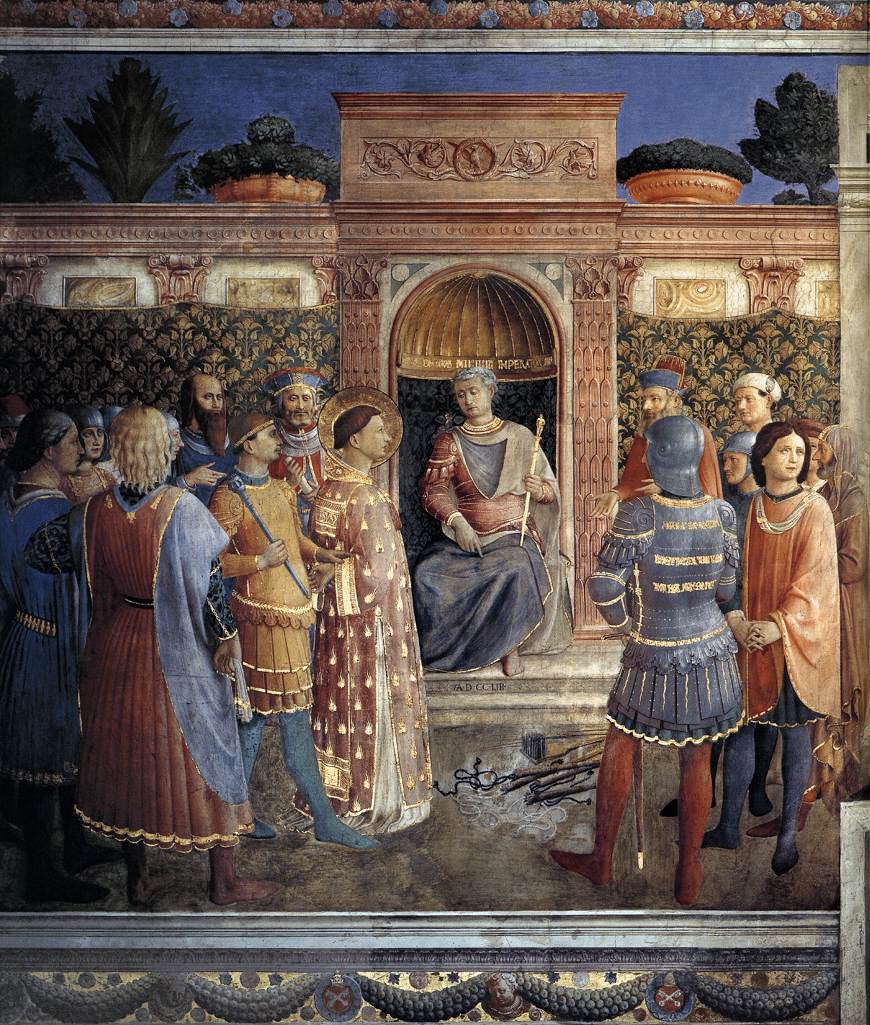
Whereas Pope Sixtus and his other deacons had been beheaded, Lawrence’s singular act of defiance earned him an especially cruel death: the sentence was passed that he should be roasted to death, suspended on a gridiron above roaring fire.
 |
| Baby catching was all the rage in Ancient Rome |
There’s some disagreement over whether or not Lawrence was actually burned to death in this way, because some sources claim that the Latin record of his death (assus est, “he was roasted”) should actually have read passus est, “he suffered”. But whether true or not, the question still remains—what does an early Christian martyr’s gruesome execution have to do with laziness?
Well, Lawrence’s death was so notably brutal that it soon became the subject of a macabre bit of folklore that claimed midway through his roasting Lawrence had quipped, “Turn me over, I’m done on this side!” It might sound more Groucho Marx than it does Archdeacon of Rome (and you can make your own mind up as to whether he actually said it or not), but this legend nevertheless apparently inspired a joke that Lawrence was “too lazy” to turn himself over.
So is this the true origin of our lazy Lawrences? It’s impossible to say for sure, but it’s a good story all the same. And one well worth telling round the barbecue this summer.
So is this the true origin of our lazy Lawrences? It’s impossible to say for sure, but it’s a good story all the same. And one well worth telling round the barbecue this summer.


