_

17 July 2015

Dandelion

For some reason, toilet talk keeps popping up on here (we’re looking at you, vespasienne), and unfortunately we’re heading back down that way now. That’s because last week we found out that when Italian slang gets weird, it gets brilliantly weird:
Pisacàn is an old Venetian word, which has long since dropped into local use in northern Italian slang. Predictably enough, the pis– means “urine”, while –càn comes from the same Latin root as canine (and Canary Islands). No surprises there then. But what is intriguing is that this is apparently another example of an etymological connection between dandelions and—well, what Samuel Johnson would euphemistically call “animal water”:
Quite right too. English is chock-full of slightly pee-tinged nicknames for dandelions, but more on those in a moment. First things first, though—why exactly is it called a dandelion?

English borrowed the word dandelion from French in the early Middle Ages. The original French name—itself derived from mediaeval Latin—was dent de lion, literally meaning “lion’s tooth”, which is a brilliantly imaginative reference to the dandelion’s jagged, sharply-toothed leaves:


Although a handful of even earlier examples of the word have been unearthed in Middle English herbals and medical textbooks—some dating back to the late 1300s—in those dandelion was still essentially a foreign word, and it wasn’t until the late Middle Ages that it started to become naturalized into English. Ultimately, the first truly English record we have comes from this translation of Virgil’s Aeneid, written in 1513.

Before then—and before we plundered dent de lion from the French—dandelions were known by all kinds of other names in English: in the fifteenth century, they were the priest’s crown (a reference to their bright golden colour) and the monk’s-head (a reference to their bald heads, after all the fluffy seeds have been blown away). Earlier still, the Old English name was ægwyrt, or “egg-wort”, an allusion to the dandelion’s egg yolk-coloured petals. But in the late Middle English period, another entirely different nickname began to emerge: pissabed

Pissabed derives from the old belief that the dandelions do indeed have a diuretic effect, increasing the amount of urine that the body produces. So have a nice fresh supper of dandelion salad and, well, you might end up having that dream where you’re asleep on the beach and the tide’s coming, or that you’re Ophelia in John Everett Millais’ painting. (If you know what I mean...)

Medicinally, diuretics are used to treat all kinds of different conditions from high blood pressure to liver disease, and in traditional and complementary medicine dandelions have been used to do precisely that for centuries. Whether they work or not (and the jury is certainly still out about that), this ancient association has become so ingrained in folklore that a whole host of pee-related nicknames for the dandelion have since emerged. 

The English Dialect Dictionary, for instance, lists pissabed alongside pissybed, pissymoor, pissimire, and pissimer-flower. Other dialect glossaries add pittly-bed, piddle-your-bedpee-the-bedpish-the-bed and pissy-mother to the list. And elsewhere there’s jack-piss-the-bed, tiddle-bed, wet-the-bed, and even pisshead. This association isn’t unique to English either: the original Middle English pissabed was probably a translation of the earlier French name piss-en-lit, and alongside that there are German nicknames like Pissblume and Bettnässer (literally “bed-wetter”), the Spanish slang meacama (“piss-the-bed”), and the Italian piscialetto.

A pappus. At 0000 hours, apparently.
It’s not just number ones that dandelions are blamed for either: the EDD also lists the fairly unsubtle shit-a-bed as another alternative name, while one nineteenth century Scots dialect dictionary likewise calls it the bumpipe. The dandelion’s supposed medical benefits are  alluded to in nicknames like heart-fever grass and live-long. There’s also dog-posy and dog-stinker, both of which tie in with the Italian “dog-pisses”. An entirely untrue bit of folklore that claims dandelions are poisonous is responsible for nicknames like devil’s-milk plant, canker flower, and witch gowan. And the ancient tradition that the number of breaths it takes to clear the dandelion’s fluffy seed head (known as the pappus, if you want to get technical) is the origin of a clutch of old nicknames like bessy-clock, one-o’clock, and fortune-teller plant

So just one question remains—why on earth are there so many different names? 

Well, it’s worth pointing out that dandelion is by no means alone here. Remember the dishwasher bird? Jack-jump-up-and-kiss-me? The lady-with-the-twelve-flounces? And take a look at this fantastic Storified list of local nicknames for woodlice, put together by Mr @MooseAllain. The fact is that many of our most familiar, most noticeable, and most frequently-encountered plants and animals end up with page after page of alternative names, simply because they’re so familiar, so noticeable, and so frequently encountered. And the fact that dandelions are edible, as well as medicinally useful, only serves to make them even more noteworthy. Just don’t eat too many of them before bed...


15 July 2015

Hooligan

Last week, we tweeted this:
It’s a great word, and given its meaning it seems plausible that it should have a much more familiar etymological cousin:
A nice idea—but unfortunately the two are unrelated. Hoolybuss is an old Cornish word, dating back to the eighteenth century at least, while the first hooligans didn’t emerge until the late 1890s, more than 250 miles away in Victorian London.

Like a lot of dialect words, a lack of early written evidence of hoolybuss makes it hard to pin down its exact etymology, but a reasonable guess would be that the hool– is probably a local pronunciation of hurl. This would make hoolybuss a distant cousin of hurly-burly, perhaps alongside other hool– words like hooloch (an old Scots word for a rockfall) and hooley (an old Irish-English word for a boisterous party). As for the –buss, that might come from bussa, another old Cornish word for an “empty-brained person”, but with so little evidence to go on, it really is difficult to say anything with any certainty.

So what about hooligan? Well, the OED’s earliest record of a hooligan comes from an 1898 article in The London Daily News, which condemned “the Hooligan gangs” now being “bred in these vile, miasmic byways”. By crikey, those Victorians really knew how to string a sentence together. 

As, apparently, originally the name of a gang, some etymologists have suggested that hooligan might derive from the surname of some notorious crook or dimber-damber, in which case it could be a slang corruption of “Houlihan”, or even the phrase “Hooley’s Gang”. It’s a neat theory, and certainly a plausible one—but as always with this kind of thing, there’s more to this story than meets the eye. For example, take a look at this:


That’s the front cover of an edition of a Victorian humour magazine called Nuggets, dating back to 1897. It depicts some of the magazine’s most popular recurring characters, namely a wacky family of Irish country-bumpkins called “The Hooligans”. In this edition, the Hooligans have cobbled together their own makeshift caravan (towed by their pet goat, of course) in which they intend to “travel ’round the country with ease and elegance”. Other editions saw them celebrating Queen Victoria’s diamond jubilee with their own ramshackle royal procession, and trying, albeit unsuccessfully, to join the Klondike gold rush. It’s all very heavily stereotyped stuff (and would undoubtedly fall foul of the censors today) but the Victorians loved it.

They also, however, loved this:


That’s a selection of theatrical reviews—taken from an 1892 edition of The Eraan old stage newspaper—for a show at the Theatre Royal in Hull, performed by a pair of Irish comedians called Jim O’Connor and Charles Brady. The duo’s act, as a number of the reviews mention, included a hugely popular musical number about a rowdy Irish family called The Hooligans:

Oh, The Hooligans!
Always on the riot, 
Cannot keep them quiet,
Oh, The Hooligans!
They are the boys
To make a noise
In our back yard!

O’Connor and Brady’s show transferred to the Elephant and Castle Theatre in central London shortly afterward, and soon proved just as big successful there as it had been elsewhere. Their Hooligans song likewise proved a roaring success in London’s music halls—speaking of which:


Stepping even further back in time, that’s the lyric sheet to an old comic broadside called Miss Hooligan’s Christmas Cake, thought to have been published in Scotland sometime around 1880. The song recounts the fictional story of a bungling Irish cook who bakes a gigantic Christmas cake that makes everyone ill:

There was plums and prunes and cherries,
And citron and raisins and cinnamon too,
There was nutmeg, cloves and berries,
And the crust it was nailed on with glue.
There was carraway seeds in abundance,
Sure ’twould build up a fine stomachache,
’Twould kill a man twice, after eating a slice,
Of Miss Hooligan’s Christmas cake.

Again, it’s all very unfairly stereotyped, but nevertheless Miss Hooligan’s nonsense musical tale proved hugely popular at the time. As did, finally, this:


That’s the opening scene of a theatrical farce called More Blunders Than One, or The Irish Valet, written way back in 1824 by the dramatist (and former manager of London’s Adelphi Theatre) Thomas G Rodwell. And one of the characters in the play, as this extract shows, was a “Mr Larry Hoolagan”. 


So. Theatrical farces. Irish comedians. Victorian cartoons. Toxic cake. Where does all this leave us?

Well, both the play and the Scottish broadside seem to prove that hooligan is indeed derived from an Irish surname—presumably, as the OED rightly suggests, “Houlihan”. It in turn derives from the old Irish Gaelic surname O’hUallachain, the –ch– of which, in its original Irish, would have been pronounced like a softer version of the ch in Bach or loch (voiceless velar fricative, if you want to get technical)

That ch sound isn’t normally used in English, so it’s not too much of a leap to presume that it could morph into an easier g sound among British English speakers, which explains the early uses and spellings of the name Hooligan in both the farce and the broadside. But they have nothing to do with riotous criminal behaviour—so for that, we need to head back to the early 1890s. 


Jim O’Connor and Charles Brady apparently chose the same surname, Hooligan, for the riotous characters in their 1892 song. And when their show transferred to London the following year, its enormous success—and the success of the music hall number it incorporated—seems to have led to a whole new word for rioting, boisterous troublemakers being adopted into the street slang of the capital. 


Soon, members of London’s criminal gangs were proudly referring to themselves as Hooligans, and when they began to fall foul of the law, the name was quickly picked up and popularized by the press: an early account of a “Hooligan boy” being arrested in 1894 has since been discovered, predating the OED’s earliest evidence by four years, and aligning the word more closely with O’Connor and Brady’s arrival in London the previous year. 


So is that the end of the story? Predictably, no. Despite all this early evidence, many etymologists still adhere to the idea that hooligan derives from the name of some notorious Victorian criminal or underworld figure, with some theories even name-checking a legendary “Patrick Hooligan”, or the disgraced politician and financier ET Hooley. Just as with hoolybuss then, it seems that until more conclusive evidence comes to light, this is yet another etymological mystery that refuses to be solved. 


9 July 2015

Britain

It’s easy to forget that place names—just like surnames, first names, months of the year, and all other proper nouns—are still only words, and as such have their own histories and etymologies. We’ve mentioned quite a few of these before on the @HaggardHawks Twitter feed, from “the wooden temple” in central Asia to the original “white house” in north Africa, to America’s “place of the wild onion” and “the best place to grow potatoes”.

Unfortunately, because place names tend to be particularly ancient, their precise origins and meanings are often very tricky to pin down. Shortfalls and inconsistencies in what little historical evidence is available mean there’s often just as much conjecture and guesswork involved as there is hard fact, and even then some names defy all attempts to explain them. 

For instance, despite being one of the most famous cities in the world, no one really knows what “London” means. Instead, theories range from the relatively sensible—perhaps a long-forgotten Welsh word, meaning something like “river-fort” (llyn-din), or “pool on the river” (llyn-dain)—to the downright bizarre, with one idea even suggesting some kind of reference to Luna, the Roman goddess of the Moon. (Shameless plus: there’s more on that in the new book…)

We tweeted another bizarre place name origin a few weeks ago:
And, well, we thought it might need a bit more explaining.

So. The earliest written record of “Britain” that we know about comes from an Ancient Greek explorer and adventurer named Pytheas of Massalia. Sometime around 325BC, Pytheas circumnavigated and explored the entire British Isles, probably becoming the first person in history to do so. He also travelled high enough into northern Europe to describe the Midnight Sun (probably becoming the first person to do so); crossed the Arctic Circle and spotted the outer fringes of the great northern icecap (probably becoming the first person to do so); and was the first explorer from Mediterranean Europe to reach the Baltic Sea by boat. He was, it’s fair to say, a bit of a dude.

Pytheas’s accounts of his journeys were among the most celebrated geographical texts in antiquity, but unfortunately all of his original writings have long since been lost. Everything we know about his travels now comes from the smattering of quotes, extracts, and discussions that later writers and historians—including the great Roman naturalist Pliny the Elder, who keeps cropping up on here—included in their work. But what has survived is Pytheas’s early use of the word “Britain”, which he recorded more than 2,300 years ago as “Bretannike.

At the time of Pytheas’s visit, Britain would still have been a hodgepodge of different Celtic and pre-Roman tribes and languages. In the far north and west, however, two increasingly dissimilar branches of the ancient Celtic language family were starting to take shape: Goidelic, or “Q-Celtic”, in the far north and northwest (which eventually gave rise to Irish, Manx and Scots Gaelic), and Brythonic, or “P-Celtic”, in the west and southwest (which eventually gave us Welsh, Cornish and Breton). 

The nicknames “P” and “Q” refer to the fact that Brythonic Celtic tended to develop a p sound where Goidelic Celtic tended to have a hard q or k sound, and vice versa. We’re dealing with impossibly ancient words here, of course, but you don’t have to look too far to find evidence that this change took place: pick up an atlas or a road map of the British Isles, and you’ll find Pentire, a peninsula on the north coast of Cornwall, and Kintyre, a peninsula in southwest Scotland. Both names literally mean “headland”; both derive from P-Celtic (penn) and Q-Celtic (keann) words meaning “head”; and both are practically identical, except for their initial p and k sounds. 

But anyway, back to Pytheas. Based on linguistic evidence like this—and based on what little we know of Pytheas’s route—it’s thought that his “Bretannike” must be derived from some early Brythonic or “P-Celtic” word, suggesting that the people he learned it from originated somewhere around modern-day Wales or southwest England. We can only guess at what this original root word might have been, but from what we know about the Celtic languages, the consensus among etymologists and toponymists (that’s place name researchers to you and me) is that its closest modern descendant is probably an old Welsh word, prŷd, essentially meaning “form”, “image”, or “countenance”. 

If this presumption is correct, then the ancient Britons would quite literally have been “the people of the forms”, which, it’s again presumed, is an apparent reference to their supposed fondness for war paint and tribal tattoos. There are, admittedly, several rivalling theories here—and historians are undecided about whether these Iron Age Britons tattooed each other or not—but, etymologically at least, there is a strong argument to suggest Britain is quite literally the home of the “tattooed people”.


And, appropriately enough, Britain is now apparently the most tattooed nation in Europe. Everything really does come full circle. 


_______________________________

Hat tips to David Willbe (@DavidWillbe) and Dr Matt Lodder (@mattlodder) for links to the historical arguments for and against Pictish tattoos. Tatt you very much. (Sorry...) 

8 July 2015

Aphercotropism

Well, well, well. Every so often something just seems to click over on @HaggardHawks, and one unsuspecting tweet suddenly goes a bit berserk. The goldfinch did. Tantling did. The racehorse with the best name in history did. And that fantastically wind-sculpted tree undoubtedly did too.

But earlier this week, an obscure nineteenth century ecological term (paired with a tremendous photograph, for which we can take no credit whatsoever) broke all the HaggardHawks records:


Understandably, the obscurity of a word that seems seldom (if ever) to be used outside of old scientific literature—and so isn’t found in the pages of any major dictionaries—raised a few eyebrows:


So, 800 retweets and nearly 1000 favourites later, we thought you might like to know a bit more about aphercotropism, and thereby address a few of these queries (and the dozens more like them). Scalpels at the ready, then—let’s dissect this thing.

First of all, the prefix ap– or aph– derives from a Greek word, apo, meaning “off” or “away from”. It’s the same root we see in words like apocalypse (which literally means “uncovered” or “disclosed”), apocryphal (literally “hidden away”), and even apology, which originally referred to a formal defence or justification, or to a personal account of a story (and so literally means “from speech”).

Secondly, the –erco– part comes from another Greek word, herkos, referring to a fence, a barrier, or a some kind surrounding wall. It only has a handful of offspring in modern English, the majority of which are fairly obscure, long-forgotten terms (the kind that HaggardHawks devours) that have found their way into the dustier corners of the OED: hercotectonic (“pertaining to the construction of walls”), poliorcetic (“relating to the besieging of cities”), and hercogamous, a botanical term describing plants that grow “barriers” between their male and female parts in order to prevent self-fertilization. Apparently.

So that only leaves the suffix –tropism, which you’ll likely recognise from words like heliotropism (“turning towards the sun”) and phototropism (“growth towards a light source”). Scientists and ecologists have invented dozens of words for different kinds of “tropism” besides these, of course, including geotropism (“growth dictated by gravity”), thigmotropism (“movement in response to touch”), homolotropism (“fixed horizontal growth”), and and thixotropism, which refers to the property of certain fluids that makes them act like a solid when subjected to a force—which is why you can run across a pool of custard.

Wait a second—let me just stop to add those last six words to my bucket list… Right, let’s carry on.

Tropism
derives from another Greek root, tropos, which literally means “a turning”. So when we put everything back together, aphercotropism ultimately refers to an organism quite literally “turning away from an obstruction”. That’s all well and good, of course, but it still doesn’t explain where the word itself comes from. Did we just make it up?

No. Seriously, no. Believe me, finding out about genuinely interesting genuine words is much more fun than making them up. Instead, this particular term seems to date back to the late nineteenth century, with the earliest record we’ve so far uncovered coming from an 1899 volume of Nature Notes, a natural history journal published by The Selborne Society, an early conservationist organization:
Aphercotropism … is a peculiarity discovered by Darwin. His experiment was as follows: after allowing a radicle to be well developed in peas, beans, &c. the seed is suspended in the air. A tiny piece of card is attached to one side of the tip by a little gum; the tip will now move away from the vertical position, on the opposite side to the card. The tip may make one or more complete circles in a vertical plane; and it has been known to pass through the first loop so as to tie itself into a knot. This explains how a radish was once dug up and found to be thus tied up.


Charles Darwin outlined this experiment—in which the root of a single pea plant grows in an obscure shape in order to avoid the card glued above it—in his 1880 work, The Power of Movement in Plants. But in his account, he makes no reference to the word aphercotropism. So until any other evidence comes to light, we can presume that the word was coined sometime between the publication of Darwin’s book in 1880, and the publication of the Nature Notes journal in 1899, the author of which likewise makes no reference to having coined the word himself. Precisely who did coin the word, ultimately, remains a mystery.

Right. Now, back to that custard thing…


____________________
With grateful thanks to avid HH-er John (no surname supplied, unfortunately!) who emailed to say, quite rightly, that the second Greek root of aphercotropism discussed above should read herkos, not erkos as it did previously. For those of you not up to speed with your Ancient Greek (a minority, surely...) this is to do with “rough breathing”, an Ancient Greek diacritic marker that indicated the vowel in question was preceded by a “h” sound, which should be transliterated into English as an H, and which we had omitted the post has now been updated accordingly. Apologies for the oversight—a more up to date Dictionary of Ancient Greek has been purchased here at HaggardHawks HQ. The other has been unceremoniously banished to the back of the cupboard.

6 July 2015

Jeep

Something over on @HaggardHawks caused a bit of a stir the other day:
For once, the main word here wasn’t the problem. Instead, what seems to have caused the most head-scratching was the inclusion of the word jeep as an example of an acronym:
Quite right too, it is a brand name. But as far as most etymological theories are concerned, it’s also an acronym. As well as an anacronym. With a reference to an obscure cartoon character thrown in for good measure. Confused? You’re not the only one...

So, first things first: how exactly is jeep an acronym? Well, the most likely theory is that the word jeep developed from an approximate pronunciation of the letters “GP”, an old military designation standing for “general purpose”. Ultimately, it’s thought that when it first appeared in American army slang in the early 1930s, the nickname jeep was originally applied to any item of widely-used military equipment, including various gadgets and gizmos, weaponry, cars, trucks, helicopters, and even early flight simulators

If this theory is correct, then jeep is an example of what is known as a “respelled initialism”, an acronym whose letters have been spelled out phonetically to form a whole new word. Linguistically these “respelled” acronyms—also known as “vocologues”—comprise a fairly rare class of words, but understandably so: after all, acronyms are motivated by brevity, so there’s little point in making them any longer than they need to be. Nevertheless, a handful of examples have emerged over the years, including emcee (from MC, a “master of ceremonies”), deejay (from DJ, a “disc jockey”), the brand name Esso (from SO, “Standard Oil”), and, most familiar of all, okay.

In the case of jeep, of course, the final –ee sound of “GP” (or “gee pee”) isn’t pronounced, which makes it an example of an even rarer class of words known as “clipped initialisms”—namely, acronyms that have been respelled phonetically, then shorted again. Veep, as a nickname for the Vice President, and Beeb, as a nickname for the BBC, both likewise fall into this category, but examples of this particular linguistic phenomenon are unsurprisingly few and far between.

There are a handful of other competing theories of the origin of jeep (at least one of which is outlined here), but most etymologists tend now to sign up to this “GP” explanation. However, many also agree that this particular story doesn’t end there, and that jeep was, somewhere along the line, influenced by something else—something, it’s fair to say, rather unexpected.


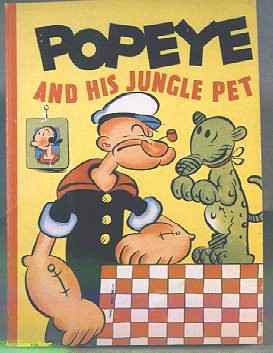
On 17 January 1929, Popeye The Sailor Man made his first appearance in print in the Thimble Theatre comic strip. Created by the US cartoonist EC Segar, as the series became increasingly popular more and more characters were introduced to the storyline, including Popeye’s mooching companion Wimpy, his bullying nemesis Bluto, and his stridewallop girlfriend Olive Oyl (who had already made her first appearance in a different comic series ten years earlier). Popeye and Olive eventually adopted a son, Swee’Pea, tracked down Popeye’s estranged father, Poopdeck Pappy, and in 1936 encountered “a mysterious strange animal” called Eugene the Jeep.

Eugene was introduced to the Popeye series when Olive Oyl was given a “jeep”—a highly intelligent dog-like animal with bright yellow fur and a large red nose—as a gift from her uncle. Puzzled by the creature’s appearance, in one edition Popeye calls in an expert, who enthusiastically explains that a “jeep” is “an animal living in a three-dimensional world … but really belonging to a fourth dimensional world.” Throughout several subsequent episodes and escapades, Eugene is ultimately shown being able to travel through time, walk through walls and doors, and teleport effortlessly from one place to another. Put another way, the “jeep” could go wherever he wanted, whenever he wanted to.

Not long after Eugene made his first appearance in 1936, the Willys-Overland Motor Company in Toledo began manufacturing its model MB Army Truck. Powerful and robust, and able to cross practically any terrain, the MB seemed to embody all of Eugene’s most impressive capabilities. As a result, it soon became known as the “jeep”—a nickname partly inspired by the earlier military slang term “GP”, and partly inspired by Popeye’s bizarre teleporting pet. 

As a representative of Willys-Overland explained in a letter in 1944:

We feel that the word [jeep] originated with Segar, King Features cartoonist, who until his recent death wrote the Popeye strips. You will recall that in this feature there was a character called “Jeep” which lived on orchids and could go anywhere and do anything. It is our contention that the boys in the service picked this name up from Segar and applied it to the Willys vehicle which has many of the “go-anywhere, do anything” characteristics of the Popeye character.
After the outbreak of the Second World War, the MB became the focus of numerous public demonstrations, all of which helped to popularize the word jeep outside of military slang: as early as February 1941, a publicity stunt was organised in which a Willys truck was driven up the steps of the Capitol Building in Washington DC, with a local newspaper report noting that “the Army’s new scout cars” were already “known as ‘jeeps’”. 

Soon, all earlier uses of the word had vanished, and the name jeep had established itself as a standard nickname for any relatively small, yet still relatively powerful, truck.