_
Showing posts with label military. Show all posts

1 April 2016

Cacafuego


There’s really no nice way of putting this, but the fact is that poop crops up more often than it duly should on this blog. And thanks to a tweet from the HH feed the other day, we’re going back down that way again now:


There’s no denying that cacafuego is a brilliant (and unavoidably useful) word, but is it really genuine? Or, to put it another way:


Wow, imagine if that were true. A plot twist to put M Night Shyamalan to shame. But let’s not get bogged down in piss halfway through a blog about shit, so to speak.

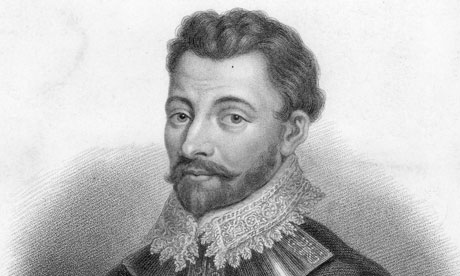
No prizes for guessing that cacafuego was borrowed into English from Spanish, and combines the verb cacar (modern Spanish cagar, “to void excrement”) with fuego, “fire”. It first appeared in English as another word for a blustering braggart in the early 1600s, but we can be fairly sure that it was in use before then thanks to the somewhat unlikely-sounding involvement of Sir Francis Drake.


Sir Francis Drake: looking a little ruff
In 1578, part-way through his circumnavigation of the Earth, Drake rounded Cape Horn and entered the Pacific Ocean, hot on the heels of a 120-tonne Spanish galleon called the Nuestra Señora that he had heard was laden with a rich cargo of silver and jewels from the Spanish colonies. And he wanted it.
Sailing up the Pacific coast of South America, Drake’s Golden Hind caught up with the Nuestra Señora off the coast of Ecuador. Knowing that an attack made under the cover of darkness was his best bet, he slowed his progress by tying some of his ship’s store of wine to the stern and throwing it overboard, so that by the time the Hind reached the Nuestra Señora it was the middle of the night. The Spanish crew were taken by surprise, and after a brief skirmish they surrendered, allowing Drake and his men to take control of the ship.
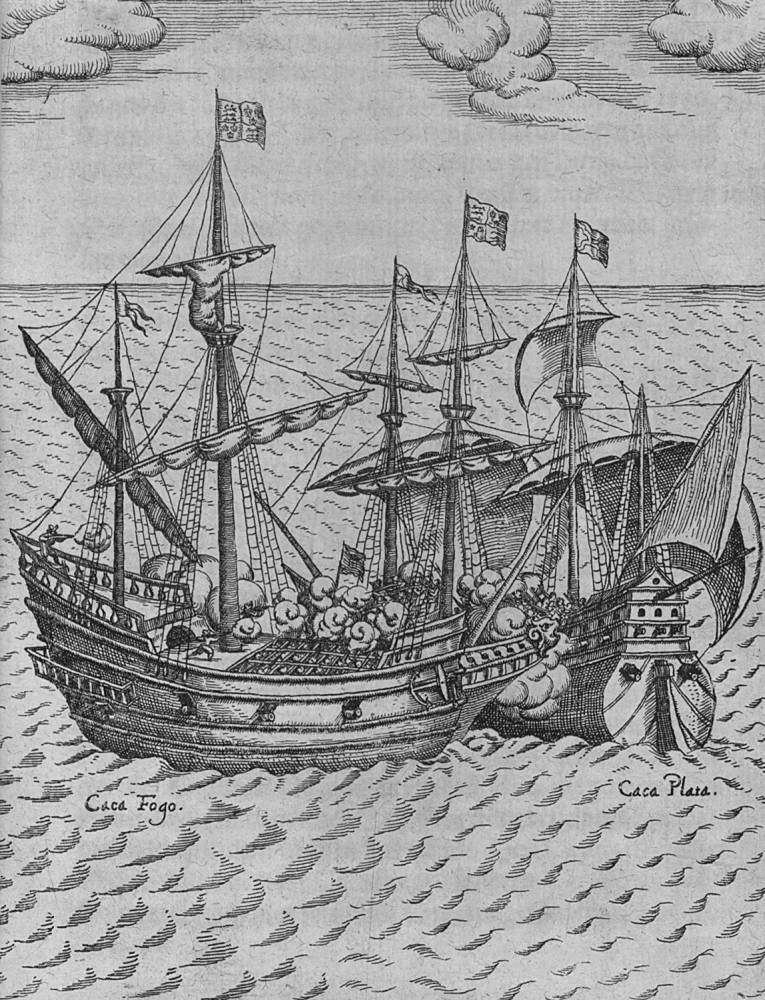

Drake sailed both the Nuestra Señora and the Golden Hind back to the South American coast to unload her treasure. Knowing just how substantial a prize he had secured for England he treated the Spanish crew well, inviting the officers to join him for a grand banquet and giving every crewmember a parting gift and a letter of safe conduct, ensuring as safe a journey home to Europe as possible. Drake himself continued on his journey, and having completed his circumnavigation arrived back in Plymouth on 26 November 1580.

So where does all the flaming poop come into this? Well, Drake’s captured galleon might have been officially known as the Nuestra Señora de la Concepción, or “Our Lady of the Immaculate Conception”, but to her crew she was the Cacafuego, or “fire-shitter”. That might seem like an odd (and fairly uncomplimentary) nickname for—well, anything really, but just like the Spitfire centuries after her, it was probably intended to be a reference to her impressive weaponry and blazing cannon fire, or else to her speed through the water and her “fiery” temperament. 

And just as spitfire was once a nickname for an irascible, hot-tempered person, in the seventeenth century cacafuego became a byword for a blustering, swaggering braggart—a meaning perhaps influenced by the fact that, despite her impressive armoury, the Cacafuego had proved no match for Drake. 


24 July 2015

Admiral

Last week HaggardHawks tweeted this screenshot, taken from a brilliantly-titled dictionary of Slang and Its Analogues Past and Present, published in 1890:
  

And, well, it probably all needs a bit more explaining.


Admiral is one of those deceptively straightforward words behind which lies the kind of history that keeps etymologists awake at night. They should really cut down on the caffeine after 5pm. It’s all a bit of a bewildering hodgepodge—the OED’s etymology alone comprises a 1300-word essay—but the basic theory is that, at its root, admiral derives from the old Arabic title amir, as in emir and emirates. This ancient title was then borrowed into and reshaped by the vocabularies of various Mediterranean countries and cultures around 1000 years ago, and via the all-conquering Normans eventually began to appear in English texts in the early thirteenth century.

Initially, admiral was used as a fairly general title for a ruler, a leader, or a military commander; things get confusing when we try to find out how it came to be used exclusively of a naval leader.

The first person we know to have held a naval title along the lines of admiral was the not-all-that-impressive-sounding George of Antioch in the early 1100s. George, who had already worked in several similar naval positions in Arabic-speaking North Africa, was put in charge of the fleet of the even-less-impressive-sounding Roger II, a twelfth-century King of Sicily, who gave him the Latin title ammiratus ammiratorum. 

It’s around this time that (etymologically, at least) things become a little hazy: it could be that George’s title ammiratus is a Mediaeval Latin spin on the Arabic title amir, which George would certainly have known of having served in North Africa. Alternatively, it could be a purely Latin title, with no connection to Arabic at all—on its own, ammiratus ammiratorum literally means “the most admired of the admired”.

Wherever the word’s ancient history might lead us from there, however, the fact is that by the time of George’s appointment Sicily too had been conquered by the Norman French—and it was the Normans who were responsible for transplanting the title from the sunny southern Mediterranean to the rainy European northwest. 

So. If that’s the story of admiral, what about the admiral of the narrow seas?

Well, in eighteenth century slang—long after admiral had established itself as a naval title in England—a curious trend emerged for applying fictitious “titles” to various people and characters. So a Captain Queernabs was “a shabby, ill-dressed fellow”, and a Captain Cork was a man who was “slow in passing the bottle”. A boatswain-captain was the naval equivalent of a swot: an overly competent seaman who never seemed to put a foot wrong. An admiral of the red was a wine-drinker. An admiral of the white was a coward. An admiral of the blue was a drunkard, or a publican (who would typically wear a blue tabard). An admiral of the red, white and blue was a ludicrously or ostentatiously dressed person. And an admiral of the narrow seas was the queasy, mulvathered seafarer mentioned above.

A vice admiral of the narrow seas, meanwhile, was an even worse drinking companion:


6 July 2015

Jeep

Something over on @HaggardHawks caused a bit of a stir the other day:
For once, the main word here wasn’t the problem. Instead, what seems to have caused the most head-scratching was the inclusion of the word jeep as an example of an acronym:
Quite right too, it is a brand name. But as far as most etymological theories are concerned, it’s also an acronym. As well as an anacronym. With a reference to an obscure cartoon character thrown in for good measure. Confused? You’re not the only one...

So, first things first: how exactly is jeep an acronym? Well, the most likely theory is that the word jeep developed from an approximate pronunciation of the letters “GP”, an old military designation standing for “general purpose”. Ultimately, it’s thought that when it first appeared in American army slang in the early 1930s, the nickname jeep was originally applied to any item of widely-used military equipment, including various gadgets and gizmos, weaponry, cars, trucks, helicopters, and even early flight simulators. 

If this theory is correct, then jeep is an example of what is known as a “respelled initialism”, an acronym whose letters have been spelled out phonetically to form a whole new word. Linguistically these “respelled” acronyms—also known as “vocologues”—comprise a fairly rare class of words, but understandably so: after all, acronyms are motivated by brevity, so there’s little point in making them any longer than they need to be. Nevertheless, a handful of examples have emerged over the years, including emcee (from MC, a “master of ceremonies”), deejay (from DJ, a “disc jockey”), the brand name Esso (from SO, “Standard Oil”), and, most familiar of all, okay.

In the case of jeep, of course, the final –ee sound of “GP” (or “gee pee”) isn’t pronounced, which makes it an example of an even rarer class of words known as “clipped initialisms”—namely, acronyms that have been respelled phonetically, then shorted again. Veep, as a nickname for the Vice President, and Beeb, as a nickname for the BBC, both likewise fall into this category, but examples of this particular linguistic phenomenon are unsurprisingly few and far between.

There are a handful of other competing theories of the origin of jeep (at least one of which is outlined here), but most etymologists tend now to sign up to this “GP” explanation. However, many also agree that this particular story doesn’t end there, and that jeep was, somewhere along the line, influenced by something else—something, it’s fair to say, rather unexpected.


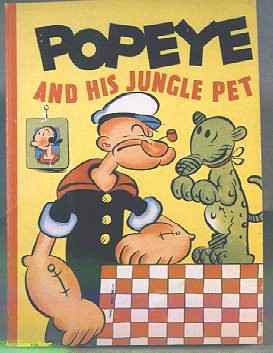
On 17 January 1929, Popeye The Sailor Man made his first appearance in print in the Thimble Theatre comic strip. Created by the US cartoonist EC Segar, as the series became increasingly popular more and more characters were introduced to the storyline, including Popeye’s mooching companion Wimpy, his bullying nemesis Bluto, and his stridewallop girlfriend Olive Oyl (who had already made her first appearance in a different comic series ten years earlier). Popeye and Olive eventually adopted a son, Swee’Pea, tracked down Popeye’s estranged father, Poopdeck Pappy, and in 1936 encountered “a mysterious strange animal” called Eugene the Jeep.

Eugene was introduced to the Popeye series when Olive Oyl was given a “jeep”—a highly intelligent dog-like animal with bright yellow fur and a large red nose—as a gift from her uncle. Puzzled by the creature’s appearance, in one edition Popeye calls in an expert, who enthusiastically explains that a “jeep” is “an animal living in a three-dimensional world … but really belonging to a fourth dimensional world.” Throughout several subsequent episodes and escapades, Eugene is ultimately shown being able to travel through time, walk through walls and doors, and teleport effortlessly from one place to another. Put another way, the “jeep” could go wherever he wanted, whenever he wanted to.

Not long after Eugene made his first appearance in 1936, the Willys-Overland Motor Company in Toledo began manufacturing its model MB Army Truck. Powerful and robust, and able to cross practically any terrain, the MB seemed to embody all of Eugene’s most impressive capabilities. As a result, it soon became known as the “jeep”—a nickname partly inspired by the earlier military slang term “GP”, and partly inspired by Popeye’s bizarre teleporting pet. 

As a representative of Willys-Overland explained in a letter in 1944:

We feel that the word [jeep] originated with Segar, King Features cartoonist, who until his recent death wrote the Popeye strips. You will recall that in this feature there was a character called “Jeep” which lived on orchids and could go anywhere and do anything. It is our contention that the boys in the service picked this name up from Segar and applied it to the Willys vehicle which has many of the “go-anywhere, do anything” characteristics of the Popeye character.
After the outbreak of the Second World War, the MB became the focus of numerous public demonstrations, all of which helped to popularize the word jeep outside of military slang: as early as February 1941, a publicity stunt was organised in which a Willys truck was driven up the steps of the Capitol Building in Washington DC, with a local newspaper report noting that “the Army’s new scout cars” were already “known as ‘jeeps’”. 

Soon, all earlier uses of the word had vanished, and the name jeep had established itself as a standard nickname for any relatively small, yet still relatively powerful, truck. 


6 June 2015

D-Day

Today marks the seventy-first anniversary of the Normandy Landings—perhaps better known as D-Day. Etymologically, there’s a longstanding myth that the D of D-Day stands for something along the lines of “disembarkation”, “decision”, or “deployment”, or even “Deutschland” or “Doomsday”, but in fact:
So if the D doesn’t standing for anything, why is it there at all?

The fact is that while military operations are being planned, it’s not always clear from the outset when they’ll actually take place. As a result, their future start date—whenever that may be—is simply referred to as “D-Day”, and this title acts as a placeholder until a specific date can be finalized. (Shameless plug: there’s more on this in the new book.) 

If anything, the D of D-Day could be said to derive from the word ‘day’ (indeed the French equivalent is J-Jour, and the exact time an operation takes place is known as H-Hour) but it certainly can’t be said to stand for it.

Not only that, but the term D-Day is also a lot older than most people think. The earliest record we have of its use dates not from the Second World War, but from the First, and an American military order sent out on 7 September 1918:
The First Army will attack at H-Hour on D-Day with the object of forcing the evacuation of St. Mihiel salient.
Saint-Mihiel is a small town in the Meuse department of north-eastern France, that for three days in September 1918 was the site of one of the most important United States military operations of the entire First World War. Under the command of US Army General John Pershing, an enormous body of American Expeditionary troops—including thousands from the newly-formed United States Army Air Service, now the US Air Force—secured a decisive Allied victory over an ill-prepared and chaotic German contingent.

The Battle of Saint-Mihiel lasted from 12-15 September, during which more than half a million US soldiers, alongside 110,000 French troops, fought to secure the strategically significant Saint-Mihiel “salient”—a technical term for a narrow, isolated strip of land projecting from one region into another—in the hope of eventually recapturing the larger French city of Metz. As it happens, the attack on Metz was never realized, and as the German forces continued to crumble the War came to an end just weeks later, on 11 November 1918.

The term D-Day continued to be used intermittently throughout the 1920s and 30s, until it became all but permanently attached to “Operation Neptune”—the military codename of the decisive Normandy Landings—on 6 June 1944.