_
Showing posts with label eponyms. Show all posts

26 June 2016

10 Chemical Element Names


So a lot of very big things have happened this week. For one, the UK voted to leave the European Union for some reason. Secondly, the shelves on the HH bookcase were starting to sag a bit in the middle, so they were rotated. And thirdly, the four new chemical elements discovered at the start of the year were given their names.


One of those stories is of much higher import than the others, of course, but don’t worry—those shelves will be fine. As for those chemical elements, well, the names chosen were nihonium, moscovium, tennessine and oganasson. Each has a story attached to it: the first three honour their places of discovery, Japan, Moscow and Tennessee respectively, while the last honours Russian-Armenian physicist Professor Yuri Oganessian.

Elsewhere on the periodic table, however, there are another 114 elementary etymologies to tell—although we only had enough time (and bandwidth) to talk about 10 in this week’s video…


Of course Yuri Oganessian and (SPOILER ALERT in case you haven’t watched the video) Vasili Samarsky-Bykhovets aren’t the only eponymous honourees on the periodic table. Elements like einsteinium, curium, bohrium and seaborgium honour some of the most famous names in science. 

Nor are nihonium, moscovium and their neighbours the only geographical namesakes: besides tennessine, America can offer berkelium and californium, as well as americium, while the UK has strontium, which takes its name via the mineral strontianite from the village of Strontian in the Scottish Highlands. And then there’s gallium, element number 31, which uniquely manages to honour both its place of discovery and—if the rumours are trumours—its discoverer.

The father of the periodic table, Dmitri Mendeleev (who has the element mendelevium named after him), predicted the existence of gallium in 1871, but it wasn’t until four years later the snappily-named French chemist Paul Émile Lecoq de Boisbaudran obtained a sample of it from the mineral sphalerite. The metal de Boisbaudran discovered was bright silver and brittle, and melted just above room temperature. He called it gallium, from Gallia, the Latin name for the Roman territory of Gaul, corresponding to modern-day France. But it’s possible he had other ideas in mind.

One of de Boisbaudran’s many, many names, Lecoq, means “the rooster” in French, while the Latin word for “rooster” is gallus. Had de Boisbaudran wryly named gallium after himself? Some fellow scientists at the time accused him of such, but he insisted that the connection was purely coincidental. Even if it was, it’s certainly a very convenient one and makes de Boisbaudran an interesting footnote to the dozens of famous names honoured on the periodic table. 


27 May 2016

10 Portmanteau Words

If you follow the HaggardHawks Twitter feed, you might have spotted the word insinuendo the other day, meaning “an insinuated remark”. According to the late Oxford English Dictionary editor Robert Burchfield, insinuendo is a “tasteless word.” Well, there’s no accounting for taste, of course, but as well as being “tasteless”, insinuendo is also a portmanteau—a blended word that brings together two existing words to form a new one. 

And it’s 10 of those we’re looking at in this week’s YouTube video.


As mentioned in the video, the term portmanteau was first used to describe “blended” words like these by Lewis Carroll, who took the name of a type of suitcase with two separate compartments, and applied it to terms in which “there are two meanings packed up into one word”.

Although Carroll was writing in 1871, it’s tempting to think of portmanteau words as a much more modern phenomenon. It’s certainly true that “blending” words together to form (albeit often fairly clumsy) new ones is still a very fruitful word-forming process today—you can take your pick from any number of recent examples, like fandom, bromance, mocktail, cosplay, metrosexual, guyliner, Brangelina, Twitterati, edutainment, frappuccino, snowmaggedon, favicon, chillax, rockumentary and mockumentary.

But despite their modern appearances, a lot of portmanteau are much older than they first appear—even insinuendo dates back to 1885.

Take a word like newscast, for example. Despite it’s relatively modern feel, its earliest appearance in the language dates from 1928, when it cropped up in an edition of Time magazine. The first motorcade drove through Rockford, Illinois, back in 1910. People have been eating with sporks since 1909, and enjoying brunch for even longer—it’s earliest record comes from an 1896 edition of the satirical magazine Punch that called it “an excellent portmanteau word … indicating a combined breakfast and lunch”. Unfortunately, another word the magazine tried to champion didn’t catch on:
At Oxford, however, two years ago, an important distinction was drawn. The combination-meal, when nearer the usual breakfast hour, is ‘brunch’, and when nearer luncheon, is ‘blunch’.
Another early portmanteau—which sadly didn’t make the final cut in our video—is gerrymander. (Shameless plug #495: there’s more on this in the HH factbook, Word Drops—which is now out in the USA!)

Gerrymander derives from the name of American politician and diplomat Elbridge Gerry. Gerry was serving as a Governor of Massachusetts when in 1812 he signed a bill that redrew the boundaries of Massachusetts’ state senate electoral districts so that they would most benefit his Democratic-Republican Party. This practice was certainly nothing new (the Anti-Federalist leader Patrick Henry had tried the same trick in Virginia back in 1788), but it nevertheless soon became known as gerrymandering—a combination Gerry’s surname and the word salamander.

Why a salamander? Well, an article in the Boston Globe on 26 March 1812 happened to liken the shape of one of Gerry’s redrawn districts to that of a salamander, a lizard-like amphibian:


Frankly, that’s the most un-salamandery salamander I’ve ever seen, but nevertheless the name stuck.

But did Gerry’s gerrymandering work? It certainly did. At the 1812 election, the senate remained in his party’s hands. Gerry himself, however, lost his seat—but went on to serve as Vice President under James Madison the following year.


15 April 2016

Lazy Lawrence


A long-forgotten (but no less useful) expression popped up on the HaggardHawks Twitter feed the other day:


And this isn’t the only proverbially lazy Lawrence to find his way into the dictionary. Long before lazy people had “Lawrence on their backs” there was an earlier expression, Lawrence bids wages, that the OED explains was used to imply that “the attractions of idleness are tempting”—or, in other words, doing nothing looks like a lot of fun. Even Lazy Lawrence itself has been used as a nickname for an idling lazybones for centuries, as well as being the name of a mischievous fairy or sprite supposed to induce lethargy or idleness.

So apologies to anyone named Lawrence, but you’re immortalized in the language as a metaphor for laziness. Still, it’s better than being known for a one-year prison sentence or destroying gates, I suppose. But why Lawrence? And why laziness?

Well, one theory is that the connection is purely coincidence, and that Lawrence just has a nice alliterative ring to it—so this could just as easily be “Lazy Linda”, or “Leon bids wages”, or “to have Loretta Lynn on your back”. It’s certainly plausible (well, apart from the Loretta Lynn bit) but needless to say there are a couple of more imaginative explanations on offer. And one of them even involves a barbecued saint, what more could you want?

One theory is that phrases like these refer to St Lawrence’s Day, 10 August. That date puts it bang in the middle of the “dog days” at the height of the summer, when you can expect to endure the hottest, sultriest, most stifling weather of the year—the kind of weather that makes you want to lounge around and do nothing except lounging around doing nothing. The dog days are traditionally said to last anywhere from mid July to early September, and take their name from the tradition—probably started in Ancient Greece, if not Ancient Egypt—that the appearance during the summer months of Sirius, the Dog Star, just above the horizon before sunrise somehow amplified or added to the heat of the Sun. In fact, the so-called “heliacal rising” of Sirius always occurs sometime around August 10–11.


You cannot be Sirius

So is our proverbially lazy Lawrence inspired by the highest hottest heat of high summer? Possibly. But we can’t ignore the fact that there’d be no St Lawrence’s Day without St Lawrence himself. 

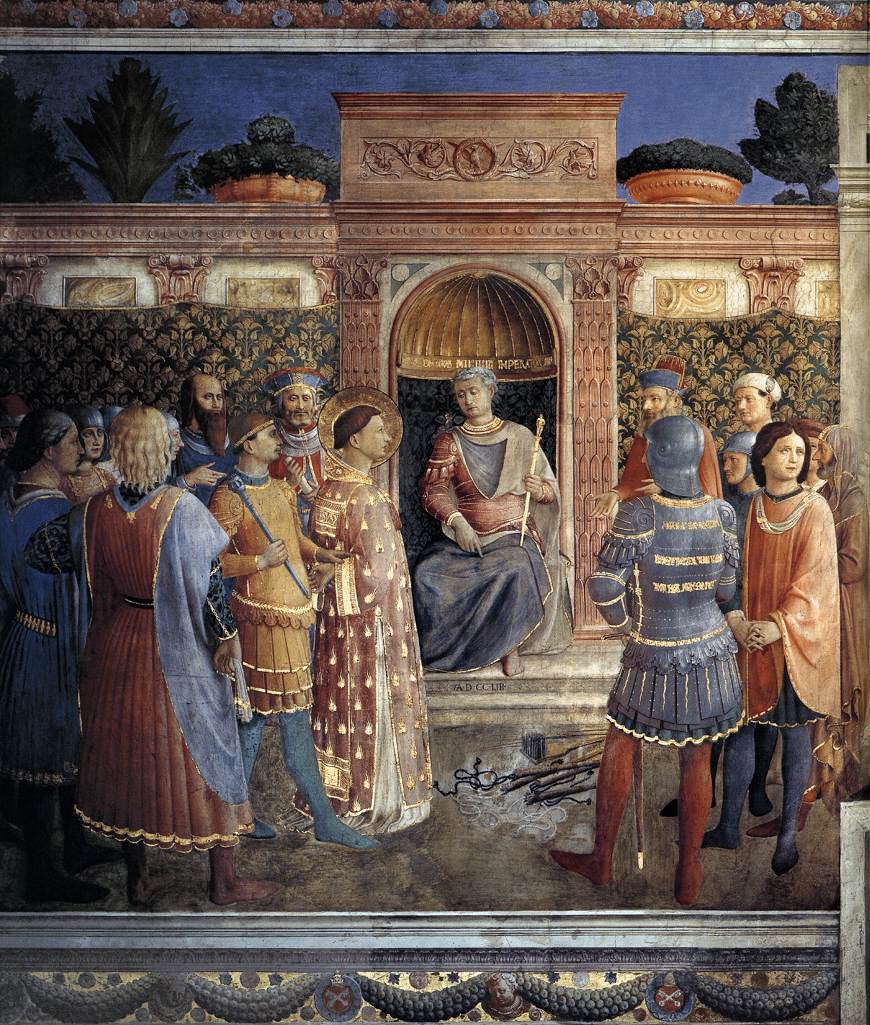
Lawrence of Rome was the highest-ranking of seven deacons that served under Pope Sixtus II in the 3rd century AD, whose job it was to oversee the church’s treasury and distribute alms to the poor. Everything was going splendidly for Lawrence until August AD258, when a letter arrived at the Senate from the Roman Emperor Valerian—who was imprisoned in Antioch, having left Rome to fight a war with the Persians—calling for all Christian senators to be stripped of their titles and assets, and for all priests, bishops and deacons to be arrested. If they renounced their faith and agreed to perform a sacrifice to the Roman gods, they would be freed. If they refused, they would be put to death. Valerian, it seems, wasn’t going to let a little thing like being held in prison 2,000 miles away stop him from running his Empire.

In accordance with Valerian’s orders, the Senate rounded up Pope Sixtus and his seven deacons. All eight refused to comply with the edict, and so, on 6 August 258, they were beheaded—all, that is, except Lawrence. As the archdeacon in charge of the treasury, Lawrence was given a three-day stay of execution to collect together all the church’s wealth and hand it over to the Roman state; instead, he reportedly spent the next three days giving as much of the money away as he could. On August 9, he returned to the Senate with a group of Rome’s poorest, sickest, neediest citizens, and boldly claimed that these were the true treasures of the church. The Prefect of Rome, frankly, was far from pleased.

Whereas Pope Sixtus and his other deacons had been beheaded, Lawrence’s singular act of defiance earned him an especially cruel death: the sentence was passed that he should be roasted to death, suspended on a gridiron above roaring fire.

Baby catching was all the rage in Ancient Rome

There’s some disagreement over whether or not Lawrence was actually burned to death in this way, because some sources claim that the Latin record of his death (assus est, “he was roasted”) should actually have read passus est, “he suffered”. But whether true or not, the question still remains—what does an early Christian martyr’s gruesome execution have to do with laziness?

Well, Lawrence’s death was so notably brutal that it soon became the subject of a macabre bit of folklore that claimed midway through his roasting Lawrence had quipped, “Turn me over, I’m done on this side!” It might sound more Groucho Marx than it does Archdeacon of Rome (and you can make your own mind up as to whether he actually said it or not), but this legend nevertheless apparently inspired a joke that Lawrence was “too lazy” to turn himself over. 

So is this the true origin of our lazy Lawrences? It’s impossible to say for sure, but it’s a good story all the same. And one well worth telling round the barbecue this summer.


29 March 2016

The Feynman Point

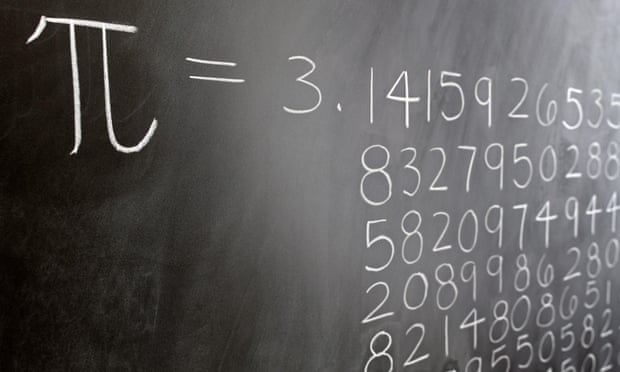
If you saw our video of words derived from numbers earlier this month, you’ll know that March 14 was Pi Day (or rather, the once-in-a-century Rounded-Up Pi Day), because when it’s written out numerically the date “3.14.16” forms the first few digits of pi.

Besides our mathematically-themed video, however, over on the HaggardHawks Twitter feed we marked Pi Day with this fairly remarkable fact:


Now. We’re not mathematicians here at HaggardHawks, and frankly the very idea of discussing the irrationality of an approximation of the mathematical constant representing the ratio of the circumference of a circle to its diametzzzzzzzzzzzzzzz…

Only joking, mathematicians, we love you really. But even dusty, bookish old wordsmiths like us can find some interest in mathematics every so often, and the Feynman Point is one of those times. So we thought you might like to know a little bit more about the point behind The Point.

The “Feynman” of the Feynman Point is the American theoretical physicist Richard Feynman. In a lifetime of achievement and accomplishment, Feynman did everything from helping develop the atomic bomb to assisting in the commission that investigated the Challenger disaster in 1986. He was also jointly awarded the 1965 Nobel Prize for Physics for his “fundamental work in quantum electrodynamics”, including his groundbreaking work on quantum path integral formulation challenging the existing notion of a unique quantum trajectory by replacing it with a functional integralzzzzzzzzzz…

Only joking, physicists, we love you as well. But long story short, Richard Feynman was a brilliant scientist—and he was also very interested in π.

According to the story, during a lecture at the California Institute of Technology, Feynman joked to his students that he would one day like to memorize pi up to the point, 762 decimal places in, that there are six consecutive nines. Why? Well, he wanted reach that particular repdigit and then state “...999999, and so on”, implying that the famously irrational π suddenly, 762 places in, becomes nothing more than an infinite chain of 9s.

Regrettably there’s little evidence that Feynman ever actually made that joke (and in fact the earliest account of it credits it to fellow scientist Douglas Hofstader), but it’s Feynman’s name that has ended up being attached to these six consecutive 9s, and its his name that has remained in place ever since.

Incidentally, another six consecutive 9s crop up in the 193,034th–193,039th decimal places of pi. Anyone fancy memorizing up to there? You could get your name in the dictionary if you do...