_
Showing posts with label facts. Show all posts

2 August 2016

10 Words For Other Words


If you’ve been keeping up with the HH “500 Words” YouTube series, you’ll so far have found out about 280 of the 500 words we’re going to look at this year. But this week, we’re turning things around. 

So from hypernyms and hyponyms to holonyms and holophrases, this week’s video is looking at 10 Words for Other Words.


(And for more words like those, then be sure to check out the HH article that inspired it over on Mental Floss.)

One word that didn’t make the final cut here, however, is backronym. We’ve discussed some backronyms on YouTube before—mainly in our 10 Word Origins Stories That Are Completely Untrue video—and it’s a myth-busting topic that’s always worth revisiting.

Backronyms are words or phrases that are widely and mistakenly believed purported to be acronyms. Posh, for instance, is often claimed to stand for “port out, starboard home”, a reference to moneyed cruise ship passengers paying for the best views on both the outward and homeward bound parts of their voyage. Golf too is said to stand for “gentlemen only, ladies forbidden” (or ladies do something else that begins with F). And the distress signal SOS is famously claimed to stand for “save our souls”, or “save our ship”.


“It says, ‘you may have been missold PPI.’”

None of these is true, of course. Posh is simply thought to come from an old slang word for cash or loose change. Golf is probably descended from an old Dutch word for a club, colf or kulf (albeit with perhaps some influence of a Scots word for a stout blow to the head). And the letter combination “SOS” was chosen as a distress signal for no other reason than that its rhythmic and symmetrical combination of dots and dashes [· · · – – – · · ·] is so immediately noticeable. Incidentally, precisely the same combination of dots and dashes could also be used to spell the letters “VTB” in Morse code, but the designation SOS was used because of its own symmetry and memorability.


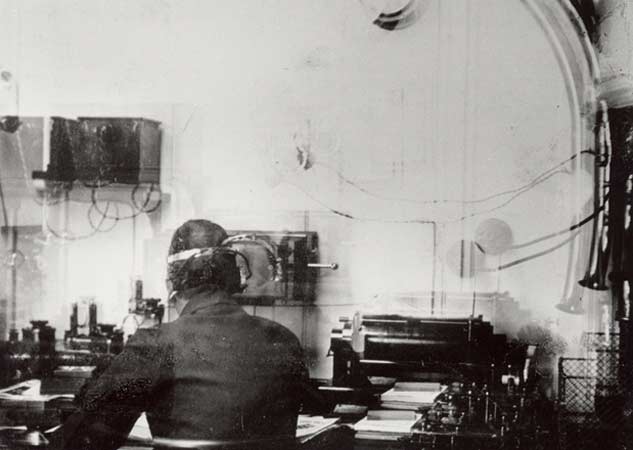
Before SOS was adopted in the early 1900s, however, the standard telegraph distress signal was “CQD” [– · – ·    – – · –    – · ·]. It’s fair to say that that’s hardly the most recognisable or memorable arrangement of dits and dahs on offer, so why pick that?

Well, on their own the letters “CQ” had long been used as a telegraphic distress signal as they sound identical to the French word “sécu”, an abbreviation of sécurité. The Marconi Telegraph Company simply added a letter D to this to make their first recommended distress signal, CQD. But just like SOS, CQD also fell foul of backronymy and before long myths had emerged claimed that it stood for “come quickly—danger!”, or “come quickly—drowning!”

Problems with interpreting the confusing set of letters “CQD” over a poor signal, however, eventually led to calls for a more immediately recognizable distress signal to be adopted, and so SOS was officially introduced in 1906. 


25 April 2016

#Shakespeare400


You probably noticed a bit of a hoo-hah at the weekend surrounding the 400th deathiversary of someone called William Shakespeare. We marked the day with a video about 10 unsolved Shakespearean terms over on YouTube and a missing words quiz here on the HH blog, while over on Twitter we were ridiculously busy bombarding you with half-hourly tweets about the great man himself all day Saturday. And apologies to all non-Shakespeare fans out there, but we’re going to do the same again now.

There were quite a few calls over on Twitter for us to collate all our Shakespeare facts in one place. And as ever, your wish is our command. So from a Shakespearean shipwreck to a man extinguishing his trousers with beer, here is our #Shakespeare400 list in full:

23 April 2016

10 Words Shakespeare Used That No One Can Work Out


In honour of the #Shakespeare400 anniversary on 23 April 2016, this week’s HaggardHawks YouTube video is looking at a part of Shakespeare’s writing that isn’t dealt with all too often.

Everybody knows Shakespeare invented a considerable number of the 31,534 words he used in his work—as many as 1 in every 20, if some statistics are to be believed—and alongside those, he transformed many pre-existing words into different parts of speech, a process known as anthimeria. So if you’ve ever grazed, squabbled with, elbowed, caked or ghosted someone, then you’ve got Shakespeare to thank for it: none of those had been used as verbs before he got hold of them...

All this linguistic playfulness, however (coupled with the obvious fact that his writing is four centuries old) can make Shakespeare’s work tough to navigate these days, and a little patience and background knowledge is often are needed to unlock some of his toughest lines. But even the best Shakespeare scholars have to admit that—well,  sometimes we just don’t know what the hell he’s talking about.

Armgaunt. Eftest. Pajock. In his buttons. The list of words and phrases that crop up in Shakespeare’s work that no one can quite decipher runs on and on. But just because we don’t know for sure what he meant doesn’t mean that we can’t have an educated guess. And it’s that that we’re looking at in this week’s video…


18 February 2016

10 Words For Things You Didn’t Know There Were Words For

If there’s one thing @HaggardHawks deals in more than anything else, it’s words that you never knew existed—and in this week’s #500Words video, we have 10 examples of precisely that.

From the spike in the middle of a sundial to the white tip at the end of a fox’s tail, from the handle of a ladle to the handle of a spade, and from the V-shaped indentation in the middle of your top lip to the L-shape formed by your hand when you extend your thumb, this week’s list of 10 Words For Things You Didn’t Know There Were Words For includes some utterly indispensable/entirely useless (delete as appropriate) additions to your vocabulary. 


10 February 2016

Uranus

Before we begin, let’s get a few things out of the way. The noxious atmosphere around Uranus could kill a man. Uranus has a circumference of 100,000 miles. Scientists are looking at a black hole near Uranus. What are those two circular objects either side of Uranus? Ass-teroids, of course. If you got through that without laughing, then we’re good to go.

So. The other day, one of those stop-you-in-your-tracks facts cropped up on the @HaggardHawks Twitter feed:


But this really is too bizarre a fact to leave unexplained:


…so your wish is my command.

The discovery of Uranus (stop sniggering, you at the back) is credited to the German-born English astronomer William Herschel in 1781. Although it had been observed by scientists and astronomers for centuries, Uranus had always been mistaken for a star, and right up to Herschel’s discovery it was still being classed as 34 Tauri, a minor star in the constellation Taurus. Even Herschel himself initially believed he had spotted a comet rather than a planet, after noting that an object he had been looking at from his observatory in Bath had changed position in the sky over a series of nights.

Herschel announced his discovery in March 1781. As word of his new “comet” spread, astronomers all across Europe began to take note and observe it themselves. Soon, enough data had been compiled to plot its apparent trajectory—which, to everyone’s surprise, appeared to be an almost perfect circular orbit around the Sun. Herschel’s discovery was no comet.

Full colour photo of Uranus. Stop laughing.

By 1783, it had become universally acknowledged that Herschel’s discovery must surely be a planet—moreover, it was the first planet ever discovered by telescope, and the first new planet added to our Solar System in modern history. It was a truly monumental discovery, and one that earned Herschel an annual salary of £200 (equivalent to £27,000/$40,000 today) from King George III (on the condition that he move his observatory from Bath to Windsor, to be closer to the royal household), as well as the never-to-be-repeated title of Court Astronomer to The King.

But with the existence of a new planet confirmed, a pressing question soon emerged: what on Earth should it be called?

The Astronomer Royal, Nevil Maskelyne, wrote to Herschel asking him “to do the astronomical world the favour” and “give a name to your planet,” which, he continued, “is entirely your own, [and] which we are so much obliged to you for the discovery of.” In honour of his new financial patron, Herschel plumped for the only name he saw fit: Georgium Sidus, or “George’s Star.” He wrote to the Royal Society:

In the fabulous ages of ancient times the appellations of Mercury, Venus, Mars, Jupiter and Saturn were given to the Planets, as being the names of their principal heroes and divinities… The first consideration of any particular event, or remarkable incident, seems to be its chronology: if in any future age it should be asked, when this last-found Planet was discovered? It would be a very satisfactory answer to say, “In the reign of King George the Third”.

The seventh planet from the Sun, ultimately, was to be called George. But the response to Herschel’s suggestion was far from encouraging.

Outside of Europe, astronomers were wary of using a such an explicitly “British” name, especially given that it had taken an international collaboration to prove its status as a planet. Consequently, despite Maskelyne specifying that Herschel’s discovery and his choice of name were “entirely his own”, George failed to gain any widespread use or permanency. The name Georgium Sidus effectively became a placeholder, and over the years that followed astronomers across Europe began utilising and pitching their own choices and suggestions.

One popular choice was simply Herschel, a name honouring its discoverer. The Swedish astronomer Erik Prosperin ironically opted for Neptune (now the name of the eighth planet, discovered in 1846). But eventually a clear choice emerged—namely the German astronomer Johann Elert Bode’s suggestion, Uranus.

Bode had been one of the European astronomers who had calculated Uranus’ orbit, lending weight to the idea that Herschel’s discovery was a planet not a star. He suggested the name Uranus as it not only maintained the classical and mythological theme set out by the other six planets, but fittingly Uranus was the Greek god of the sky. Moreover, just as Saturn had been the father of Jupiter, Uranus was the father of Saturn, thereby creating a mythological family tree in the heavens.

Bose’s choice quickly gained momentum, and was reinforced by the German chemist Martin Klaproth in 1789, who named his famous discovery—the chemical element uranium—in support of Bose’s suggestion.

Out of deference to Herschel, however, it took another 60 years for the name Uranus to be universally acknowledged by the scientific community, when, in 1850, the official astronomical almanac published by the Royal Greenwich Observatory in London finally abandoned Herschel’s Georgium Sidus and in favour of Uranus.


4 January 2016

100 words worth knowing

Typical. You wait months for a milestone to come along, and then two come along at once. 

Just two days after reaching the 15,000 followers mark, the @HaggardHawks Twitter feed tweeted its 10,000th tweet in the early hours of Monday morning. If you’ve been with us since the start (and some of you certainly have), that’s 10,000 obscure and unusual words you’ve potentially added to your vocabulary. So apologies for fuelling your lexiphanic tendencies—you may well be guilty of gadzookery, but at least you can now consider yourself a logodaedalus.

But for those of you who have joined us more recently—or for those of you who might have forgotten some of the best HH words (which would make two of us...)—not to worry. To mark our 10,000th tweet, and to refresh our collective memory, here are 100 HaggardHawks words that are well worth remembering, each linked to its original tweet should you want to read or share it over on Twitter.

Thanks again everyone for following, and stay tuned for another development very soon…


  1. The pleasant feeling that follows a nice dream is euneirophrenia. 
  2. Bomphiologia is boastful, self-aggrandizing language. 
  3. To famgrasp is to shake someone’s hand...
  4. ...while kissing a woman’s hand on meeting her is called a baisemain. 
  5. To unhappen something is to make it look like it never took place. 
  6. A growlery is somewhere you like to retire to when you’re ill or in a bad mood. 
  7. If you’re comfoozled then you’re utterly exhausted. 
  8. An autohagiography is an autobiography that makes its subject look better than they are. 
  9. A ridibundal person is prone to laugh at things. 
  10. A hangy-bangy is a good-for-nothing. 
  11. An ohnosecond is a moment between doing something and realising you shouldn’t have done it.
  12. Jamais-vu is the opposite of déjà-vu...
  13. ...and a eucatastrophe is the opposite of a catastrophe.
  14. If you’re noctivagant then you like to wander around at night. 
  15. A gowkthropple is someone who frequently uses bad language.
  16. To jirble is to spill liquid while pouring it with shaking hands. 
  17. Old women who gossip over tea and cakes? They’re muffin-wallopers.
  18. Huckmuck is the feeling of confusion caused by things not being in the right place.
  19. A bessybab is an adult that likes childish things. 
  20. To dacker is to deliberately spin out a simple task just to fill up a day’s work.
  21. Killing time is temporicide. 
  22. To do something lickfaladity is to do it with full force. 
  23. A miscomhap is a stroke of bad luck. 
  24. Infucation is the process of applying makeup. 
  25. A sudden feeling of grief when you remember a loss is a stound. 
  26. If you’re parvipotent then you have very little power. 
  27. A buccula is a double chin. 
  28. Shivviness is the uncomfortable feeling caused by wearing new underwear.
  29. A muck-robin is a child who likes deliberately annoying adults. 
  30. To goufter is to laugh heartily. 
  31. Looking younger than your age is called agerasia. 
  32. Posing a question and then immediately answering it yourself? That’s sermocination.
  33. An ichnogram is a footprint. 
  34. Talking in your sleep is somniloquy. 
  35. An aquabib is someone who drinks water, not alcohol. 
  36. To honeyfuggle someone is to trick or deceive them. 
  37. A zwodder is a drowsy, stupid state of mind. 
  38. A callomaniac is someone who believes they’re more beautiful than they really are. 
  39. To walk in shoes that are too big for your feet is to clomph. 
  40. Cats that like to climb along high shelves are climb-tacks. 
  41. To titty-toit is to tidy up. 
  42. Aimlessly wandering the streets is vicambulation. 
  43. If you’re ludibrious, then you’re the butt of the joke. 
  44. A compulsion to look at awful things, like horror movies, is called cacospectomania.
  45. A mouse-nook is a hard-to-reach, hard-to-clean corner of a room. 
  46. Mogshade is the shade provided by trees. 
  47. A puckfist is someone who braggingly dominates a conversation. 
  48. To constantly repeat something so that it loses all meaning is to battologize. 
  49. The drops of food or drink that fall down your chin when eating are your lebber-beard. 
  50. To sklute is to fall into something wet or muddy. 
  51. An onomasticon is a list of names. 
  52. Speaking through gritted teeth is dentiloquy. 
  53. If you’re pawp-footed, then you’re prone to walk into things. 
  54. To dedoleate is to cease being upset. 
  55. Your opisthenar is the back of your hand. 
  56. The drops of rain that drip from things after it’s stopped raining are the easing-drops.  
  57. If something is xyresic then it’s razor-sharp. 
  58. Making mistakes at work because you’re so tired or bored? That’s fauchling. 
  59. To scurryfunge is to hastily tidy a house. 
  60. Using a fan to cool yourself down is flabellation. 
  61. A crinkie-winkie is a fuss over nothing, or a pointless reason for not doing something. 
  62. The boredom that comes with being unwell is alysm. 
  63. Oysterhood is unsociableness or an overwhelming desire to stay at home. 
  64. A nonty-niddlety is a fool. 
  65. A zoilist is an unfair critic, or someone who loves complaining or finding fault.
  66. A spinkie-den is a woodland clearing full of flowers. 
  67. Trinkgeld is money intended only to be spent on drink. 
  68. A fyoag is a loud, cheerful laugh. 
  69. Anything that is hoozy-poozy is done just to pass the time. 
  70. A brother-chip is someone who does the same job as you...
  71. ...while a nameling is someone with the same name as you. 
  72. Something that is isochroöus is the same colour outside and throughout. 
  73. Untidy or unpleasant work is vargling. 
  74. If you’re floby-mobly, then you’re not unwell, but still not quite feeling your best.
  75. The stiffness in your legs after a long walk is called hansper. 
  76. Eating your words is autologophagy. 
  77. A lennochmore is a larger-than-average baby. 
  78. Glutching is trying to stifle sobs or cries. 
  79. A scliff is an old, worn out shoe. 
  80. The loose feathers that fall out of cushions and pillows is called culf. 
  81. To bang-a-bonk is to sit lazily on a riverbank. 
  82. Armogan is the perfect weather for travelling...
  83. ...while hurling-weather is the perfect weather for drying clothes... 
  84. ...and if the weather flenches, then it looks like it might improve but never does.
  85. An adoxography is a great work written about a pointless subject. 
  86. Crockans are bits of food that shrivel up during cooking. 
  87. Hanging around with nothing to do? That’s lobbeting. 
  88. Saturday-wit is dirty jokes. 
  89. A waffle-frolic is a sumptuous meal or feast. 
  90. To twankle is to idly play a musical instrument. 
  91. Superalimentation is eating too much food. 
  92. The process of taking off your shoes? That’s discalceation. 
  93. A scripturient person has a constant desire to write. 
  94. Trying to cover up the fact that you’re laughing is kneistering. 
  95. An ocnophil is someone who clutches onto familiar things when upset. 
  96. To penelopize is to restart a piece of work just to waste time. 
  97. A dildram is a strange or improbable story. 
  98. All the facial features that make someone recognisable comprise their headmark.
  99. To jakes is to walk mud into a house. 
  100. If you’re linguipotent, then you have great skill with languages.