_
Showing posts with label figure of speech. Show all posts

19 June 2016

10 Fossil Words


A while ago on the HH blog, we looked at the history of time immemorial—an expression now used to mean “time beyond memory” or “time out of mind”, but which began life as a legal term in mediaeval England referring to anything that happened before the coronation of Richard I, on 6 July 1189.


And that’s just one of 10 so-called “fossil” words that we’re looking at in this week’s YouTube video.


Fossils, or “fossilized” words, are words—like the immemorial of time immemorial, the shrift of short shrift, and the lurch of left in the lurch—that survive in the language only in one stock phrase or expression.

It’s fair to say that words like these are often hiding in plain sight: the phrases they appear in are so familiar that the obscurity of the word or words they contain slips by unnoticed. So you might not know what a caboodle is (it’s actually an alteration of boedel, an Old Dutch word for a person’s belongings), but you’ll know precisely what someone means when they talk about the whole kit and caboodle. You might not know that a pale is a wooden picket fence, but if someone or something is beyond the pale you’ll know it’s outside the accepted standards. And if we agree to let bygones be bygones, we let go of earlier contentious issues or disagreements. But what exactly is a bygone?

Well, back in the fifteenth century, bygone was an adjective rather than a noun, essentially meaning “former”, “elapsed”, or “that has gone by”—Shakespeare spoke of “the by-gone-day” in A Winter’s Tale in 1611. From there, the word came to describe anything dead or departed, and later obsolete or anachronistic—Dickens spoke of “the byegone old Assembly Rooms” in a letter dated 1869. But for bygones to be plural, it has to be a noun. So when did that happen?

Well, based on the original meaning of the word, back in the mid-sixteenth bygone came to be used not merely to describe something that has gone by or expired, but essentially as a placeholder name for it itself. Soon everything from overdue payments and financial arrears to a criminals’ previous convictions were being labelled bygones, before what we might call the modern meaning of the word—that is, “any past incident or event”—began to emerge in the mid-1600s. According to the OED, the earliest record of the phrase bygones be bygones itself dates from 1648. 


23 April 2016

10 Words Shakespeare Used That No One Can Work Out


In honour of the #Shakespeare400 anniversary on 23 April 2016, this week’s HaggardHawks YouTube video is looking at a part of Shakespeare’s writing that isn’t dealt with all too often.

Everybody knows Shakespeare invented a considerable number of the 31,534 words he used in his work—as many as 1 in every 20, if some statistics are to be believed—and alongside those, he transformed many pre-existing words into different parts of speech, a process known as anthimeria. So if you’ve ever grazed, squabbled with, elbowed, caked or ghosted someone, then you’ve got Shakespeare to thank for it: none of those had been used as verbs before he got hold of them...

All this linguistic playfulness, however (coupled with the obvious fact that his writing is four centuries old) can make Shakespeare’s work tough to navigate these days, and a little patience and background knowledge is often are needed to unlock some of his toughest lines. But even the best Shakespeare scholars have to admit that—well,  sometimes we just don’t know what the hell he’s talking about.

Armgaunt. Eftest. Pajock. In his buttons. The list of words and phrases that crop up in Shakespeare’s work that no one can quite decipher runs on and on. But just because we don’t know for sure what he meant doesn’t mean that we can’t have an educated guess. And it’s that that we’re looking at in this week’s video…


15 April 2016

Lazy Lawrence


A long-forgotten (but no less useful) expression popped up on the HaggardHawks Twitter feed the other day:


And this isn’t the only proverbially lazy Lawrence to find his way into the dictionary. Long before lazy people had “Lawrence on their backs” there was an earlier expression, Lawrence bids wages, that the OED explains was used to imply that “the attractions of idleness are tempting”—or, in other words, doing nothing looks like a lot of fun. Even Lazy Lawrence itself has been used as a nickname for an idling lazybones for centuries, as well as being the name of a mischievous fairy or sprite supposed to induce lethargy or idleness.

So apologies to anyone named Lawrence, but you’re immortalized in the language as a metaphor for laziness. Still, it’s better than being known for a one-year prison sentence or destroying gates, I suppose. But why Lawrence? And why laziness?

Well, one theory is that the connection is purely coincidence, and that Lawrence just has a nice alliterative ring to it—so this could just as easily be “Lazy Linda”, or “Leon bids wages”, or “to have Loretta Lynn on your back”. It’s certainly plausible (well, apart from the Loretta Lynn bit) but needless to say there are a couple of more imaginative explanations on offer. And one of them even involves a barbecued saint, what more could you want?

One theory is that phrases like these refer to St Lawrence’s Day, 10 August. That date puts it bang in the middle of the “dog days” at the height of the summer, when you can expect to endure the hottest, sultriest, most stifling weather of the year—the kind of weather that makes you want to lounge around and do nothing except lounging around doing nothing. The dog days are traditionally said to last anywhere from mid July to early September, and take their name from the tradition—probably started in Ancient Greece, if not Ancient Egypt—that the appearance during the summer months of Sirius, the Dog Star, just above the horizon before sunrise somehow amplified or added to the heat of the Sun. In fact, the so-called “heliacal rising” of Sirius always occurs sometime around August 10–11.


You cannot be Sirius

So is our proverbially lazy Lawrence inspired by the highest hottest heat of high summer? Possibly. But we can’t ignore the fact that there’d be no St Lawrence’s Day without St Lawrence himself. 

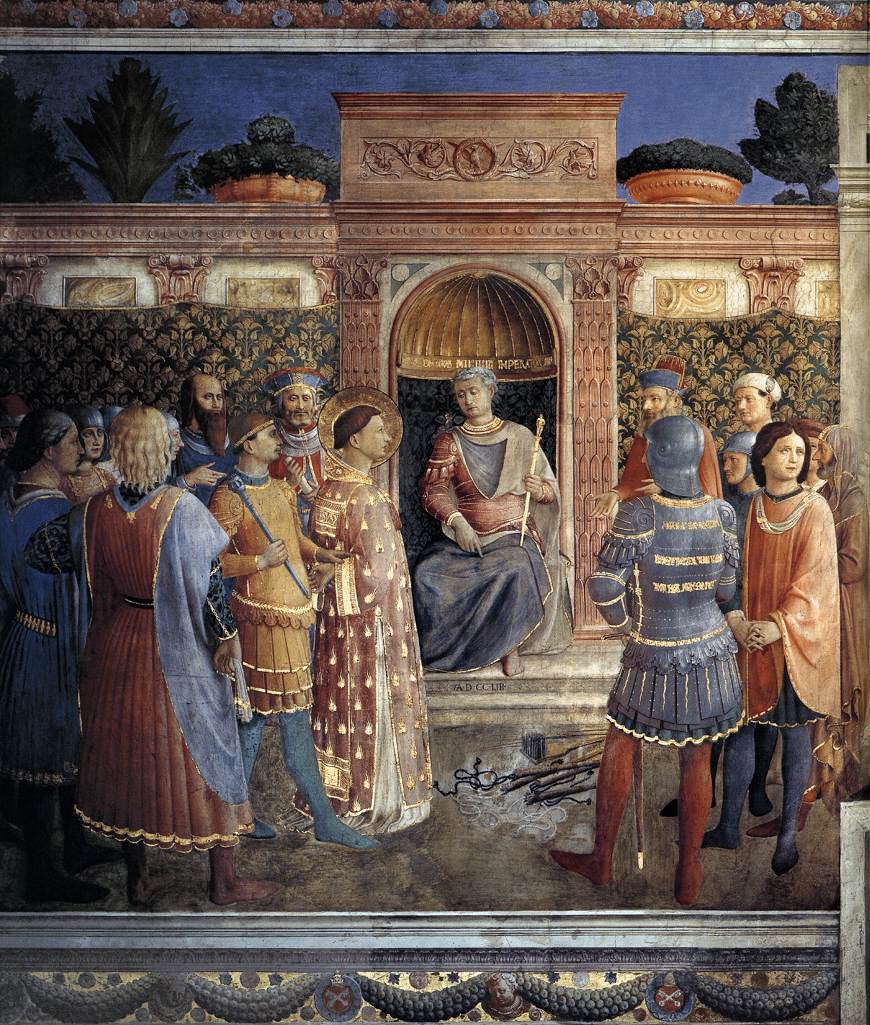
Lawrence of Rome was the highest-ranking of seven deacons that served under Pope Sixtus II in the 3rd century AD, whose job it was to oversee the church’s treasury and distribute alms to the poor. Everything was going splendidly for Lawrence until August AD258, when a letter arrived at the Senate from the Roman Emperor Valerian—who was imprisoned in Antioch, having left Rome to fight a war with the Persians—calling for all Christian senators to be stripped of their titles and assets, and for all priests, bishops and deacons to be arrested. If they renounced their faith and agreed to perform a sacrifice to the Roman gods, they would be freed. If they refused, they would be put to death. Valerian, it seems, wasn’t going to let a little thing like being held in prison 2,000 miles away stop him from running his Empire.

In accordance with Valerian’s orders, the Senate rounded up Pope Sixtus and his seven deacons. All eight refused to comply with the edict, and so, on 6 August 258, they were beheaded—all, that is, except Lawrence. As the archdeacon in charge of the treasury, Lawrence was given a three-day stay of execution to collect together all the church’s wealth and hand it over to the Roman state; instead, he reportedly spent the next three days giving as much of the money away as he could. On August 9, he returned to the Senate with a group of Rome’s poorest, sickest, neediest citizens, and boldly claimed that these were the true treasures of the church. The Prefect of Rome, frankly, was far from pleased.

Whereas Pope Sixtus and his other deacons had been beheaded, Lawrence’s singular act of defiance earned him an especially cruel death: the sentence was passed that he should be roasted to death, suspended on a gridiron above roaring fire.

Baby catching was all the rage in Ancient Rome

There’s some disagreement over whether or not Lawrence was actually burned to death in this way, because some sources claim that the Latin record of his death (assus est, “he was roasted”) should actually have read passus est, “he suffered”. But whether true or not, the question still remains—what does an early Christian martyr’s gruesome execution have to do with laziness?

Well, Lawrence’s death was so notably brutal that it soon became the subject of a macabre bit of folklore that claimed midway through his roasting Lawrence had quipped, “Turn me over, I’m done on this side!” It might sound more Groucho Marx than it does Archdeacon of Rome (and you can make your own mind up as to whether he actually said it or not), but this legend nevertheless apparently inspired a joke that Lawrence was “too lazy” to turn himself over. 

So is this the true origin of our lazy Lawrences? It’s impossible to say for sure, but it’s a good story all the same. And one well worth telling round the barbecue this summer.


6 June 2015

Grandmother

When it came to being amazed, those Victorians really knew how to respond:
If ever an old fashioned phrase needed bringing back into circulation, it was this one. But where does a saying as bizarre as this one come from?

The earliest record we have of this beats my grandmother! dates back to 1833, when it first appeared in a comic poem included in an American elocutionary reader, The United States Speaker. The poem, “Logic”, outlines a light-hearted back-and-forth conversation between a young schoolboy—“an Eton stripling”—who has just returned from boarding school, and his uncle, Sir Peter, whom he is visiting:


“Well, Tom, the road; what saw you worth discerning?
How’s all at college Tom: what is’t you’re learning?”
“Learning?—Oh, logic, logic; not the shallow rules
Of Lockes and Bacons, antiquated fools!
But wits’ and wranglers’ logic; for d’ye see
I’ll prove as clear as A, B, C,
That an eel-pie’s a pigeon; to deny it
Is to say that black’s not black;”—“Come, let’s try it?”
“Well, sir; an eel-pie is a pie of fish:” “Agreed.”
“Fish-pie may be a jack-pie:”—“Well, well, proceed.”
“A jack-pie is a John-pie—and ’tis done!
For every John-pie must be a pie-John!”
“Bravo! bravo!” Sir Peter cries,—“Logic for ever! 
This beats my grandmother, and she was clever!”

Tom’s grandmother-beating argument is that the eels in an eel-pie are fish, as are the jacks (an old nickname for a young pike) in a “jack-pie”. Jack is a pet form of John, and “John-pie” when reversed gives “pie-John”— hence, “pigeon”. Ipso facto. Quod erat demonstrandum. Logic forever, indeed.

The poem is unfortunately anonymous, which makes it hard to pin down the precise origin of this beats my grandmother. Its appearance here in an American textbook makes it tempting to presume it’s an American invention, but the reference to Eton College confuses things, as does the fact that the entire “pigeon”/“pie-John” argument is apparently considerably older than this poem might suggest: a reference to it here, for instance, from a book published in London in 1821, suggests that it was already fairly well known even by then.

But regardless of its American or British ancestry, one question remains—why on earth does it beat my grandmother? 

Well, oddly enough, this beats my grandmother! was just one in a long line of bizarre eighteenth-nineteenth century slang expressions that emphatically alluded to the speaker’s grandmother. So all my eye and my grandmother! meant “don’t talk rubbish”. So is your grandmother! was the Victorian equivalent of that schoolyard favourite, “I know you are, but what am I?” And to shoot your grandmother meant to find out a juicy bit of gossip, only to discover that everybody else already knows it. (Shameless plug: there’s more on this here.) 

Some of these expressions even made the leap from everyday colloquial English into hard-copy literature. Dickens, for instance, used the emphasizing expression not even to your grandmother in Our Mutual Friend (1865). Anthony Trollope dismissively used your grandmother! in his novel Phineas Redux (1873), as did Mark Twain in his short story How I Edited An Agricultural Paper Once (1870). And chances are you’ll have heard someone warn not to teach your grandmother to suck eggs—which Henry Fielding used in Tom Jones as far back as 1749.

As well as being the only one of these phrases to still be in use today, this egg-sucking grandma is also the oldest—and as such provides the best clue to the origin of this entire clutch of expressions. It’s earliest record dates all the way back to 1707, but before then, seventeenth-century speakers were telling each other not to teach their grandmothers “to sup sour milk”, “to make milk-kail” (a type of cabbage soup), and even “to grope a goose” (meaning to poke a goose’s rear end to see if it’s ready to lay an egg—which is likely the origin of the egg-sucking grandma).

Some geese: boy, has grandmother got a surprise for you...

The implication of all of these sayings was the same—don’t try to tell an informed, experienced person how to do something they already know how to do. Tellingly, a similar meaning is implied by another expression, you can’t teach an old dog new tricks, which has been found in a list of proverbs dating back to 1636 but is probably much, much older: a book on animal husbandry written in 1534, for instance, advises that “it is harde to make an olde dogge to stoupe [i.e. be compliant]”. The same book also explains the best technique for greasing sheep. Truly, it’s an indispensable read.

The implications in the old dog new tricks and grandma to suck eggs might be different, but there’s only a slight semantic sidestep from “old dog” to “old person”, and hence to “grandmother”—so it’s likely that the one inspired the other, and, eventually, its plethora of later variations. 

And if that doesn’t beat your grandmother, I don’t know what will.


30 April 2015

Cacemphaton


Earlier this month, UK Labour Party leader Ed Miliband made headlines (as well as a new Labour Party slogan) by exclaiming that “Hell, yes!” he was tough enough to be the next Prime Minister. Then, earlier this week, David Cameron likewise made headlines when he admitted to feeling “bloody lively” about the upcoming election. Well, somebody has to.

But no matter how rousing, how convincing, or how appropriate you might think the two leaders’ sweary outbursts were (and if they think this is swearing, they should really try standing at a bar in Newcastle on a Friday night), their use of tongue-worms nevertheless brings to mind two brilliant terms from the murky world of rhetoric.

The first, cacemphaton, is the rhetorical use of bad language. It literally means “bad show” or “bad appearance” in Greek, the –phaton suffix being a distant relative of words like phantom and epiphany. It was coined by the Roman rhetorician Quintilian in the first century AD, in his enormous guide to speech-making, Institutio Oratoria, or “The Institutes of Oratory”. Twelve volumes of rhetorical treatises, you say? Count me in! 

(Asking a rhetorical question and then answering it yourself? That’s anthypophora.) 

Marcus Fabius Quintilian: He’ll never catch a cab up there.

Quintilian, unsurprisingly, wasn’t a big fan of bad language—in fact he labelled it “objectionable”, “corrupt”, and “unbecoming”. So when it came to actually writing about the expletives he had in mind, he neatly dodged the issue by writing instead that, “it would be tedious to specify them, and in doing so I should dwell upon the very fault which I say should be avoided.” He’s got a fucking point.

But the bad language Quintilian was referring to wasn’t the same “bad language” we use today. Instead, he used cacemphaton to refer to a clumsy or ill-advised choice words, and in particular a chance combination of words that could be misinterpreted or misheard as something vulgar. By means of an example, he singled out the Latin word intercapedo, meaning “interruption” or “interval”, which he advised against using because its final two syllables sound remarkably like the Latin word for “I fart”.

So originally cacemphaton referred to the unintentional use of bad or vulgar language—like when the F word suddenly appears in the middle of your polite request to “pass a fork and knife”, or when you tell someone to “catch it!”, and instead it sounds like a warning not to step in a used litter tray. But over time Quintilian’s definition broadened, so that today cacemphaton generally refers to any rhetorical use of coarse or vulgar language, particularly for emphasis or effect. The unintentional “bad language” that Quintilian identified, meanwhile, is now termed cacosyntheton—literally “badly put together” language.

If you are going to swear, though, there should always be a good reason for it—which brings us to the second word on our list: lalochezia. It describes the use of foul language to relieve stress, pain or frustration. So those words that rush through your mind (and out of your mouth) when you miss your train, stub your toe, or accidentally brush against a hot iron? That’s lalochezia. 

Appropriately enough for a word concerning foul language, lalochezia itself has a pretty foul etymology. So while the initial lalo– is a derivative of the Greek word for “speech”, lalia (as in glossolalia, the proper name for speaking in tongues), the –chezia part is a derivative of the Greek verb chezo—which means “to defecate”, and is a not-so-distant ancestor of the English word shit. So, etymologically speaking at least, lalochezia is literally “shitting out of your mouth”. 

Quintilian would have been horrified.