_
Showing posts with label law. Show all posts

19 June 2016

10 Fossil Words


A while ago on the HH blog, we looked at the history of time immemorial—an expression now used to mean “time beyond memory” or “time out of mind”, but which began life as a legal term in mediaeval England referring to anything that happened before the coronation of Richard I, on 6 July 1189.


And that’s just one of 10 so-called “fossil” words that we’re looking at in this week’s YouTube video.


Fossils, or “fossilized” words, are words—like the immemorial of time immemorial, the shrift of short shrift, and the lurch of left in the lurch—that survive in the language only in one stock phrase or expression.

It’s fair to say that words like these are often hiding in plain sight: the phrases they appear in are so familiar that the obscurity of the word or words they contain slips by unnoticed. So you might not know what a caboodle is (it’s actually an alteration of boedel, an Old Dutch word for a person’s belongings), but you’ll know precisely what someone means when they talk about the whole kit and caboodle. You might not know that a pale is a wooden picket fence, but if someone or something is beyond the pale you’ll know it’s outside the accepted standards. And if we agree to let bygones be bygones, we let go of earlier contentious issues or disagreements. But what exactly is a bygone?

Well, back in the fifteenth century, bygone was an adjective rather than a noun, essentially meaning “former”, “elapsed”, or “that has gone by”—Shakespeare spoke of “the by-gone-day” in A Winter’s Tale in 1611. From there, the word came to describe anything dead or departed, and later obsolete or anachronistic—Dickens spoke of “the byegone old Assembly Rooms” in a letter dated 1869. But for bygones to be plural, it has to be a noun. So when did that happen?

Well, based on the original meaning of the word, back in the mid-sixteenth bygone came to be used not merely to describe something that has gone by or expired, but essentially as a placeholder name for it itself. Soon everything from overdue payments and financial arrears to a criminals’ previous convictions were being labelled bygones, before what we might call the modern meaning of the word—that is, “any past incident or event”—began to emerge in the mid-1600s. According to the OED, the earliest record of the phrase bygones be bygones itself dates from 1648. 


31 July 2015

Rebecca

Yesterday, HaggardHawks tweeted this fairly peculiar definition: 
In fact, Rebecca is just one of a handful of first names that you can use as a word in its own right. A George, for instance, is a loaf of brown bread. Abigail is an old nickname for a lady’s maid. A Robert is a restaurant waiter (inspired by a series of cartoons from the late 1800s). Peter can be used as a verb to mean “to blow open a safe” (because St Peter held the keys to Heaven). And as for John—well, he can be a nickname for anything from your signature (thanks to John Q Hancock) to the client of a prostitute.

But what’s the story behind Rebecca? Well, if you know your British history—and a hat-tip to @Evansianl, who got it spot on—you’re probably way ahead of us:


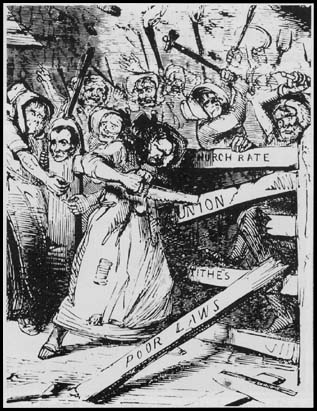
The Rebecca Riots were a series of disturbances in the early 1840s prompted by the increasing exploitation and worsening prospects of the local farming communities in Wales. In the years leading up to the riots, farmers had had to contend with several seasons of bad weather and failed crops, poor financial returns on their produce, increased rents from landowners, and the on-going enclosure of common land. On top of that, farmers (who were already paying 10% of their profits to the local church) were then faced with the newly-amended Poor Law Act of 1834, which increased taxes and began channelling more and more public money into the controversial workhouse system. 

Enough was understandably enough. And in southern Wales, local farmers began taking their frustration out on what they saw as the embodiment of all their woes: the local tollgates.

“Down with this sort of thing.”

By the early nineteenth century, there were already 30,000 miles of toll roads and 8,000 toll gates in Britain, each of which was overseen by a local body of landowners and businessmen called a turnpike trust. On paper, the idea was simple enough—the money the toll roads raised would go towards the upkeep and repair of the roads themselves. But in practice, it often proved hopelessly flawed. 


The turnpike trusts were left largely to their own devices; they could charge however much they wanted, and could introduce however many tollgates on their land as they wished. Before long, many were taking full advantage of the loopholes in the system: by the 1830s, Carmarthen in south Wales was completely encircled by tollgates, leaving no free route into or out of the town. The gates, it seemed, had to go.

On 13 May 1839, an angry crowd rallied together and destroyed the tollgate in the tiny hamlet of Efailwen, 20 miles west of Carmarthan. This initial protest quickly sparked others, and soon tollgates all across south Wales were being attacked and destroyed by groups of locals fed up with the extortionate prices they were being forced to pay. The protests rumbled on for several months, reaching a peak in 1842 when a combination of an unexpectedly successful harvest and a cut in the taxes imposed on imported meat led to the prices of corn and cattle collapsing.

Within a year, however, it was all over. As the protests had grown ever more violent (a young woman working at a tollgate in Hendy, near Llanelli, was shot and killed in 1843), a diplomatic solution was quickly sought, and the Turnpikes Act of 1844 slashed the toll rates, and amalgamated all the turnpike trusts into one regulated body.

That’s all well and good, of course, but one question remains: why “Rebecca”?

Well, to answer that we need to turn to the Bible. Rebecca was the name of Isaac’s wife, and in the Book of Genesis we’re told that before leaving her family home to go and marry him, Rebecca’s mother gave her a blessing:
And they blessed Rebekah, and said unto her, Thou art our sister, be thou the mother of thousands of millions, and let thy seed possess the gate of those which hate them. 
Clearly, it was the words “let thy seed possess the gate of those which hate them” that gave the Rebecca Riots their name—and inspired the protesters in more ways than one: if you noticed that some of the befrocked protestors shown in the picture above looked, well, less than ladylike, that’s because they quite literally are.

As the protests picked up pace across south Wales, any gate-destroying farmers not wanting to be identified began disguising themselves in women’s clothing. These “Rebeccas” soon became the figureheads of the “Rebecca Riots”, with the leader of each protest even taking on the role of “Rebecca” in a bizarre role play before each gate was destroyed.

As strange as all that might sound, it’s worth bearing in mind that the Rebecca Riots grew out of genuine hardship and sense of frustration, and led to a change in the law that, although not perfect, nevertheless improved conditions for hundreds of the poorest people involved. Today, they are quite rightly seen as one of the most important movements in British social history.


11 June 2015

Immemorial

The other day, we tweeted this:
Frankly, it sounds made up:
But, in fact, this bizarre quirk of legal terminology is entirely true.

The word immemorial literally means “unrememberable”, or “beyond memory”. Although it’s occasionally found on its own (Alfred Lord Tennyson’s The Princess, for one), by and large it’s now considered an example of a “fossil” word—an archaism that only survives in the language in one solitary fixed expression or cliché, like the beck of “beck and call”, the kith of “kith and kin”, or the riddance of “good riddance”. (Shameless plug: there’s more on that in the book.)

The sole expression this particular fossil finds itself embedded in dates back a little over 400 years: the OED has unearthed the earliest record of time immemorial in a document drawn up by Richard Cosin, a sixteenth century ecclesiastical lawyer, in 1593. But the legal concept of time immemorial—referring to a time beyond legal memory, which can be used to establish long-term rights of ownership—dates back considerably further than that.

During his 35 year reign from 1272-1307, Edward I oversaw the institution of three so-called Statutes of Westminster, a set of formal legal documents that attempted to codify all the laws of England and thereby establish a new and fully comprehensive English legal system. Ironically, the foundations of this fully comprehensive English legal system were written in French—or rather Old French—which, two centuries after the Norman Conquest, was still the language of the law and government in England.


Edward I: Hammer of the Scots. Holder of the Long Thin Stick.

The First Statute was drawn up in 1275, and comprised a total of 51 clauses or “chapters”, each of which set out various rules, writs, laws, and legal definitions. Clause 4, for instance, outlined the legality surrounding shipwrecks:
On a wreck of the sea, it is agreed that when a man, a dog, or a cat escapes alive from a ship, neither the ship nor the boat nor anything that was in them shall be adjudged a wreck.
Clause 5, The Freedom of Election Act, is still in force in England and Wales, seven centuries later:
Because elections ought to be free, the king forbids … any man, great or otherwise, to interfere by force of arms or by malicious conduct with the making of a free election.
Clause 34 outlawed slander:
Because many [people] have often invented and told lying tales … it is forbidden … for anyone henceforward to be so bold as to utter or repeat false news or fabrications whence any discord, or intention of discord or slander could arise between the king and his people.
And Clause 39, known as “The Limitation of Prescription Act”, set out to define a standardized cut-off point for legal ownership—a precise date against which all grievances over ownership of land or property could be measured and determined:
No one is to be given a hearing to claim seisin [feudal ownership of land] by an ancestor of his further back than the time of King Richard, uncle of King Henry, the father of the present king.
Effectively, this meant that if you had your ownership of a given property or plot of land challenged by writ of right, all you had to do to quash the challenge was prove that you and your ancestors had maintained ownership of said property since before Richard I became king. The First Statute of Westminster ultimately established the date of Richard’s ascendancy—6 July 1189—as the cut off point for living memory, or the time “whereof the memory of Man runneth not to the contrary”. Anything that occurred before that date was thereby deemed to be beyond living memory, or, in legal parlance at least, time immemorial.

This definition remained in force in England and Wales right through to 1832, when it was finally figured out that being compelled to demonstrate ancestral ownership of something for 643 years could prove somewhat tricky. As a result, shortly before his death, William IV passed The Prescription Act that shortened the legally required length of ownership or use of a contested property to anything between 20 and 60 years, depending on its use. 

This remains the standard requirement for disputes of ownership in England and Wales, and consigned the legal definition of time immemorial to the history books. Although the phrase itself—albeit a fossilized one—still lives on.