_
Showing posts with label letters. Show all posts

2 August 2016

10 Words For Other Words


If you’ve been keeping up with the HH “500 Words” YouTube series, you’ll so far have found out about 280 of the 500 words we’re going to look at this year. But this week, we’re turning things around. 

So from hypernyms and hyponyms to holonyms and holophrases, this week’s video is looking at 10 Words for Other Words.


(And for more words like those, then be sure to check out the HH article that inspired it over on Mental Floss.)

One word that didn’t make the final cut here, however, is backronym. We’ve discussed some backronyms on YouTube before—mainly in our 10 Word Origins Stories That Are Completely Untrue video—and it’s a myth-busting topic that’s always worth revisiting.

Backronyms are words or phrases that are widely and mistakenly believed purported to be acronyms. Posh, for instance, is often claimed to stand for “port out, starboard home”, a reference to moneyed cruise ship passengers paying for the best views on both the outward and homeward bound parts of their voyage. Golf too is said to stand for “gentlemen only, ladies forbidden” (or ladies do something else that begins with F). And the distress signal SOS is famously claimed to stand for “save our souls”, or “save our ship”.


“It says, ‘you may have been missold PPI.’”

None of these is true, of course. Posh is simply thought to come from an old slang word for cash or loose change. Golf is probably descended from an old Dutch word for a club, colf or kulf (albeit with perhaps some influence of a Scots word for a stout blow to the head). And the letter combination “SOS” was chosen as a distress signal for no other reason than that its rhythmic and symmetrical combination of dots and dashes [· · · – – – · · ·] is so immediately noticeable. Incidentally, precisely the same combination of dots and dashes could also be used to spell the letters “VTB” in Morse code, but the designation SOS was used because of its own symmetry and memorability.


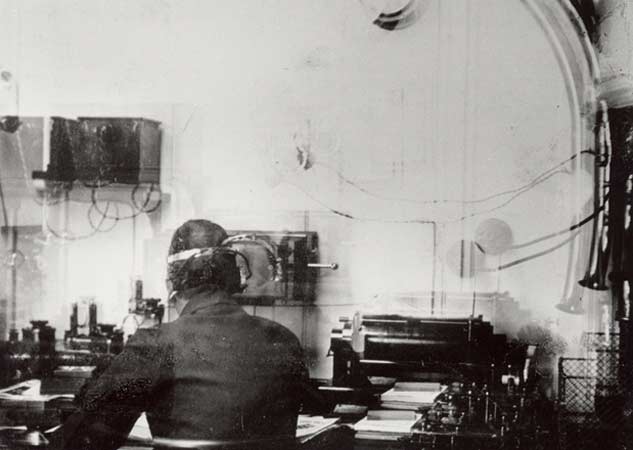
Before SOS was adopted in the early 1900s, however, the standard telegraph distress signal was “CQD” [– · – ·    – – · –    – · ·]. It’s fair to say that that’s hardly the most recognisable or memorable arrangement of dits and dahs on offer, so why pick that?

Well, on their own the letters “CQ” had long been used as a telegraphic distress signal as they sound identical to the French word “sécu”, an abbreviation of sécurité. The Marconi Telegraph Company simply added a letter D to this to make their first recommended distress signal, CQD. But just like SOS, CQD also fell foul of backronymy and before long myths had emerged claimed that it stood for “come quickly—danger!”, or “come quickly—drowning!”

Problems with interpreting the confusing set of letters “CQD” over a poor signal, however, eventually led to calls for a more immediately recognizable distress signal to be adopted, and so SOS was officially introduced in 1906. 


14 April 2016

10 Words From Johnson’s Dictionary


The great Samuel Johnson’s Dictionary of the English Language was first published 261 years ago today, on 15 April 1755. Its two volumes defined a total of 42,773 words, illustrated by 114,000 literary quotations (the majority from Shakespeare), and unlike dictionaries today, it was infused throughout with Johnson’s own personality and humour. 

Words that he personally disliked or thought unimportant were omitted (so out went recent French loanwords like champagne and bourgeois), as was the letter X, which he bluntly explained in a note on page 2,308 “begins no word in the English language.” The definitions too were full of Johnson’s wit and wisdom:


And who, of course, could forget this:


Or, indeed, this:


Johnson was paid the princely sum of 1,500 guineas (equivalent to more than £200,000 today) to compile the work, which he did so single-handedly over nine years, with assistants only ever brought in to reproduce pages and copy out quotations. It was, frankly, a monumental achievement and remained the standard English dictionary for the next 150 years.

So in honour of the anniversary of Johnson’s wonderful contribution to our language, this week on the HH YouTube channel we’ve picked 10 long-forgotten words from his dictionary that deserve to be revived:


As explained in the video, that doesn’t mean that Johnson is personally responsible for coining these words (although it’s thought that a number of his entries were his own invention), nor that his dictionary provides us with their earliest written record. Instead, these are just words that were included in his Dictionary but which have long since disappeared from the language—and more than deserve to be recovered.


17 March 2016

I, Part II

Last year on the HaggardHawks blog, we looked at why the lower-case letter i—and its alphabetical cousin j, for that matter—has a dot above it. Turns out it had something to do with stopping intelligent people being mistaken for their knees. But this week in our noticeably infrequent series of Questions About The Language You Never Even Thought About, we’re posing another I-related conundrum: why do we capitalize the pronoun I?

After all, none of the other English pronouns—including all the other first person pronouns, like me, mine, my and myself—is capitalized, unless you happen to be God or He Who Should Not Be Named. Nor was I’s ancestor, the Old English word ic, written with an uppercase letter. And the translated equivalent of I in most other languages is usually left in lowercase, like the French je, Spanish yo, Italian io, and German ich.


Speaking of German, it of course capitalizes all of its nouns, like Mann and Frau, Apfel and Orange, Kapitalbuchstaben and Kleinbuchstaben. That’s something that English reserves only for its proper nouns (John Smith, Australia, the Cabinet, Sister Act), unless you happen to have some kind of point-making rhetorical effect in mind, as in “He doesn’t just think he’s the bee’s knees, he thinks he’s The Bee’s Knees”.

German does however capitalize the formal form of its second person pronoun, Sie, “you”, along with all its derivate case forms like Ihr, “your”. That’s part of a linguistic phenomenon known as the T-V Distinction, which has nothing to do with how much better than terrestrial television Netflix is, but rather the way in which some languages like to show polite respect by altering the pronouns used to refer to people you don’t know very well or hold in high regard. It’s the same reason why French speakers will politely ask you to respondez s’il vous plaît, unless they know you particularly well (in which case résponds s’il te plaît will do just fine). Same goes for voulez-vous coucher avec moi, çe soir, but you really shouldn’t be saying that to someone you don’t hold in high regard.


So is this what’s happening in English? Do we think so highly of ourselves that we’ve grown accustomed to capitalizing our first person pronoun? Some etymologists have suggested so, and have even theorized that there’s a latently egocentric, psychological reason behind uppercase I. But if that’s the case, why hasn’t that filtered down to the likes of me and myself, or we and ourselves? And why is it only English speakers who are self-centred enough to capitalize ourselves while other languages are not? Don’t answer that.

So perhaps there’s something more pragmatic going on. An alternative theory claims that because the pronoun I occurs so frequently in sentence-first position, it’s only natural that it would eventually become capitalized. It’s a plausible idea, but does I really occur enough times in sentence-initial position to permanently alter its form in every other context? And again, why hasn’t the same thing happened to all the other pronouns?

Instead the most likely explanation of how we ended up with capital I is a surprisingly practical one, instigated by the fact that around the time capital-I first began to appear in English texts—in the Middle English period, roughly 700-800 years ago, so Chaucer’s Canterbury Tales provides much of its early evidence—there was a phonological change also taking place.

At that time, many dialects of English were busy reducing the Old English word for I—ic or ich, which was pronounced a bit like “itch” but without the T—to a single “i” sound, making the Cs and Hs normally used to spell it no longer necessary. In written English, however, a single lowercase letter i can look a little lost on its own, and in a densely handwritten document it’s easy to imagine just how easily a solitary pint-sized stroke, even with or without its dot, might be misread, overlooked, or even dismissed as a smudge or dash.

As a result, early Middle English scribes began making their single letter Is a little bigger, so that they could stand a little prouder and little more robust on the line of text. And over time, that became the standard and gave us the pronoun capital I. And that’s The Truth—or at least, the Best Theory We Have.