_
Showing posts with label horse racing. Show all posts

8 April 2016

Feague


If you’ve been keeping up with our new YouTube series, you might remember possibly the strangest word we’ve ever come across from our Words You Won’t Believe Exist video: the eighteenth century verb feague.


Feague, for those of you who don’t already know (or practise it), means “to put a piece of ginger up a horse’s anus,” with the somewhat predictable outcome of making him appear more lively. If you think that sounds impossibly cruel, then fear not—according to the 1811 edition of Francis Grose’s aptly titled Dictionary of the Vulgar Tongue, it was just as common to replace the ginger with a live eel. A much more sensible idea, I’m sure you’ll agree.

So why on earth—seriously, why? FOR THE LOVE OF GOD WHY?—would anyone want to spend even one microfortnight of their day forcing a piece of ginger up a horse’s arse? 


“You’re going to do WHAT?”

Well, as explained (though, alas, not demonstrated) in our video, if you were selling the horse, then it’s only natural that you would want it to look as frisky and as energetic as possible, to ensure that you got the best price for it. And if there’s one thing guaranteed to make a horse frisky, it’s shoving the spicy root of a herbaceous perennial up its ass. That makes feaguing essentially the 250-year-old equivalent of those tricks estate agents use when prospective buyers stop by. You know how it goes—a bouquet of freshly picked flowers on the table. A fresh pot of coffee brewing in the kitchen. A horse desperately trying to evacuate a live eel from its poop chute in the garden. 

Another fairly cruel means of improving the asking price of your horse incidentally was bishoping, which involved filing down its teeth. Because horse’s teeth continue to grow throughout their lives, shaving them down meant that even a worn out old carthorse could pass as a young colt, and in that sense bishoping was essentially the eighteenth-century equine equivalent of botox. Or six pints of Guinness.


But while bishoping was straightforwardly enough named after a crooked horse salesman named Mr Bishop, feaguing is more of an etymological mystery. 

One theory is that it comes from fake, which besides its more familiar meaning was used in nineteenth century slang to mean “to tamper with something in order to deceive.” That sounds exactly like our horse-enlivening ginger insertion, but the dates don’t match up—in fact, the OED suggests faking in this sense might derive from feaguing, not the other way around.

Another theory is that feague comes from an even earlier sixteenth century word, feak or fyke, meaning “to twitch” or “to be restless.” Twitching and restlessness certainly sounds along the lines of feaguing, but this theory stumbles because by the time feague first began to appear in the language, feak had morphed into a more figurative word, meaning “to be officiously busy,” or “to appear busy, yet accomplish little.” Hey, we’ve all been there.

But then there’s this:

’Slife, this She Devil will ruin me! Alas, madam, she’s merry, she drolls; but come, let’s dance and put these things out of our heads. Come in, Minnim and Crotchet, and fegue your violins away, fa, la, la, la!

That’s a line from The Humorist, a play written in 1671 by the English playwright Thomas Shadwell. Here, “Minnim and Crotchet” are the names of musicians, and when they’re called upon to “fegue their violins,” they’re not being told to put a piece of ginger inside them (nor, for that matter, to put their violins somewhere it’s anatomically unadvisable) but to start playing them, quickly and energetically. 

To feague away was a seventeenth century phrase basically meaning “to set in quick motion,” “to agitate,” or “to work flat out.” It’s thought that it derives from an even earlier sixteenth century word, feg or feagle, meaning “to beat” or “thrash,” which in turn probably comes from an even older German word, fegen, meaning “to clean” or “sweep”, or to busy yourself with housework. 

Feaguing away then seems to be the missing link: it’s easy to see how a word meaning “to busy yourself with housework” could give birth to a phrase meaning “to work quickly,” or “to agitate,” and ultimately “to enliven” or “to make energetic.” The ginger-inserting part, it seems, was just a bit of added spice.


7 October 2015

Cocktail

The word cocktail is a bit of an etymological puzzle: originally only used as a nickname for an animal that rears up when irritated, by the late 1700s it had become another word for a horse with a “cocked” or shortened tail. How it then made the leap to alcoholic mixed drinks in the 1800s is, however, a mystery. 

One theory claims it’s to do with the drinks making you feel energised and sprightly, like an energetic horse, while another suggests it’s to do with cocktails being popular at the races. Alternatively, the two meanings could be entirely unrelated—one very plausible explanation is that cocktail might actually an anglicized version of the French coquetier, meaning “egg-cup”, which was perhaps once used to measure out quantities of spirits.

The names of individual cocktails are often just as problematic, and often it’s difficult to track down the histories of individual names. The margarita, for instance, is various credited to Marjorie King, a former Broadway dancer; the singer Peggy (i.e. Margaret) Lee; and Margarita Henkel, the daughter of a former German ambassador to Mexico. Even then, margarita is the Spanish word for “daisy”, and so it might instead take its name from an earlier drink known as the “tequila daisy”.

Equally, no one is quite sure why a sidecar is called a sidecar (although one story claims that it was invented in Paris just after World War I by an American Army captain who could often be seen being driven around the city in a motorcycle sidecar). The highball is another mystery: originally a straightforward mixture of Scotch and soda water, it’s thought that its name it refers to the drinks’ popularity in the bars on early steam locomotives. The train’s coal-powered boiler would be fitted with a pressure gauge with a floating ball inside it, so that when the train was going at its fastest speed, the pressure gauge would be “highballing”.

Some cocktails famously take their names from the places where they were invented. So while a sling is a general American name for any sweetened and flavoured drink made from a spirit base, the Singapore sling was invented in the early 1900s at the famous Raffles Hotel in Singapore. A classic daiquiri cocktail—essentially a mojito without the mint—is named after the village of Daiquirí on the southeast coast of the island; legend has it that the drink was invented by local American mining engineers in the early 1900s when they ran out of gin and had to use the local rum instead. (Mojito, incidentally, is thought to derive from mojo, the Cuban Spanish name of a type of sauce or marinade made with citrus fruit—so a mojito is literally a little mojo.)

But what about a Manhattan? Well, although accounts of the event are debatable, legend has it that the Manhattan cocktail was specially invented for a banquet hosted by Lady Randolf (mother of Winston) Churchill at the trendy Manhattan Club in New York in the late 1800s. The name Manhattan was, however, already in use long before then as the name of a different drink from the modern Manhattan cocktail—so, if the story is true, it was probably the success of Lady Randolf’s banquet that popularised the recipe used today.  

A Manhattan made with Scotch rather than Canadian whisky, incidentally, is a Rob Roy. It was originally invented at New York’s Waldorf Astoria Hotel in 1894 to celebrate the Broadway premiere of an operetta loosely based on the life of the Scottish folk hero Rob Roy.

Other more straightforward etymologies like this one include julep, which was borrowed into English from French as far back as the 1400s to refer to a sweet-tasting or sweetened drink, but has its earliest origins in the Arabic word for rose-water, julab. The mimosa takes its name from the mimosa plant, Acacia dealbata, which produces bright orange-yellow flowers the same colour as mixed champagne and orange juice. 

Piña colada means “strained pineapple” in Spanish, a reference to the drink’s fruity base, and maitai means “good” or “nice” in Tahitian. The pale orange-red colour of a classic Bellini cocktail reportedly reminded its inventor—Giuseppe Cipriani, the founder of Venice’s famous Harry’s Bar—of a similar colour often used in paintings by the Venetian artist Giovanni Bellini.

And when it became popular in the late 1800s to introduce liqueurs into cocktail recipes, the older more basic recipes that omitted them—and in particular this classic mix of whiskey and bitters—became known as “old fashioned” cocktails. Hence an old fashioned is a straightforward mix of Bourbon or rye whiskey, Angostura bitters, sugar.

Cheers!


28 February 2015

Handicap

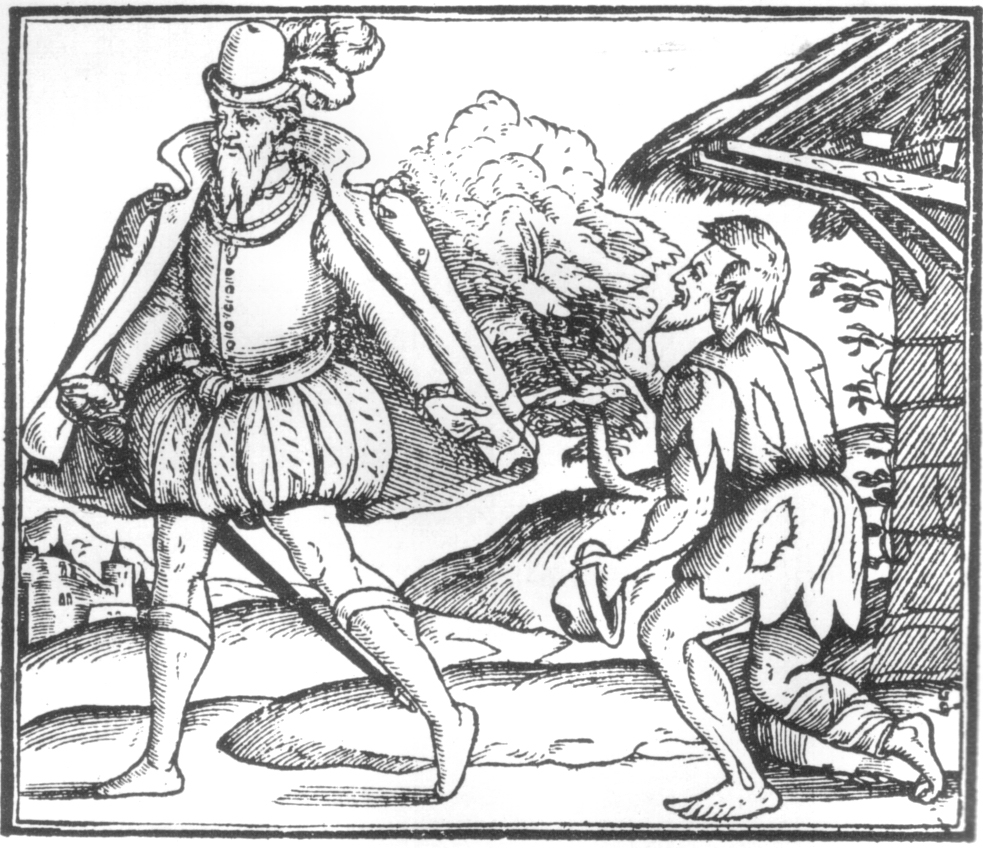
There’s an old story that claims the word handicap derives from wounded soldiers returning home from war with injuries preventing them from returning to their day jobs, and leaving them with no option other than to beg on the streets, their caps literally held in their hands to catch the pennies of passers-by.

Nothing says wealth and sophistication better than a puffball skirt

As ingenious a story as this is, it is of course completely untrue. (Not least because this would have likely given us the word “capihand” rather than handicap.) In fact the true origin of the word lies in an old method of trading goods called “hand-in-cap”, the origins of which date back as far as the fourteenth century at least.

Imagine there are two traders who want to exchange goods, but who are unsure about the relative value of the items they’re looking to swap. In a “hand-in-cap” trade, they would turn to a third party—essentially, a kind of umpire—who would take a look at the items up for exchange and assess their value. If he thought there were any kind of discrepancy between the two, he’d come up with a price (called the “odds”, or the “boot”) that the owner of the cheaper lot would then have to add into the exchange to make it fair.

Next, out comes the cap. The umpire, having given his assessment of the exchange, would then hold out his upturned cap. Both of the traders would take a few loose coins from their pockets, and go to drop them in it. If they agreed to the exchange, they’d drop their money into the cap, but if they didn’t, they’d keep it in their hands.

If both traders agreed, the exchange would go ahead as planned and the umpire would get to keep whatever change had been thrown in the cap as his fee. If neither of the traders agreed, the umpire would get nothing. And if only one agreed, he would get to retrieve his cash from the cap, the umpire would still get nothing, and no trade would go ahead. 

Whatever the outcome, the umpire was always incentivised to come up with as fair exchange as possible, and the trade would only go ahead once everyone was happy. 

So how does an obscure mediaeval trading system lead us to the word handicap as we have it today? Well, it was the idea of assessing the worth of something, just as the umpire did, that led to the idea of “handicap” horse races, in which an adjudicator is brought in to assess the quality of the horses taking part. Stronger horses would be laden down with weights to hamper their speed and make for a fairer race overall. And it’s this sense of something that hampers or encumbers an ordinary activity that we’ve retained in the language today.