_
Showing posts with label dogs. Show all posts

15 April 2016

Lazy Lawrence


A long-forgotten (but no less useful) expression popped up on the HaggardHawks Twitter feed the other day:


And this isn’t the only proverbially lazy Lawrence to find his way into the dictionary. Long before lazy people had “Lawrence on their backs” there was an earlier expression, Lawrence bids wages, that the OED explains was used to imply that “the attractions of idleness are tempting”—or, in other words, doing nothing looks like a lot of fun. Even Lazy Lawrence itself has been used as a nickname for an idling lazybones for centuries, as well as being the name of a mischievous fairy or sprite supposed to induce lethargy or idleness.

So apologies to anyone named Lawrence, but you’re immortalized in the language as a metaphor for laziness. Still, it’s better than being known for a one-year prison sentence or destroying gates, I suppose. But why Lawrence? And why laziness?

Well, one theory is that the connection is purely coincidence, and that Lawrence just has a nice alliterative ring to it—so this could just as easily be “Lazy Linda”, or “Leon bids wages”, or “to have Loretta Lynn on your back”. It’s certainly plausible (well, apart from the Loretta Lynn bit) but needless to say there are a couple of more imaginative explanations on offer. And one of them even involves a barbecued saint, what more could you want?

One theory is that phrases like these refer to St Lawrence’s Day, 10 August. That date puts it bang in the middle of the “dog days” at the height of the summer, when you can expect to endure the hottest, sultriest, most stifling weather of the year—the kind of weather that makes you want to lounge around and do nothing except lounging around doing nothing. The dog days are traditionally said to last anywhere from mid July to early September, and take their name from the tradition—probably started in Ancient Greece, if not Ancient Egypt—that the appearance during the summer months of Sirius, the Dog Star, just above the horizon before sunrise somehow amplified or added to the heat of the Sun. In fact, the so-called “heliacal rising” of Sirius always occurs sometime around August 10–11.


You cannot be Sirius

So is our proverbially lazy Lawrence inspired by the highest hottest heat of high summer? Possibly. But we can’t ignore the fact that there’d be no St Lawrence’s Day without St Lawrence himself. 

Lawrence of Rome was the highest-ranking of seven deacons that served under Pope Sixtus II in the 3rd century AD, whose job it was to oversee the church’s treasury and distribute alms to the poor. Everything was going splendidly for Lawrence until August AD258, when a letter arrived at the Senate from the Roman Emperor Valerian—who was imprisoned in Antioch, having left Rome to fight a war with the Persians—calling for all Christian senators to be stripped of their titles and assets, and for all priests, bishops and deacons to be arrested. If they renounced their faith and agreed to perform a sacrifice to the Roman gods, they would be freed. If they refused, they would be put to death. Valerian, it seems, wasn’t going to let a little thing like being held in prison 2,000 miles away stop him from running his Empire.
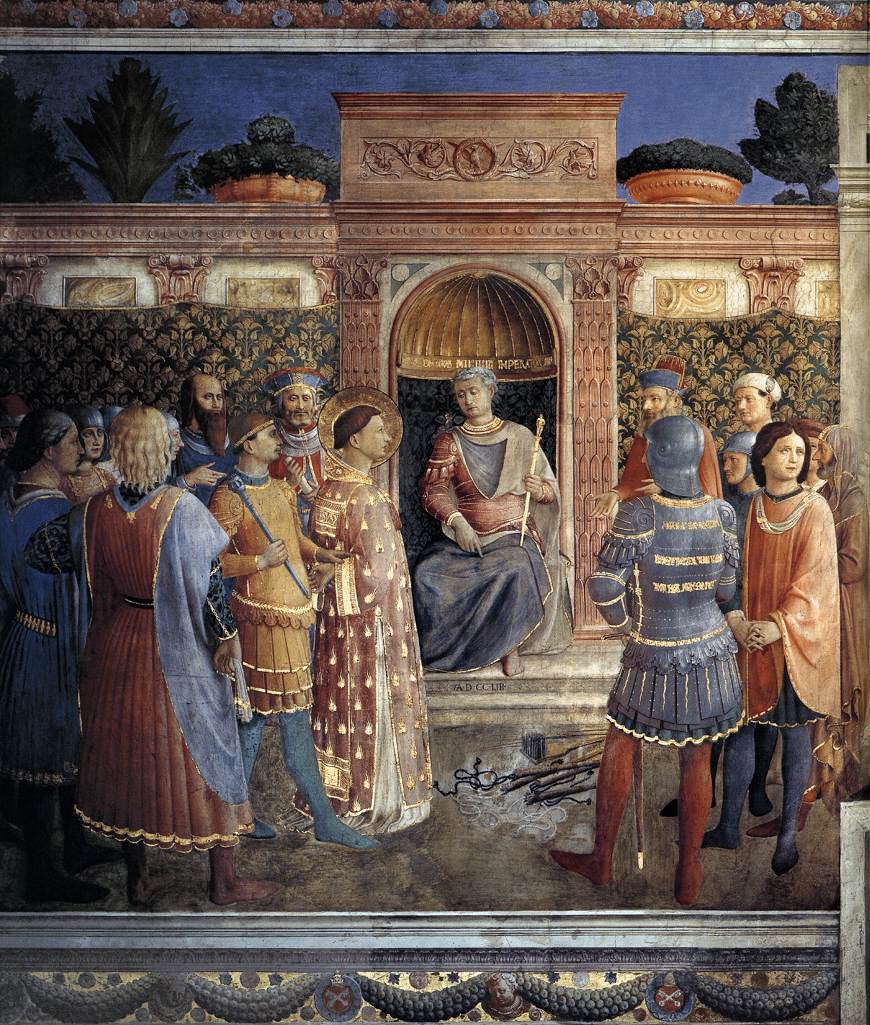
In accordance with Valerian’s orders, the Senate rounded up Pope Sixtus and his seven deacons. All eight refused to comply with the edict, and so, on 6 August 258, they were beheaded—all, that is, except Lawrence. As the archdeacon in charge of the treasury, Lawrence was given a three-day stay of execution to collect together all the church’s wealth and hand it over to the Roman state; instead, he reportedly spent the next three days giving as much of the money away as he could. On August 9, he returned to the Senate with a group of Rome’s poorest, sickest, neediest citizens, and boldly claimed that these were the true treasures of the church. The Prefect of Rome, frankly, was far from pleased.

Whereas Pope Sixtus and his other deacons had been beheaded, Lawrence’s singular act of defiance earned him an especially cruel death: the sentence was passed that he should be roasted to death, suspended on a gridiron above roaring fire.

Baby catching was all the rage in Ancient Rome

There’s some disagreement over whether or not Lawrence was actually burned to death in this way, because some sources claim that the Latin record of his death (assus est, “he was roasted”) should actually have read passus est, “he suffered”. But whether true or not, the question still remains—what does an early Christian martyr’s gruesome execution have to do with laziness?

Well, Lawrence’s death was so notably brutal that it soon became the subject of a macabre bit of folklore that claimed midway through his roasting Lawrence had quipped, “Turn me over, I’m done on this side!” It might sound more Groucho Marx than it does Archdeacon of Rome (and you can make your own mind up as to whether he actually said it or not), but this legend nevertheless apparently inspired a joke that Lawrence was “too lazy” to turn himself over. 

So is this the true origin of our lazy Lawrences? It’s impossible to say for sure, but it’s a good story all the same. And one well worth telling round the barbecue this summer.


3 March 2016

10 Words From Victorian Slang

If you’ve been following the new @HaggardHawks YouTube channel so far this year, you might remember that a few weeks ago we posted a list of 10 Words Derived From Dickens Characters, just in time for Dickens’ 204th birthday on February 7. And following on from that, this week as part of our #500Words series we’re heading back to the nineteenth century with 10 Words From Victorian Slang.

Nineteenth century slang crops up fairly regularly on the @HaggardHawks Twitter feed (indeed a few choice examples ended up being among the most popular tweets of 2015), but we’ve picked ten of the best and most interesting examples for this week’s video—from blue fire, the perfect theatrical term for something amazing or spectacular, to collieshangie, a word for a noisy argument that’s so Victorian it was even used by Queen Victoria.

Although we’re labelling it a Victorian slang term here (as that’s when it first gained any wider currency, and is often listed as such in slang dictionaries), the word collieshangie itself actually has its origins in eighteenth-century Scotland: it probably began life as culleshnagee or cullyshang, an old Scots dialect word presumed to be a compound of collie (a sheepdog) and shangie, a word used for both a noisy quarrel, and a restraint attached to a dog’s tail to make it behave. Either way, collieshangie can fairly confidently be said to derive from one very angry dog. 


26 May 2015

Feisty

It’s fair to say that some of the words and facts we tweet about are a little unusual. Yes, take a bow monkey-poop, we mean you.

But one of the most unusual we’ve posted in a long time was this nugget of etymological gold (lifted—shameless plug alert—from our new book), which we tweeted earlier this week:

So, hold your nose. We’re going in.

We might have name-checked the Tudors in that tweet, but we’ll get to them in a moment. For now, this malodorous story starts with a tenth-century English monk named Ælfric of Eynsham, who as well as being abbot of Eynsham Abbey in Oxfordshire was also one of the most prolific writers of his day. Ælfric’s output included homilies, sermons, biographies of saints, biblical translations and biblical commentaries, as well as several scholarly works written for students of Latin. Among them was a vast bilingual glossary of Latin and English, which contains the earliest records of a whole host of English words—two of which, feorting and fysting, he defined as “breaking wind”.

Unsurprisingly, the Old English word feorting is the ancestor of the modern English farting, and it’s fair to say that its meaning has lingered on, unchanged, for the last thousand years. Fysting too has survived down into modern English, but unlike feorting it’s no longer found in its original sense—instead, it’s the ancestor of a handful of seemingly innocent English words, including our old friend feisty. So how did we get from a word for “a small windy escape backwards” (as the great Francis Grose defined it in 1785), to a word meaning “lively”, “aggressive”, and “courageous”? Well, the answer lies with those aforementioned Tudors—or rather, with their flatulent dogs.

As Old English wafted into Middle English, fyst was still being used as just another general word for—well, a whiffy crackaret. But by the mid-fifteenth century, fysting had come to be used particularly in reference to foul-smelling dogs, which it can only be presumed had a notable habit of letting one go. In fact, Tudor-period English is filled with so many references to “fysting hounds” and “foisting curs” (literally “farting dogs”) that they’ve earned themselves their own entries in some historical dictionaries.

Hey, don't look at me—I can't smell anything.

Unlike Old English, of course, a lot of literature from the Tudor period still survives, and because of that we’ve even got some idea what kind of dogs these “foisting curs” were. Just take a look at this quote from De Canibus Britannicis, or Of English Dogges, a work by the sixteenth century English physician (and namesake of Caius College, Cambridge), John Caius:
Canis Meliteus … This puppitly and pleasantly curre, (which some frumpingly tearme fysteing hounds), serves ... no good vse except … to succour and strengthen quailing and quammning stomackes, to bewray bawdery and filthy abbominable leudnesse. 
We now know canis Meliteusis as the Maltese, a small white-haired lapdog seemingly once popular with Tudor women (not least because of its apparent ability to “quell filthy abominable lewdness”). But that’s not the Maltese’s only quirk: like a lot of diminutive dog breeds, it also has a gutsy, energetic character, and is quick to snappily defend what it sees as its own territory. 

And it’s this “feisty” nature—helped along by some inopportune Tudor flatulence—that brings us right up to date: by the mid-nineteenth century, feist had become just another nickname for any small dog, and it wasn’t long before the related adjective made its first appearance in print in 1896.

Now, please—someone open a window.