

A few weeks ago over on the HaggardHawks YouTube channel, we looked at the origins of 10 city names, covering everywhere from Chicago (“a place to grow wild onions”) to Funafuri, the capital of Tuvalu (“banana-woman”).
But one city that didn’t make the final cut was the largest city in the UK and the second largest city in Europe. The home of Britain’s smallest police station. The world’s oldest underground network. Two of the world’s best universities. And a woman with a pig’s face. Yep, we’re talking about London.
So why—to resurrect our occasional series of Questions About The Language You Never Even Thought About—is London called “London?”
In terms of etymology (or rather toponymy, to give the study of place names its proper name), London is something of a mystery. Actually, that’s putting it mildly—over the past few hundred years, a number of linguists, scholars and geographers have put their heads together and come up with little more than a mutual discrediting of each other’s theories and one gigantic Buckingham Palace-sized question mark. Why is London called “London”? The short answer at least is that no one really knows.
That’s partly to do with a lack of written evidence. It’s also partly to do with the fact that we’re dealing with exceptionally old words and word elements, the barest bare bones of the language. And partly it’s because London is such a unique name—it really just doesn’t look like any other ancient word or word element that we know about, which makes working out what it might mean an especially tricky business. But just because we don’t have a definitive answer, doesn’t mean that we don’t have any answer at all.
By far the oldest explanation on record is that of the twelfth century Welsh scholar and historian Geoffrey of Monmouth. In his History of the Kings of Britain (c.1135), Monmouth claimed that London was founded by and named in honour of a pre-Roman king of Britain named Lud, who built the city on the site of an even more ancient city called “New Troy” that had been founded by Brutus, grandson of Aeneas, in 1100BC. It’s a nice story alright. It’s just a shame it’s complete rubbish.
Geoffrey of Monmouth probably based his mythical tale of King Lud on that of a legendary figure from Welsh folklore called Lludd Llaw Eraint, or “Lud Silver-Hand”, who is said to have saved Wales from a plague of dragons and a magical giant who had the power to send people to sleep by playing music; to escape the giant’s soporific tunes, Lud dipped his head in a bucket of water.
Oddly enough, it’s likely that none of that ever actually happened, which makes the idea that London is named after a dragon-slaying monarch with his head in a bucket somewhat implausible. Oh, and linguistically it’s highly unlikely that a word like Lud would morph into something like “Lond”. But still—dragons and giants. That’s probably all the proof you need there.
Oddly enough, it’s likely that none of that ever actually happened, which makes the idea that London is named after a dragon-slaying monarch with his head in a bucket somewhat implausible. Oh, and linguistically it’s highly unlikely that a word like Lud would morph into something like “Lond”. But still—dragons and giants. That’s probably all the proof you need there.
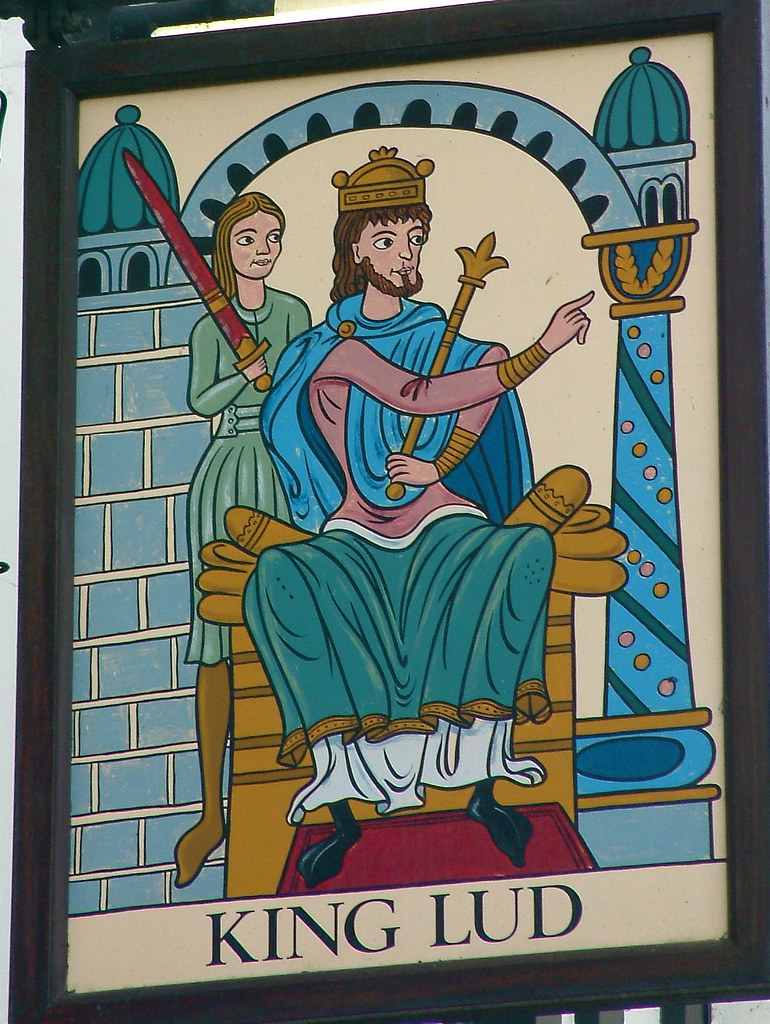 |
| “...and over there is the bucket I put my head in.” |
As unlikely as Geoffrey of Monmouth’s theory might be, he nevertheless might’ve been onto something by suggesting that London was named after or in honour of someone—but precisely who that “someone” was is another question.
For a while, one popular theory was that London was founded by or named in honour of someone called Londino or Londinos, a hypothetical name supposed to derive from an old Celtic word meaning “wild” or “fierce”. But there’s no historical precedent for that name whatsoever, and (without getting into too much detail) phonologists tend to agree that a Celtic word beginning lond– would give you a modern English word pronounced something like “loaned”, not like the “lund” of London. So despite being more than century old, this theory is now widely discredited.
Alternatively it might not be the Lond– part of London that’s taken from someone’s name, but rather the –don. It’s been suggested that London might once have been called Lunadin, Luandan or Lan Dain, an ancient name meaning something like “moon temple of the goddess Diana”. Sir Christopher Wren certainly believed that he had unearthed a Roman temple dedicated to Diana when he rebuilt St Paul’s Cathedral, but again the linguistic and historical evidence just isn’t there to back this theory up.

So if it’s not an honorific name, how about a geographical one?
Another theory is that London was originally llyn din, or llyn dain, both Welsh-inspired names literally meaning “lake-fort” or “pool of the river” respectively (the “lake” and “pool” in question possibly being the widening, deepening part of the river Thames). They’re both plausible theories, but linguistically a word like llyn would be expected to produce a modern name like Lindon-with-an-I, not London-with-an-O.
And London has almost always been London-with-an-O: the earliest records we have of it are all from ancient Roman Latin documents and inscriptions that refer to it as Londinium or Londinion. The people of London themselves were the Londiniensi—a word taken from a stone tablet dating from around AD 150 that was unearthed at an archaeological dig in Southwark in 2002, and which provides us with the earliest known evidence of the name “London” that we have. And for the Romans to have spelled their “London” with an O (or a U, as they sometimes did) casts doubt on those Welsh-origin theories.
Instead, we might have to look even further back in time.
 |
| Bring on the wall! |
In 1998, Professor Richard Coates—then President of the English Place-Name Society—put forward perhaps the most convincing argument for the origin of the word London yet: Plowonida. If you think Plowonida sounds more like something you’d use to treat athlete’s foot rather than the origin of one of the most famous cities in the world, you’ve got a point. But the reason this looks so unfamiliar—and so unlike the modern name “London”—is because we’re dealing with impossibly old pre-Celtic language.
In Coates’ theory, Plowonida would have started life as a hydronym (a river name) referring to the part of the Thames on which London was founded. It combines (brace yourselves, we’re going even further back in time here) two Proto-Indo-European word roots meaning “to flow”, plew– and nejd–, whose descendants are found in river names all across Europe. In combination, it’s theorized that these two elements might have referred to the first noticeably deep, fast-flowing part of the Thames, where it was impossible to ford or cross on horseback.
Knowing what we know about pre-Celtic language, calling the river itself Plowonida would have given the town or village that stood on the banks of the river the name Plowonidonjon, which over centuries of simplification and alteration would have become a Celtic name along the lines of Lūndonjon, then the Latin name Londinium, and ultimately the modern English name “London”. If Coates’ theory is correct, that would mean the name “London” could be interpreted as something like “the town at the unfordable part of the river”—which is a considerably better theory that “the town of the king who put his head in a bucket”.
No one knows for sure what the name LONDON actually means. http://t.co/oLcpVgYaIF— Haggard Hawks Words (@HaggardHawks) 9 June 2015


