_
Showing posts with label exploration. Show all posts

11 August 2016

10 Words Borrowed From Other Languages - 500 Words Ep. 31


A long, long time ago over on HaggardHawks, this little fact popped up:


In retrospect, that’s a little disingenuous (not least because linguists can’t really decide what actually constitutes a word), but regardless of the parameters involved, studies of etymology tend to agree that anywhere from one-quarter to one-third of the English language has been borrowed directly into English from French.

Elsewhere in the dictionary, things get increasingly far-flung: besides the likes of German, Spanish and Italian, English has adopted words from practically every major European language, including Norwegian (slalom), Finnish (sauna), and Czech (robot), as well as a number of global big-hitters like Russian (vodka), Arabic (almanac), the Chinese (lychee) and Japanese (karate) languages, and Hindi (juggernaut), Bengali (jute), Urdu (cummerbund) and all the other languages of the Indian subcontinent.

And it’s borrowed words and the languages we have taken them from that are up for discussion in this week’s HH video:


We might owe the humble word tattoo to (SPOILER ALERT if you haven’t seen the video) one of the furthest of the far-flung languages of the south Pacific, but it is by no means alone. 

Other somewhat surprising languages to have provided words to English include Tamil, another Indian language and the official language of both Sri Lanka and Singapore, which is the origin of the likes of catamaran, cheroot and pariah. Javanese, the most widely spoken language in Indonesia, is the origin of batik and lahar, another name for a volcanic mudflow. 

The native Aboriginal languages of Australia have given us billabong, budgerigar and dingo. When you run amok, you’re using a Malay word (borrowed into English via Portuguese) meaning “attacking frenziedly”. The boondocks take their name from a Tagalog word meaning “remote place”. And over in the Caribbean, the Taíno language is responsible for a number of very familiar words adopted into English via Spanish Caribbean colonists, including tobacco, hurricane, potato, canoe and even Caribbean itself. But these words, and several others like them, are almost all that remains of the Taíno civilization.

An indigenous Arawak people, the Taíno were once the most numerous people in the entire Caribbean. As such were the first Native Americans that Christopher Columbus came into contact with when he arrived in the Americas in the late 1400s; Columbus’s misinterpretation of the Carib people’s word for themselves, Caniba (as well his misapprehension that they were anthropophagous) even gave us the word cannibalism.


But as more Europeans arrived in the Caribbean, the Taíno population collapsed as its people contracted diseases for which they had no natural immunity, most notably smallpox. Within three decades, their numbers had dwindled by as much as 90%; according to some accounts, by the mid 1500s there were fewer than 500 individual Taíno people alive in the world. 

Although the population understandably never recovered, pockets of Taíno people survive across North America today. But their culture and language suffered so terrifically in the aftermath of Columbus’s arrival that the handful of Taíno words to have survived in English offer an extraordinary and tantalizingly rare glimpse of a long-lost civilization... 


28 April 2016

Penguin


You might have seen this frankly brilliant fact pop up on the @HaggardHawks Twitter feed this week:


Poor old penguins. It can’t be much fun humpling around in sub-zero temperatures avoiding being eaten by seals all day. But then along comes Oliver Goldsmith—whose seven-volume History of the Earth and Animated Nature is the source of that quote—to tell us that eighteenth century sailors called them arse-feet. It’s just not fair really, is it?

Not that it was only the penguins, though. The nickname arse-feet dates back to the sixteenth century, when it was originally another name for the little grebe, and over the centuries it’s been used in reference to a whole host of other species, all of which had one thing in common—the position of their feet noticeably close to their derrieres. Frankly, it gives a whole new meaning to having a boot up the arse. (Shameless plug: there’s more on all this in the HH factbook, Word Drops.)

But if that’s the history of arse-feet, what about penguin?

Well, the word penguin also dates back to the sixteenth century, with the earliest record we know about coming from the logbook of Sir Francis Drake’s Golden Hind. According to Drake’s admiral, Francis Fletcher, as he sailed through the Magellan Strait in 1577: 

[20 August 1577] In these Islands we found great reliefe and plenty of good victualls, for infinite were the number of fowle, which the Welsh men named Pengwin … [The birds] breed and lodge at land, and in the day tyme goe downe to the sea to feed, being soe fatt that they can but goe, and their skins cannot be taken from their bodyes without tearing off the flesh, because of their exceeding fatnes.
Yep, not only did the penguins have to contend with waddling around in sub-zero temperatures and being called arse-feet, but Drake and his crew decided to announce their presence in the Southern Ocean by eating every penguin they could lay their hands on.

But then there’s this:
New found land is in a temperate Climate… There are Sea Guls, Murres, Duckes, wild Geese, and many other kinds of birdes store, too long to write, especially at one Island named Penguin, where wee may driue them on a planke into our ship as many as shall lade her. These birdes are also called Penguins, and cannot flie.
If you know anything about natural history, that quote might strike you as a little odd—penguins are only found in the Southern Hemisphere, so what the dickens were they doing in Newfoundland?

Well, that second quote isn’t from Drake’s logbook, but from a letter, written on 13 November 1778, by a Bristol merchant sailor named Anthony Parkhurst to the famed English geographer Richard Hakluyt. And the penguins Parkhurst is talking about aren’t the same penguins we know today—in fact, the penguins he’s talking about haven’t been seen by anybody for 150 years.

Parkhurst’s Newfoundland penguins were in actual fact great auks—tall, flightless, black-and-white seabirds (whose arses were just as close to their feet) that were once native to much of the North Atlantic. Although the great auk is now extinct (and the story of its slow demise makes for a sobering read, alas) in Drake and Fletcher’s day they were still widely abundant—so abundant, in fact, that as Parkhurst points out they could be driven in huge numbers from “Penguin Island”, along a plank, and onto a ship to provide food for the crew.


Well, this is aukward...

Fletcher’s quote might predate Parkhurst’s by over a year, but it’s thought that the birds Parkhurst wrote about were the original “penguins”—after all, for there to be a place called “Penguin Island” in 1578, we can presume the word penguin was in use in reference to the great auk long before then. Drake’s crew, meanwhile, would have presumably been familiar with the sea birds they knew from back home, and so when they saw remarkably similar flightless black-and-white birds in the equally freezing cold waters of the Southern Ocean in 1577, they either mistook them for the great auks they knew from home, or simply referred to them by the same name, penguin, because they were so similar.

That’s all well and good, of course, but what does the word penguin actually mean? Well, Fletcher’s reference to the birds’ “exceeding fatness” points to one possible theory: that penguin might derive from a Latin word, pinguis, meaning “plump”, “dense”, “fatty”—or pinguid. But a more likely explanation lies with Fletcher’s “Welsh men”. Penguin is thought to derive from pen gwyn, the Welsh for “white head”, and sure enough the great auk had a noticeably bright white patch of plumage between its bill and its eyes. 

So all that means that the original “penguins” weren’t actually penguins, and weren’t from the Antarctic. But their feet were close to their arses...


1 April 2016

Cacafuego


There’s really no nice way of putting this, but the fact is that poop crops up more often than it duly should on this blog. And thanks to a tweet from the HH feed the other day, we’re going back down that way again now:


There’s no denying that cacafuego is a brilliant (and unavoidably useful) word, but is it really genuine? Or, to put it another way:


Wow, imagine if that were true. A plot twist to put M Night Shyamalan to shame. But let’s not get bogged down in piss halfway through a blog about shit, so to speak.

No prizes for guessing that cacafuego was borrowed into English from Spanish, and combines the verb cacar (modern Spanish cagar, “to void excrement”) with fuego, “fire”. It first appeared in English as another word for a blustering braggart in the early 1600s, but we can be fairly sure that it was in use before then thanks to the somewhat unlikely-sounding involvement of Sir Francis Drake.


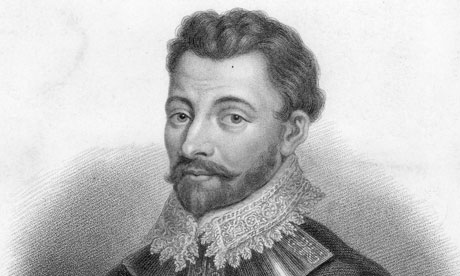
Sir Francis Drake: looking a little ruff
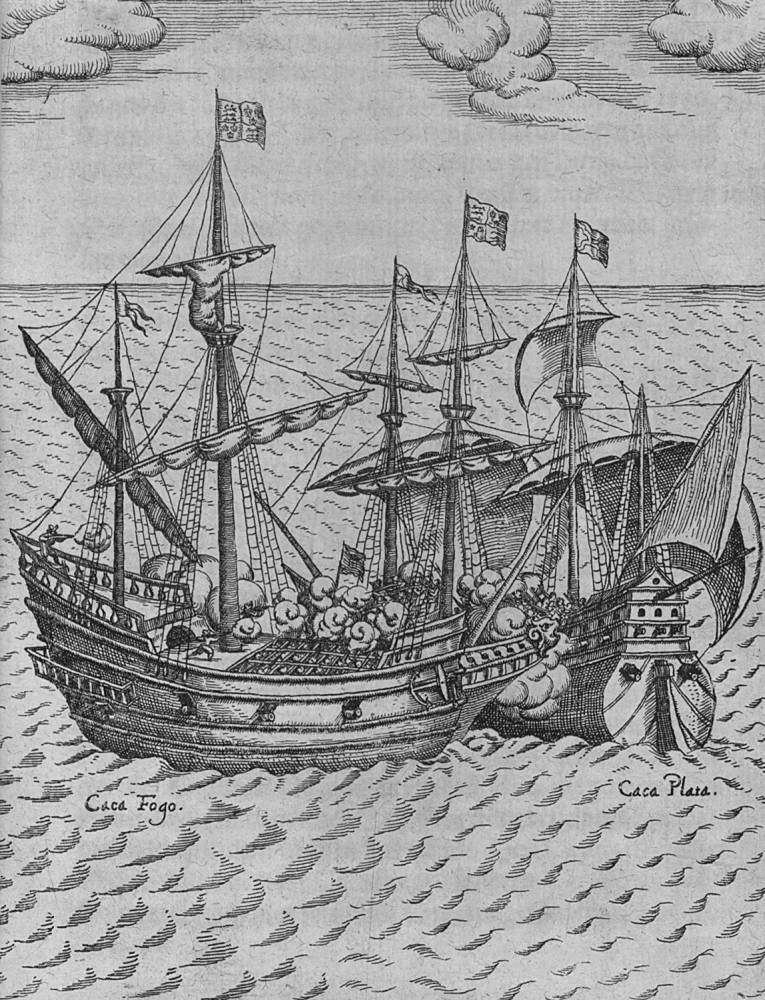
In 1578, part-way through his circumnavigation of the Earth, Drake rounded Cape Horn and entered the Pacific Ocean, hot on the heels of a 120-tonne Spanish galleon called the Nuestra Señora that he had heard was laden with a rich cargo of silver and jewels from the Spanish colonies. And he wanted it.

Sailing up the Pacific coast of South America, Drake’s Golden Hind caught up with the Nuestra Señora off the coast of Ecuador. Knowing that an attack made under the cover of darkness was his best bet, he slowed his progress by tying some of his ship’s store of wine to the stern and throwing it overboard, so that by the time the Hind reached the Nuestra Señora it was the middle of the night. The Spanish crew were taken by surprise, and after a brief skirmish they surrendered, allowing Drake and his men to take control of the ship.


Drake sailed both the Nuestra Señora and the Golden Hind back to the South American coast to unload her treasure. Knowing just how substantial a prize he had secured for England he treated the Spanish crew well, inviting the officers to join him for a grand banquet and giving every crewmember a parting gift and a letter of safe conduct, ensuring as safe a journey home to Europe as possible. Drake himself continued on his journey, and having completed his circumnavigation arrived back in Plymouth on 26 November 1580.

So where does all the flaming poop come into this? Well, Drake’s captured galleon might have been officially known as the Nuestra Señora de la Concepción, or “Our Lady of the Immaculate Conception”, but to her crew she was the Cacafuego, or “fire-shitter”. That might seem like an odd (and fairly uncomplimentary) nickname for—well, anything really, but just like the Spitfire centuries after her, it was probably intended to be a reference to her impressive weaponry and blazing cannon fire, or else to her speed through the water and her “fiery” temperament. 

And just as spitfire was once a nickname for an irascible, hot-tempered person, in the seventeenth century cacafuego became a byword for a blustering, swaggering braggart—a meaning perhaps influenced by the fact that, despite her impressive armoury, the Cacafuego had proved no match for Drake. 


25 September 2015

St Lucia

Here’s an intriguing little fact that popped up on @HaggardHawks the other day:
This is actually (shameless plug #1) one of the choicer entries cherry-picked from the Haggard Hawks fact book, Word Drops. And although (shameless plug #2) you can find out more about it (shameless plug #3) in the award-nominated book, maybe all this deserves a bit more explanation here.

On a global scale, the etymologies of country names are a bit of mixed bag. Some are so straightforward that they require no explanation at all (we’re looking at you, United Kingdom). Some are named after their inhabitants (France = “the land of the Franks”), or their colonists or conquerors (Philippines = “islands of Philip II of Spain”). Some are more descriptive (Bahamas = “the shallows”, Bahrain = “two seas”), or more poetic (Luxembourg = “little castle”, Zimbabwe = “land of stones”). And some are just plain weird (Cameroon = “land of shrimp”).

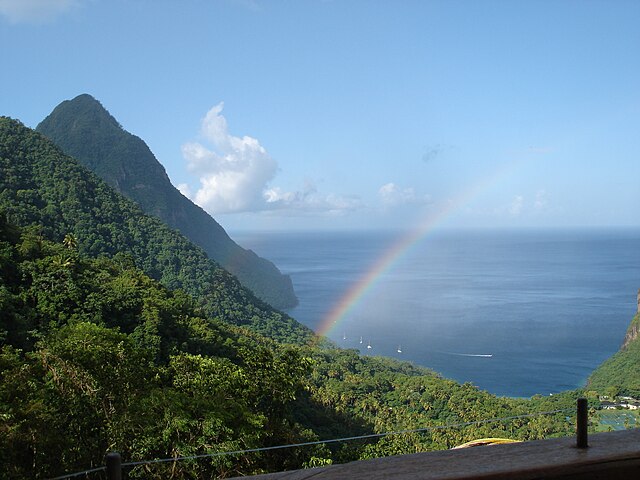
St Lucia takes its name from Lucy of Syracuse, a third-century Italian saint (the patron saint of blindness and throat infections, no less) who was martyred during the Roman Emperor Diocletian’s persecution of the Christians in AD 304. Although the reasoning behind the name is unclear, we nevertheless know that it was chosen by the island’s first European explorers and settlers, the French, who arrived there in the early 1600s—although rumour has it that the island was being used as a base by French pirates long before then. 

But according to the US Department of State, as of 2015 there are 195 countries (defined as “a people politically organized into a sovereign state with a definite territory recognized as independent”) in the world. Is it really true that only 0.51% of them are named after women? 

Unfortunately, yes—although there are a couple of very close calls.

One of the most famous almost-but-not-quites is the Republic of Ireland. Both Ireland and its Irish equivalent Éire derive from Eiru, the name of a goddess of the land and sovereignty in Celtic mythology. On a similar theme, one theory claims that Tunisia takes its name from Tanith, a Phoenician goddess of the moon who, with her husband Baal-Hammon, was the principal deity of the ancient city of Carthage.

But as far as eponymous women on our list of 195 countries go, that really is it: if we exclude all the ancient mythological and supernatural beings, St Lucia really is the only country named after a woman. Although, as a handful of astute followers noted, there is one final possibility:

St Helena is a tiny 50 square-mile volcanic island in the South Atlantic, home to around 4,500 people. It takes its name from St Helena of Constantinople (the patron saint of difficult marriages, should you need one), who was the wife of Constantinus Chlorus, ruler of the Western Roman Empire from AD 293-306. 

Can we add St Helena to our list? Well, the problem here is that St Helena is officially classed as just one-third of a British Overseas Territory known as St Helena, Ascension and Tristan da Cuhna—the collective name for a clutch of British-controlled islands in the South Atlantic Ocean. And so long as we’re limiting our list to independent countries, St Helena just doesn’t fit the bill. 

So it seems St Lucia it seems really is the only country in the world named after a woman. But, hey—it could be worse: 


9 July 2015

Britain

It’s easy to forget that place names—just like surnames, first names, months of the year, and all other proper nouns—are still only words, and as such have their own histories and etymologies. We’ve mentioned quite a few of these before on the @HaggardHawks Twitter feed, from “the wooden temple” in central Asia to the original “white house” in north Africa, to America’s “place of the wild onion” and “the best place to grow potatoes”.

Unfortunately, because place names tend to be particularly ancient, their precise origins and meanings are often very tricky to pin down. Shortfalls and inconsistencies in what little historical evidence is available mean there’s often just as much conjecture and guesswork involved as there is hard fact, and even then some names defy all attempts to explain them. 

For instance, despite being one of the most famous cities in the world, no one really knows what “London” means. Instead, theories range from the relatively sensible—perhaps a long-forgotten Welsh word, meaning something like “river-fort” (llyn-din), or “pool on the river” (llyn-dain)—to the downright bizarre, with one idea even suggesting some kind of reference to Luna, the Roman goddess of the Moon. (Shameless plus: there’s more on that in the new book…)

We tweeted another bizarre place name origin a few weeks ago:
And, well, we thought it might need a bit more explaining.

So. The earliest written record of “Britain” that we know about comes from an Ancient Greek explorer and adventurer named Pytheas of Massalia. Sometime around 325BC, Pytheas circumnavigated and explored the entire British Isles, probably becoming the first person in history to do so. He also travelled high enough into northern Europe to describe the Midnight Sun (probably becoming the first person to do so); crossed the Arctic Circle and spotted the outer fringes of the great northern icecap (probably becoming the first person to do so); and was the first explorer from Mediterranean Europe to reach the Baltic Sea by boat. He was, it’s fair to say, a bit of a dude.

Pytheas’s accounts of his journeys were among the most celebrated geographical texts in antiquity, but unfortunately all of his original writings have long since been lost. Everything we know about his travels now comes from the smattering of quotes, extracts, and discussions that later writers and historians—including the great Roman naturalist Pliny the Elder, who keeps cropping up on here—included in their work. But what has survived is Pytheas’s early use of the word “Britain”, which he recorded more than 2,300 years ago as “Bretannike”.

At the time of Pytheas’s visit, Britain would still have been a hodgepodge of different Celtic and pre-Roman tribes and languages. In the far north and west, however, two increasingly dissimilar branches of the ancient Celtic language family were starting to take shape: Goidelic, or “Q-Celtic”, in the far north and northwest (which eventually gave rise to Irish, Manx and Scots Gaelic), and Brythonic, or “P-Celtic”, in the west and southwest (which eventually gave us Welsh, Cornish and Breton). 

The nicknames “P” and “Q” refer to the fact that Brythonic Celtic tended to develop a p sound where Goidelic Celtic tended to have a hard q or k sound, and vice versa. We’re dealing with impossibly ancient words here, of course, but you don’t have to look too far to find evidence that this change took place: pick up an atlas or a road map of the British Isles, and you’ll find Pentire, a peninsula on the north coast of Cornwall, and Kintyre, a peninsula in southwest Scotland. Both names literally mean “headland”; both derive from P-Celtic (penn) and Q-Celtic (keann) words meaning “head”; and both are practically identical, except for their initial p and k sounds. 

But anyway, back to Pytheas. Based on linguistic evidence like this—and based on what little we know of Pytheas’s route—it’s thought that his “Bretannike” must be derived from some early Brythonic or “P-Celtic” word, suggesting that the people he learned it from originated somewhere around modern-day Wales or southwest England. We can only guess at what this original root word might have been, but from what we know about the Celtic languages, the consensus among etymologists and toponymists (that’s place name researchers to you and me) is that its closest modern descendant is probably an old Welsh word, prŷd, essentially meaning “form”, “image”, or “countenance”. 

If this presumption is correct, then the ancient Britons would quite literally have been “the people of the forms”, which, it’s again presumed, is an apparent reference to their supposed fondness for war paint and tribal tattoos. There are, admittedly, several rivalling theories here—and historians are undecided about whether these Iron Age Britons tattooed each other or not—but, etymologically at least, there is a strong argument to suggest Britain is quite literally the home of the “tattooed people”.


And, appropriately enough, Britain is now apparently the most tattooed nation in Europe. Everything really does come full circle. 


_______________________________

Hat tips to David Willbe (@DavidWillbe) and Dr Matt Lodder (@mattlodder) for links to the historical arguments for and against Pictish tattoos. Tatt you very much. (Sorry...) 

24 June 2015

Archipelago

Earlier this week, HaggardHawks tweeted this:
Aside from giving us the chance to tweet that fantastic NASA spaceshot, again this is one of those weird facts that almost sounds too strange to be true:
“Infuriatingly interesting” might just be the finest compliment we’ve ever received. But our blushes aside—this factoid is indeed completely genuine. And here’s why.

The arch– of archipelago is the same as in words like archangel and archbishop: derived from the Greek word archos, it essentially means “ruler”, “chief”, or “first and foremost”. It’s also the same arch– we have in words like patriarch (in the sense of a “ruling” father, or an earliest ancestor), anarachy (literally “without a leader”), and even archaeology (which is the study, quite literally, of our “first” artefacts).

The –pelago part, meanwhile, comes from the Greek word for the sea, pelagos, which is similarly the origin of a whole bunch of fairly esoteric geographical terms like bathypelagic. Put these two halves together, and you end up with a word that literally means something like “chief sea”.

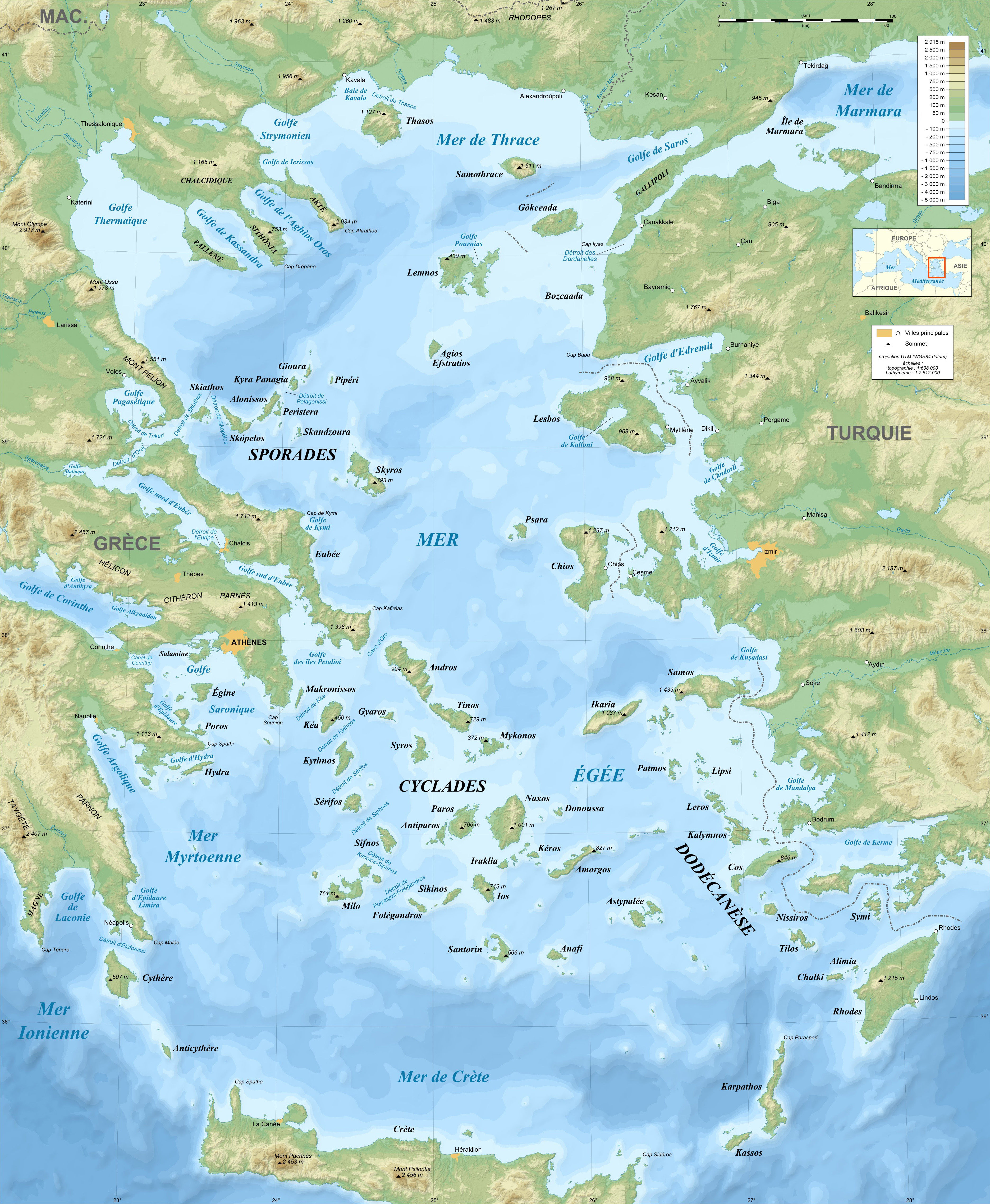
The Aegean was (for obvious geographical reasons) the “chief” sea of the Ancient Greeks, so (for obvious etymological reasons) the word archipelago simply began life as another name for it. This was also the meaning that the word had when it first appeared in English back in 1503—but how did we get from there to the meaning we have today?

If you know your European geography, you’ll know that the Aegean Sea is absolutely full of islands. Well, not exactly full, because then there’d be no water. But there are, nevertheless, quite a few of them:


In fact, from the Adelfoi group in the west to the tiny rocky outcrop of Zourafa, there are almost 2,500 islands in the Aegean Sea that together form one-eighth of Greece’s entire land area and are home to one-seventh of the Greek population. So, yes—that’s a lot of islands. And explorers in the sixteenth century knew it.

Thanks to the Aegean’s notably island-studded appearance on maps and navigational charts, when ever more daring journeys of exploration began to be made in the 1500s and 1600s, its name, archipelago, began to be used as a byword for any newly-discovered patch of water that likewise appeared full of islands. 

So when the English explorer Martin Frobisher’s third voyage to uncover the Northwest Passage in 1578 led him into the frozen, island-strewn Canadian Arctic, his lieutenant George Best (no, not that George Best), appropriately noted that:
These broken landes and ilandes, being very many in number, do seeme to make there an Archipelagus, which as they all differ in greatnesse, forme, and fashion, one from another, so are they in goodnesse, couloure, and soyle [soil] muche unlike.
By the 1600s, however, this meaning had altered so that archipelago no longer referred to an island-strewn stretch of water, but to the islands themselves—as in this English translation of the Portuguese explorer Fernão Mendes Pinto’s journey to southeast Asia:
For then he might have means, with less charge, to shut up the Straights of Cincapura [Singapore] … and so stop our Ships from passing to the Seas of China … and the Molucques; whereby he might have the profit of all the Drugs which came from that great Archipelague.
Pinto’s account was translated into English in 1633, and the meaning of archipelago his remained unchanged ever since.