_
Showing posts with label Q. Show all posts

26 August 2016

10 Words Coined By Writers – 500 Words Ep. 33


If you’ve been keeping up with the HH 500 Words YouTube series, you’ll have seen a few literary lists crop up amidst all the weird words and word origins. Back in February, we marked Dickens’ birthday with a list of words derived from his characters. In April, we marked the 400th anniversary of Shakespeare’s death with a list of words he used that no one can quite decipher. 

And this week, we’re heading back down the library with 10 Words Coined By Writers:


One word that could have made this list (and would have done, had we not already addressed it in our video on little-known opposites) is eucatastrophe, a term coined by Lord of the Rings author JRR Tolkien as the opposite of catastrophe: a sudden event of sheer good fortune in the plot of a story that typically hastens its conclusion.


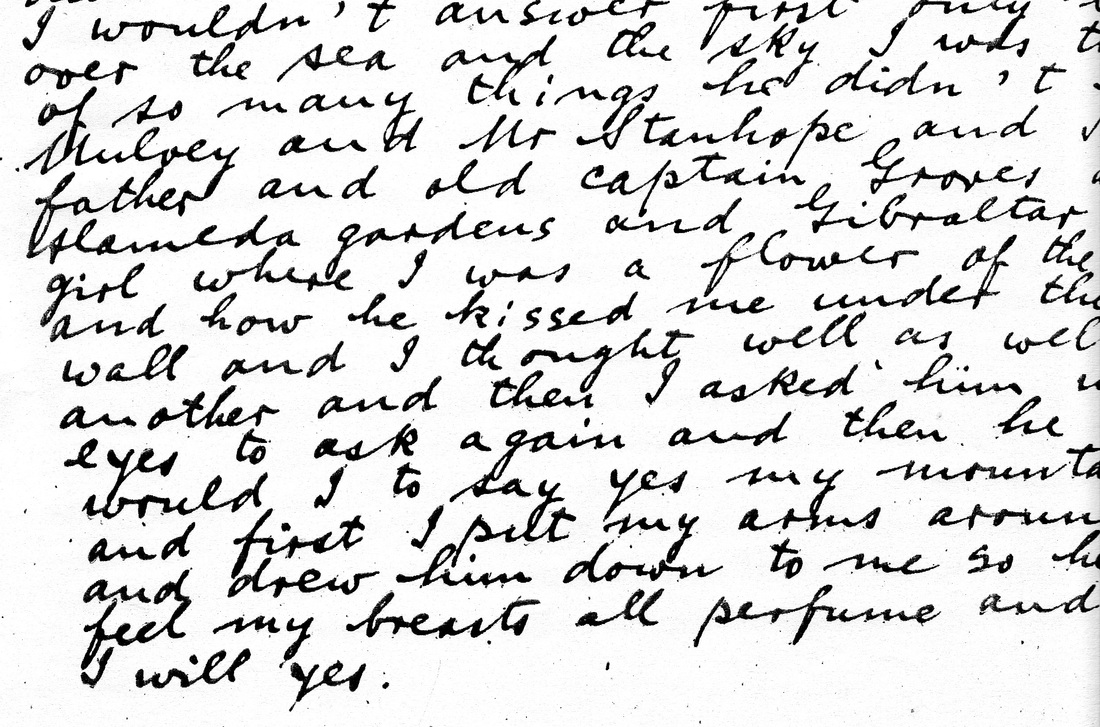
Lewis Carroll’s chortle could have made our top 10 too, had we not already explained its origins in our video on portmanteaux. But one word that failed to make the final cut here and yet still deserves an explanation, is the story behind James Joyce’s little known contribution to particle physics: the quark.

A quark, for those of you not too well versed in this subject (a minority, surely…) is defined by the Oxford English Dictionary as:
Each of a group of subatomic particles regarded, with leptons, as basic constituents of matter, and postulated never to occur in the free state but to be combined in pairs to form mesons and in triplets to form baryons, and to have fractional electric charges, +⅔ and −⅓ that of the proton.
Well, that clears that up. But without going too deeply into the science behind the likes of leptons and quarks, all that concerns us here is that quarks were first postulated by American physicist and Nobel Prize winner Murray Gell-Mann in 1964. Although originally theoretical, Gell-Mann’s model of the subatomic “particle zoo” has since been validated, and ultimately the terminology he used in his original explanation has since become the standard across all physics. But why call them quarks in the first place? Well, why not let the man himself explain. 

In 1978, Gell-Mann wrote to the editor of the OED Supplement to explain the thinking behind his word:
I employed the sound “quork” for several weeks in 1963 before noticing “quark” in Finnegans Wake, which I had perused from time to time since it appeared in 1939 ... I needed an excuse for retaining the pronunciation “quork” despite the occurrence of “Mark”, “bark”, “mark”, and so forth in Finnegans Wake. I found that excuse by supposing that one ingredient of the line “Three quarks for Muster Mark” was a cry of “Three quarts for Mister…” heard in H. C. Earwicker’s pub.
In other words, as Gell-Mann later expounded in his book, The Quark and the Jaguar (1995), he knew the sound of the word he wanted to use before he decided on how it should be spelled; at one time, he explained, quark might even have been spelled “kwork”. But then, purely by chance, he stumbled across the word quark in James Joyce’s enigmatic writing, and the Q spelling stuck. 

One question remains, however—what was James Joyce’s quark in the first place? Well, it’s presumed that the quark used in Finnegans Wake is meant to represent the sound of a seagull, and is used in the novel as a call to buy a round of drinks. Any excuse…


21 January 2016

10 Words Spelled Q Without U

The second video in HaggardHawks’ new 500 Words project is live now on YouTube! Click below to take a look...


This time around, we’re looking at 10 Words Spelled Q Without U—including an Albanian currency unit, an Inuit word for the wool of the musk ox, a bizarre onomatopoeic Zulu word that found its way into South African slang, and a chain of six letters that every English-speaking person will likely know.


There are still 48 videos to come, so remember to subscribe to catch them all, and of course to keep an eye on the HaggardHawks Twitter and Facebook pages to make sure you don’t miss out on anything. Next in the series, we’re sticking with our theme of rarely-used letters of the alphabet with 10 Words Beginning With X... 


30 April 2015

Quockerwodger

If you’re reading this in the UK (and you don’t live under a rock) then chances are you’ll know that there’s a general election on its way. If you’re not reading this in the UK, then frankly I hope you’re getting better weather than we are at the minute, but apologies in advance—this is going to be about politics...

So. With the election now all but imminent, the lovely people at BBC Radio 4’s World At One programme asked @HaggardHawks to pop along and explain the origins of some choice political words—some, but not all, taken from our new factbook, Word Drops. These etymological snippets have been going out on Radio 4 every day this week, and while you can catch up with any that you missed on the BBC iPlayer (for the next few weeks, at least), we thought it might be worth explaining a few of the more intriguing word histories here on the blog.

We began on Monday with one of the main buzzwords of the 2015 electoral campaign—no, not Milibrand, but austerity. 


With arguments raging over the plans opposing parties are each putting forward in their election budgets (a derivative of bougette, a French leather coinpurse, incidentally), it’s fitting to know that austerity traces all the way back to austeros, a Greek word meaning “harshness” or “bitterness”. Originally, it was used only in relation to poor-tasting or poor-quality food or wine, but over time this meaning broadened to come to include the figurative use of austere to mean “severe”, “frugal”, or “spartan”.

Speaking of political plans, manifesto unsurprisingly comes from the same root as manifest, in the sense of something becoming or being made clear or visible; the notion is, quite literally, that a politician or party makes all of their ideas clear in their manifesto. The initial mani– here derives from the Latin word for “hand”, manus (as in manipulate and manicure), and it’s thought that manifest might once have been used to describe thieves that were caught red-handed, with clear, incontrovertible proof of their guilt—hence the later sense of “clarity” or “visibility”. A connection between criminality and politics, you say? Surely not.

That brings us to quockerwodger. If ever a political word needed bringing back into common currency, then this is it. Though not a truly political term in its own right—it’s actually an old dialect word for a single-string wooden marionette, derived from quock, meaning “tremble” or “shake”—in nineteenth century slang, quockwodger was commandeered by the satirical press as a name for a “pseudo-politician”, namely one whose strings are being pulled by someone unseen. 

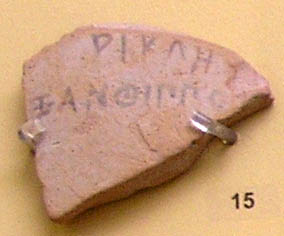
And if you’re fed up with quockerwodgers, then it’s worth bearing in mind the original meaning of ostracism: back in Ancient Athens, voters could elect to have someone they disliked ejected from the city for anything up to ten years. Votes would be cast by writing down names on a shard of pottery called an ostrakon, and whoever’s name came up the most would be fairly unceremoniously run out of the city.

An ostrakon. That says “Pericles”, not “Farage”

And, finally, you may have caught this over on Twitter the other day:


Although, as we tweeted, no one is quite sure of the precise connection between sycophancy and figs, one possible theory holds that while Ancient Athenian politicians would sycophantically ingratiate themselves with one another, behind the scenes they would encourage their followers and supporters to heckle and jeer their opponents—which included showing them “the fig”. Effectively an Ancient Greek version of sticking two fingers up at someone, “giving the fig” involves pushing the thumb through the closed fingers of a clenched fist, so that the hand looks (with a little imagination) a bit like a fig. But is this the genuine origin of sycophant? It’s impossible to tell—but it’s a good story all the same.