_
Showing posts with label QATLYNETA. Show all posts

5 August 2016

10 Rhymable Unrhymable Words - 500 Words Ep. 30


A little while ago, this fact cropped up on the HH Twitter feed:


It ended up sparking quite a debate about whether carpet actually did have a rhyme, with everything from trumpet to market thrown into the mix. But, no. Seriously. Nothing rhymes with carpet. And nor does nothing, for that matter. In fact nothing rhymes with nothing either (depending on your accent, of course), but at the risk of tumbling into existential vortex, let’s just move on. 

Rhymes—and in particular words that purport not have any rhymes but actually do—are the focus of this week’s YouTube video, the 30th in the 500 Words series we’re running every week this year:


But following on both from this week’s episode, and from the misnomers episode from a couple of weeks back, one question we want to answer: what came first, orange or oranges? (Shameless plug: there’s more on this in the HH factbook, Word Drops—which is now available Stateside too…)

Chicken-and-egg language questions like this crop up on HH every so often (case in point below), but what about orange vs. oranges?


Well, the fact is that there was no word for the colour orange in the English language until oranges first began to be imported into England with any regularity in the early Middle Ages. Before then, anything orange coloured simply had to be described in terms of red and yellow, as in this description of a fox from Chaucer’s Nun’s Priest’s Tale:

His colour was bitwixe yelow and reed, 
And tipped was his tayl and both his eeris 

[His colour was between yellow and red, 
and tipped was his tail and both ears.]

The earliest record of the word orange—which derives at length from the Sanskrit word for the orange tree, naranga—comes from the Sinonoma Bartholomei, a fourteenth century Latin herbal, which listed all the plants known to have medical applications. And there, on page 15, “orenge” was listed as the English equivalent of the Latin “Citrangulum pomum”, or “citrus fruit”.

The colour orange didn’t appear until around a century and a half later. In 1557, orange cloth was listed in a legal document, collected in the so-called Statutes at Large in the late sixteenth century, that prohibited the selling of all fabrics except those of a certain set of colours:

And moreover, be it enacted by the authority aforesaid that no person nor persons … shall sell or put to sale within the realm of England any coloured cloth of any other colour or colours than are hereafter mentioned, that is to say, scarlet, red, crimson, morrey, violet, pewke, brown, blue, black, green, yellow, blue, orange, tawny, russet, marble grey, sad new colour, azure watchet, sheeps colour, lion colour, motly, iron grey, friers grey, crane colour, purple, and old medley colour, most commonly used to be made above and before twenty years past.

Thank goodness “sheeps colour” made the final cut, frankly. And same goes for the “sad new colour”, otherwise I’d have nothing left to wear. But Chaucer’s foxes and sartorial rules and regulations aside, it’s clear that in this particular chicken-and-egg situation, it was the chicken that came first: the bright orange fruits gave the colour orange its name, not vice versa. 

All in all, it’s a colourful little story. 


12 May 2016

London


A few weeks ago over on the HaggardHawks YouTube channel, we looked at the origins of 10 city names, covering everywhere from Chicago (“a place to grow wild onions”) to Funafuri, the capital of Tuvalu (“banana-woman”).


But one city that didn’t make the final cut was the largest city in the UK and the second largest city in Europe. The home of Britain’s smallest police station. The world’s oldest underground network. Two of the world’s best universities. And a woman with a pig’s face. Yep, we’re talking about London. 

So why—to resurrect our occasional series of Questions About The Language You Never Even Thought About—is London called “London?”

In terms of etymology (or rather toponymy, to give the study of place names its proper name), London is something of a mystery. Actually, that’s putting it mildly—over the past few hundred years, a number of linguists, scholars and geographers have put their heads together and come up with little more than a mutual discrediting of each other’s theories and one gigantic Buckingham Palace-sized question mark. Why is London called “London”? The short answer at least is that no one really knows.

That’s partly to do with a lack of written evidence. It’s also partly to do with the fact that we’re dealing with exceptionally old words and word elements, the barest bare bones of the language. And partly it’s because London is such a unique name—it really just doesn’t look like any other ancient word or word element that we know about, which makes working out what it might mean an especially tricky business. But just because we don’t have a definitive answer, doesn’t mean that we don’t have any answer at all.

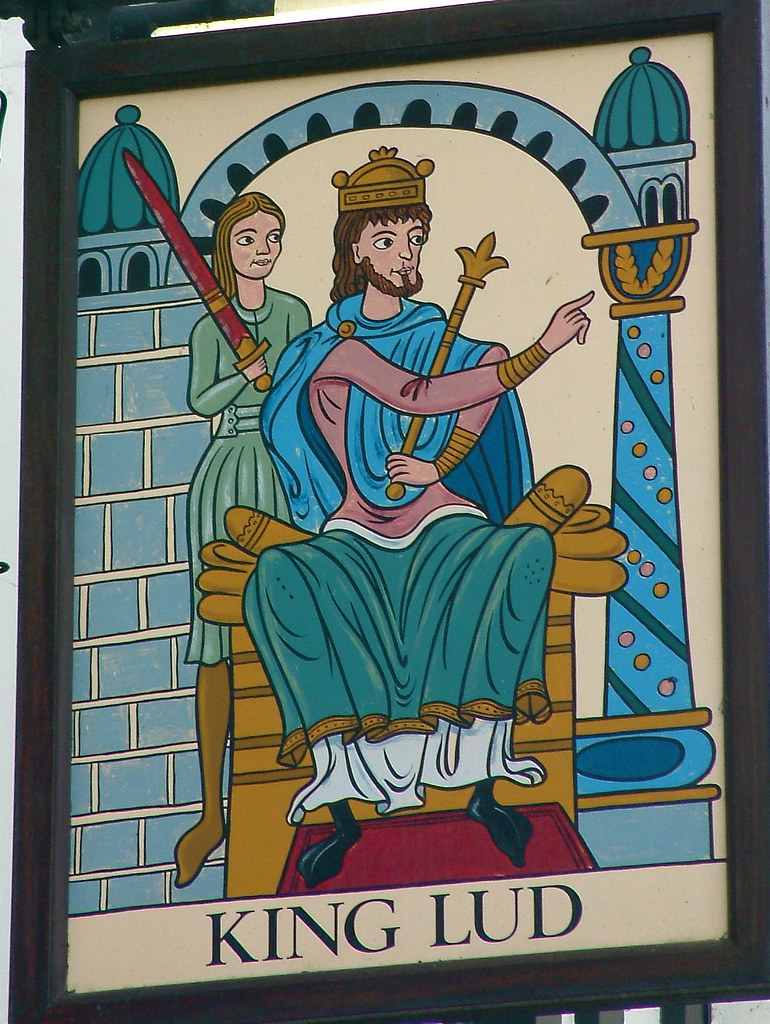
By far the oldest explanation on record is that of the twelfth century Welsh scholar and historian Geoffrey of Monmouth. In his History of the Kings of Britain (c.1135), Monmouth claimed that London was founded by and named in honour of a pre-Roman king of Britain named Lud, who built the city on the site of an even more ancient city called “New Troy” that had been founded by Brutus, grandson of Aeneas, in 1100BC. It’s a nice story alright. It’s just a shame it’s complete rubbish.


Geoffrey of Monmouth probably based his mythical tale of King Lud on that of a legendary figure from Welsh folklore called Lludd Llaw Eraint, or “Lud Silver-Hand”, who is said to have saved Wales from a plague of dragons and a magical giant who had the power to send people to sleep by playing music; to escape the giant’s soporific tunes, Lud dipped his head in a bucket of water. 

Oddly enough, it’s likely that none of that ever actually happened, which makes the idea that London is named after a dragon-slaying monarch with his head in a bucket somewhat implausible. Oh, and linguistically it’s highly unlikely that a word like Lud would morph into something like “Lond”. But still—dragons and giants. That’s probably all the proof you need there.


“...and over there is the bucket I put my head in.”

As unlikely as Geoffrey of Monmouth’s theory might be, he nevertheless might’ve been onto something by suggesting that London was named after or in honour of someone—but precisely who that “someone” was is another question.

For a while, one popular theory was that London was founded by or named in honour of someone called Londino or Londinos, a hypothetical name supposed to derive from an old Celtic word meaning “wild” or “fierce”. But there’s no historical precedent for that name whatsoever, and (without getting into too much detail) phonologists tend to agree that a Celtic word beginning lond– would give you a modern English word pronounced something like “loaned”, not like the “lund” of London. So despite being more than century old, this theory is now widely discredited. 

Alternatively it might not be the Lond– part of London that’s taken from someone’s name, but rather the –don. It’s been suggested that London might once have been called Lunadin, Luandan or Lan Dain, an ancient name meaning something like “moon temple of the goddess Diana”. Sir Christopher Wren certainly believed that he had unearthed a Roman temple dedicated to Diana when he rebuilt St Paul’s Cathedral, but again the linguistic and historical evidence just isn’t there to back this theory up.


So if it’s not an honorific name, how about a geographical one? 

Another theory is that London was originally llyn din, or llyn dain, both Welsh-inspired names literally meaning “lake-fort” or “pool of the river” respectively (the “lake” and “pool” in question possibly being the widening, deepening part of the river Thames). They’re both plausible theories, but linguistically a word like llyn would be expected to produce a modern name like Lindon-with-an-I, not London-with-an-O. 

And London has almost always been London-with-an-O: the earliest records we have of it are all from ancient Roman Latin documents and inscriptions that refer to it as Londinium or Londinion. The people of London themselves were the Londiniensi—a word taken from a stone tablet dating from around AD 150 that was unearthed at an archaeological dig in Southwark in 2002, and which provides us with the earliest known evidence of the name “London” that we have. And for the Romans to have spelled their “London” with an O (or a U, as they sometimes did) casts doubt on those Welsh-origin theories. 

Instead, we might have to look even further back in time.


Bring on the wall!

In 1998, Professor Richard Coates—then President of the English Place-Name Society—put forward perhaps the most convincing argument for the origin of the word London yet: Plowonida. If you think Plowonida sounds more like something you’d use to treat athlete’s foot rather than the origin of one of the most famous cities in the world, you’ve got a point. But the reason this looks so unfamiliar—and so unlike the modern name “London”—is because we’re dealing with impossibly old pre-Celtic language.

In Coates’ theory, Plowonida would have started life as a hydronym (a river name) referring to the part of the Thames on which London was founded. It combines (brace yourselves, we’re going even further back in time here) two Proto-Indo-European word roots meaning “to flow”, plew– and nejd–, whose descendants are found in river names all across Europe. In combination, it’s theorized that these two elements might have referred to the first noticeably deep, fast-flowing part of the Thames, where it was impossible to ford or cross on horseback.

Knowing what we know about pre-Celtic language, calling the river itself Plowonida would have given the town or village that stood on the banks of the river the name Plowonidonjon, which over centuries of simplification and alteration would have become a Celtic name along the lines of Lūndonjon, then the Latin name Londinium, and ultimately the modern English name “London”. If Coates’ theory is correct, that would mean the name “London” could be interpreted as something like “the town at the unfordable part of the river”—which is a considerably better theory that “the town of the king who put his head in a bucket”.


17 March 2016

I, Part II

Last year on the HaggardHawks blog, we looked at why the lower-case letter i—and its alphabetical cousin j, for that matter—has a dot above it. Turns out it had something to do with stopping intelligent people being mistaken for their knees. But this week in our noticeably infrequent series of Questions About The Language You Never Even Thought About, we’re posing another I-related conundrum: why do we capitalize the pronoun I?

After all, none of the other English pronouns—including all the other first person pronouns, like me, mine, my and myself—is capitalized, unless you happen to be God or He Who Should Not Be Named. Nor was I’s ancestor, the Old English word ic, written with an uppercase letter. And the translated equivalent of I in most other languages is usually left in lowercase, like the French je, Spanish yo, Italian io, and German ich.


Speaking of German, it of course capitalizes all of its nouns, like Mann and Frau, Apfel and Orange, Kapitalbuchstaben and Kleinbuchstaben. That’s something that English reserves only for its proper nouns (John Smith, Australia, the Cabinet, Sister Act), unless you happen to have some kind of point-making rhetorical effect in mind, as in “He doesn’t just think he’s the bee’s knees, he thinks he’s The Bee’s Knees”.

German does however capitalize the formal form of its second person pronoun, Sie, “you”, along with all its derivate case forms like Ihr, “your”. That’s part of a linguistic phenomenon known as the T-V Distinction, which has nothing to do with how much better than terrestrial television Netflix is, but rather the way in which some languages like to show polite respect by altering the pronouns used to refer to people you don’t know very well or hold in high regard. It’s the same reason why French speakers will politely ask you to respondez s’il vous plaît, unless they know you particularly well (in which case résponds s’il te plaît will do just fine). Same goes for voulez-vous coucher avec moi, çe soir, but you really shouldn’t be saying that to someone you don’t hold in high regard.


So is this what’s happening in English? Do we think so highly of ourselves that we’ve grown accustomed to capitalizing our first person pronoun? Some etymologists have suggested so, and have even theorized that there’s a latently egocentric, psychological reason behind uppercase I. But if that’s the case, why hasn’t that filtered down to the likes of me and myself, or we and ourselves? And why is it only English speakers who are self-centred enough to capitalize ourselves while other languages are not? Don’t answer that.

So perhaps there’s something more pragmatic going on. An alternative theory claims that because the pronoun I occurs so frequently in sentence-first position, it’s only natural that it would eventually become capitalized. It’s a plausible idea, but does I really occur enough times in sentence-initial position to permanently alter its form in every other context? And again, why hasn’t the same thing happened to all the other pronouns?

Instead the most likely explanation of how we ended up with capital I is a surprisingly practical one, instigated by the fact that around the time capital-I first began to appear in English texts—in the Middle English period, roughly 700-800 years ago, so Chaucer’s Canterbury Tales provides much of its early evidence—there was a phonological change also taking place.

At that time, many dialects of English were busy reducing the Old English word for I—ic or ich, which was pronounced a bit like “itch” but without the T—to a single “i” sound, making the Cs and Hs normally used to spell it no longer necessary. In written English, however, a single lowercase letter i can look a little lost on its own, and in a densely handwritten document it’s easy to imagine just how easily a solitary pint-sized stroke, even with or without its dot, might be misread, overlooked, or even dismissed as a smudge or dash.

As a result, early Middle English scribes began making their single letter Is a little bigger, so that they could stand a little prouder and little more robust on the line of text. And over time, that became the standard and gave us the pronoun capital I. And that’s The Truth—or at least, the Best Theory We Have.


24 April 2015

I

Earlier on today, we tweeted this:
It’s always nice to discover words for things you didn’t realise have names (we’re looking at you vartiwell, piqûre and manicule), and tittle undoubtedly falls into that category. But this great little fact raises a great little question: why do we even bother to put a dot over the letters i and j at all? 

Actually, the second part of that question is much easier to answer than the first: J is just a modification of the considerably older letter I, and probably first emerged as a means of signalling the last figure in a row of Roman numerals—so 18 might once have been written “xviij”, 28 as “xxviij”, and so on. And because lower-case i had a dot, so did lower-case j. (Shameless plug: there’s more on that in our new book.) 


Roman numerals: XI and they know it

Eventually J was used enough in written language to warrant its own place in the alphabet and ultimately to earn its own distinct sound—more often than not, in English at least, the voiced palato-alveolar affricate, /dʒ/, the j sound in words like jump, judge and janitor. But the fact that I and J were historically intertwined was enough for dictionaries as recently as the eighteenth century to continue lumping their I-words and J-words together. And it’s also the reason why Indiana Jones misspells “Jehovah” in The Last Crusade. What a film that was. Is it too late to make Marcus Brody the official mascot of HaggardHawks? It is? But we digress. 


So. If j has a dot because i has a dot, how did i get its dot?


Well, when distinct lower-case letters first began to appear more than 1000 years ago, they were typically just smaller, slightly simplified versions of their upper-case equivalents. This meant that lower-case i originally didn’t have a dot above it, because upper case I didn’t have one either. Instead, it was just a single, small vertical stroke: ı. 


This wouldn’t ordinarily have been a problem, except at the time a great deal of written language was still being written in Latin—and because of that, an unexpected snag began to emerge. 


Take a Latin word like foci, the plural of focus. Spell that with a dotless ı and it’s still perfectly legible, focı. But take a word like genii, the plural of genius—or for that matter radii, the plural of radius (or, according to Toyota at least, Prii, the plural of Prius). Change their two consecutive i’s to dotless ı and you’re left with genıı. Still legible? Well, maybe so in a nice, tidy, computer-generated typeface, but try to imagine it in handwritten cursive script, something along the lines of:

genıı

Suddenly these two ı’s become almost indistinguishable from a lower-case u:

genu

(which has the unfortunate added consequence of being the Latin word for “knee”, not the Latin word for “intelligent people”.) Ultimately, Latin scholars faced a problem: the ii combination, which turns up fairly frequently in Latin vocabulary, could easily be misinterpreted in these newly-emerging lower-case letters. So to ensure that their texts were legible, something had to be done—and that’s where the tittle came in.

Not long after the Norman Conquest, writers and scholars began adding tiny dots or strokes above lower-case i (and hence lower-case j) to show, without doubt, that it was a separate character, independent from those around it. Eventually this simple and ingenious solution became standard practice, and, like all the best solutions, has remained in place ever since.