_

15 April 2016

Lazy Lawrence


A long-forgotten (but no less useful) expression popped up on the HaggardHawks Twitter feed the other day:


And this isn’t the only proverbially lazy Lawrence to find his way into the dictionary. Long before lazy people had “Lawrence on their backs” there was an earlier expression, Lawrence bids wages, that the OED explains was used to imply that “the attractions of idleness are tempting”—or, in other words, doing nothing looks like a lot of fun. Even Lazy Lawrence itself has been used as a nickname for an idling lazybones for centuries, as well as being the name of a mischievous fairy or sprite supposed to induce lethargy or idleness.

So apologies to anyone named Lawrence, but you’re immortalized in the language as a metaphor for laziness. Still, it’s better than being known for a one-year prison sentence or destroying gates, I suppose. But why Lawrence? And why laziness?

Well, one theory is that the connection is purely coincidence, and that Lawrence just has a nice alliterative ring to it—so this could just as easily be “Lazy Linda”, or “Leon bids wages”, or “to have Loretta Lynn on your back”. It’s certainly plausible (well, apart from the Loretta Lynn bit) but needless to say there are a couple of more imaginative explanations on offer. And one of them even involves a barbecued saint, what more could you want?

One theory is that phrases like these refer to St Lawrence’s Day, 10 August. That date puts it bang in the middle of the “dog days” at the height of the summer, when you can expect to endure the hottest, sultriest, most stifling weather of the year—the kind of weather that makes you want to lounge around and do nothing except lounging around doing nothing. The dog days are traditionally said to last anywhere from mid July to early September, and take their name from the tradition—probably started in Ancient Greece, if not Ancient Egypt—that the appearance during the summer months of Sirius, the Dog Star, just above the horizon before sunrise somehow amplified or added to the heat of the Sun. In fact, the so-called “heliacal rising” of Sirius always occurs sometime around August 10–11.


You cannot be Sirius

So is our proverbially lazy Lawrence inspired by the highest hottest heat of high summer? Possibly. But we can’t ignore the fact that there’d be no St Lawrence’s Day without St Lawrence himself. 

Lawrence of Rome was the highest-ranking of seven deacons that served under Pope Sixtus II in the 3rd century AD, whose job it was to oversee the church’s treasury and distribute alms to the poor. Everything was going splendidly for Lawrence until August AD258, when a letter arrived at the Senate from the Roman Emperor Valerian—who was imprisoned in Antioch, having left Rome to fight a war with the Persians—calling for all Christian senators to be stripped of their titles and assets, and for all priests, bishops and deacons to be arrested. If they renounced their faith and agreed to perform a sacrifice to the Roman gods, they would be freed. If they refused, they would be put to death. Valerian, it seems, wasn’t going to let a little thing like being held in prison 2,000 miles away stop him from running his Empire.
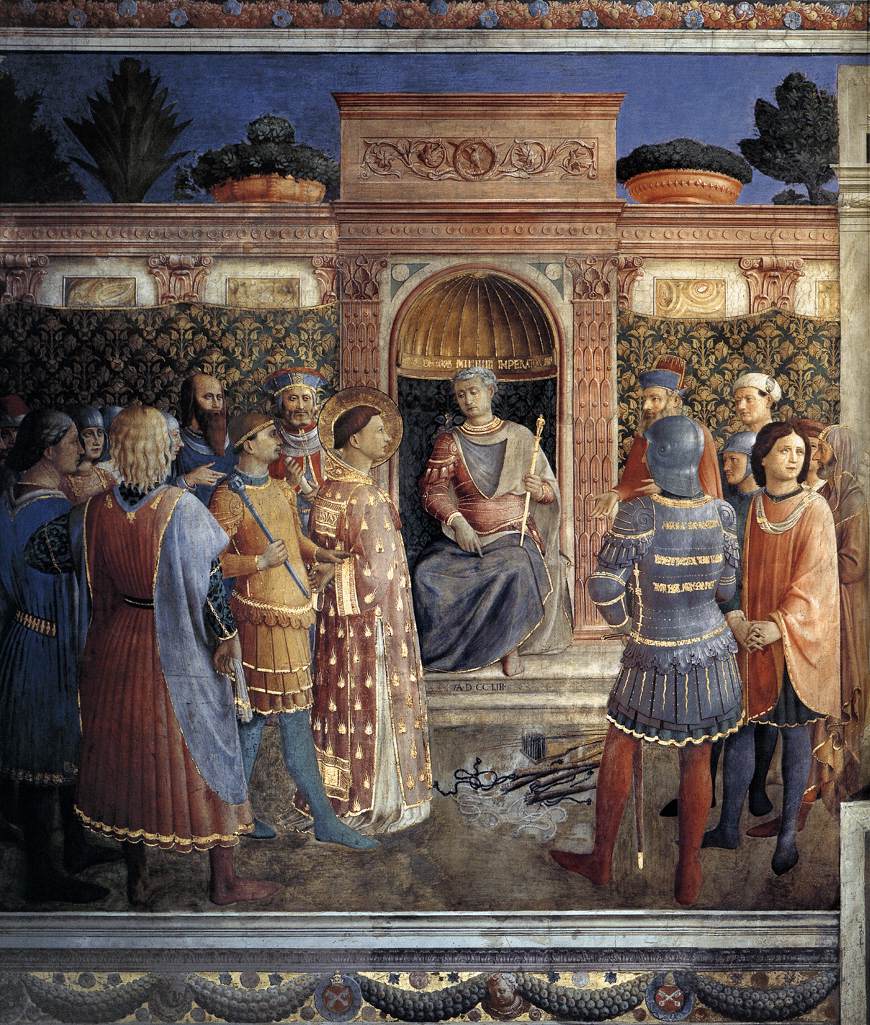
In accordance with Valerian’s orders, the Senate rounded up Pope Sixtus and his seven deacons. All eight refused to comply with the edict, and so, on 6 August 258, they were beheaded—all, that is, except Lawrence. As the archdeacon in charge of the treasury, Lawrence was given a three-day stay of execution to collect together all the church’s wealth and hand it over to the Roman state; instead, he reportedly spent the next three days giving as much of the money away as he could. On August 9, he returned to the Senate with a group of Rome’s poorest, sickest, neediest citizens, and boldly claimed that these were the true treasures of the church. The Prefect of Rome, frankly, was far from pleased.

Whereas Pope Sixtus and his other deacons had been beheaded, Lawrence’s singular act of defiance earned him an especially cruel death: the sentence was passed that he should be roasted to death, suspended on a gridiron above roaring fire.

Baby catching was all the rage in Ancient Rome

There’s some disagreement over whether or not Lawrence was actually burned to death in this way, because some sources claim that the Latin record of his death (assus est, “he was roasted”) should actually have read passus est, “he suffered”. But whether true or not, the question still remains—what does an early Christian martyr’s gruesome execution have to do with laziness?

Well, Lawrence’s death was so notably brutal that it soon became the subject of a macabre bit of folklore that claimed midway through his roasting Lawrence had quipped, “Turn me over, I’m done on this side!” It might sound more Groucho Marx than it does Archdeacon of Rome (and you can make your own mind up as to whether he actually said it or not), but this legend nevertheless apparently inspired a joke that Lawrence was “too lazy” to turn himself over. 

So is this the true origin of our lazy Lawrences? It’s impossible to say for sure, but it’s a good story all the same. And one well worth telling round the barbecue this summer.


14 April 2016

10 Words From Johnson’s Dictionary


The great Samuel Johnson’s Dictionary of the English Language was first published 261 years ago today, on 15 April 1755. Its two volumes defined a total of 42,773 words, illustrated by 114,000 literary quotations (the majority from Shakespeare), and unlike dictionaries today, it was infused throughout with Johnson’s own personality and humour. 

Words that he personally disliked or thought unimportant were omitted (so out went recent French loanwords like champagne and bourgeois), as was the letter X, which he bluntly explained in a note on page 2,308 “begins no word in the English language.” The definitions too were full of Johnson’s wit and wisdom:


And who, of course, could forget this:


Or, indeed, this:


Johnson was paid the princely sum of 1,500 guineas (equivalent to more than £200,000 today) to compile the work, which he did so single-handedly over nine years, with assistants only ever brought in to reproduce pages and copy out quotations. It was, frankly, a monumental achievement and remained the standard English dictionary for the next 150 years.

So in honour of the anniversary of Johnson’s wonderful contribution to our language, this week on the HH YouTube channel we’ve picked 10 long-forgotten words from his dictionary that deserve to be revived:


As explained in the video, that doesn’t mean that Johnson is personally responsible for coining these words (although it’s thought that a number of his entries were his own invention), nor that his dictionary provides us with their earliest written record. Instead, these are just words that were included in his Dictionary but which have long since disappeared from the language—and more than deserve to be recovered.


10 April 2016

Game: Missing Letters

Well, it’s been quite the year and a bit. 92 blogposts, 2 books, 10 quizzes, 13 YouTube videos, 8 stories about poop, something about a herring on top of a magistrate’s horse-drawn carriage, and a planet called George. The HaggardHawks blog might only be a little over 12 months old, but incredibly it flew past the 100,000 hits mark earlier last week. So a massive thank you, everyone, for reading, sharing, commenting and just generally being brilliant. You’ve earned yourselves the toughest quiz we’ve put together in a while…

Click PLAY in the box below and you’ll be given all 26 letters of the alphabet, and a word with some of its letters removed. All the missing letters will be the same, so all you have to do is pick the correct letter of the alphabet to complete the word. So if the clue was _ _ RDV _ RK, you’d click A. If it was _U_ _LEGUM, you’d click B. _HI_KEN, you’d click C. Sound easy? Yes. Yes it does. A little too easy in fact—so let’s just say the words are going to be a little tougher than aardvark, bubblegum and chicken. Oh, and you’ve only got 90 seconds to complete the entire alphabet. That’s more like it…

Feel free to share the quiz or your scores over on Twitter or in the comments section below—and good luck!


8 April 2016

Feague


If you’ve been keeping up with our new YouTube series, you might remember possibly the strangest word we’ve ever come across from our Words You Won’t Believe Exist video: the eighteenth century verb feague.


Feague, for those of you who don’t already know (or practise it), means “to put a piece of ginger up a horse’s anus,” with the somewhat predictable outcome of making him appear more lively. If you think that sounds impossibly cruel, then fear not—according to the 1811 edition of Francis Grose’s aptly titled Dictionary of the Vulgar Tongue, it was just as common to replace the ginger with a live eel. A much more sensible idea, I’m sure you’ll agree.

So why on earth—seriously, why? FOR THE LOVE OF GOD WHY?—would anyone want to spend even one microfortnight of their day forcing a piece of ginger up a horse’s arse? 


“You’re going to do WHAT?”

Well, as explained (though, alas, not demonstrated) in our video, if you were selling the horse, then it’s only natural that you would want it to look as frisky and as energetic as possible, to ensure that you got the best price for it. And if there’s one thing guaranteed to make a horse frisky, it’s shoving the spicy root of a herbaceous perennial up its ass. That makes feaguing essentially the 250-year-old equivalent of those tricks estate agents use when prospective buyers stop by. You know how it goes—a bouquet of freshly picked flowers on the table. A fresh pot of coffee brewing in the kitchen. A horse desperately trying to evacuate a live eel from its poop chute in the garden. 

Another fairly cruel means of improving the asking price of your horse incidentally was bishoping, which involved filing down its teeth. Because horse’s teeth continue to grow throughout their lives, shaving them down meant that even a worn out old carthorse could pass as a young colt, and in that sense bishoping was essentially the eighteenth-century equine equivalent of botox. Or six pints of Guinness.


But while bishoping was straightforwardly enough named after a crooked horse salesman named Mr Bishop, feaguing is more of an etymological mystery. 

One theory is that it comes from fake, which besides its more familiar meaning was used in nineteenth century slang to mean “to tamper with something in order to deceive.” That sounds exactly like our horse-enlivening ginger insertion, but the dates don’t match up—in fact, the OED suggests faking in this sense might derive from feaguing, not the other way around.

Another theory is that feague comes from an even earlier sixteenth century word, feak or fyke, meaning “to twitch” or “to be restless.” Twitching and restlessness certainly sounds along the lines of feaguing, but this theory stumbles because by the time feague first began to appear in the language, feak had morphed into a more figurative word, meaning “to be officiously busy,” or “to appear busy, yet accomplish little.” Hey, we’ve all been there.

But then there’s this:

’Slife, this She Devil will ruin me! Alas, madam, she’s merry, she drolls; but come, let’s dance and put these things out of our heads. Come in, Minnim and Crotchet, and fegue your violins away, fa, la, la, la!

That’s a line from The Humorist, a play written in 1671 by the English playwright Thomas Shadwell. Here, “Minnim and Crotchet” are the names of musicians, and when they’re called upon to “fegue their violins,” they’re not being told to put a piece of ginger inside them (nor, for that matter, to put their violins somewhere it’s anatomically unadvisable) but to start playing them, quickly and energetically. 

To feague away was a seventeenth century phrase basically meaning “to set in quick motion,” “to agitate,” or “to work flat out.” It’s thought that it derives from an even earlier sixteenth century word, feg or feagle, meaning “to beat” or “thrash,” which in turn probably comes from an even older German word, fegen, meaning “to clean” or “sweep”, or to busy yourself with housework. 

Feaguing away then seems to be the missing link: it’s easy to see how a word meaning “to busy yourself with housework” could give birth to a phrase meaning “to work quickly,” or “to agitate,” and ultimately “to enliven” or “to make energetic.” The ginger-inserting part, it seems, was just a bit of added spice.


6 April 2016

10 Words You Didn’t Know Had Opposites

If you’ve been keeping up with our 500 Words series over on the HaggardHawks YouTube channel, you’ll know that recently we’ve been expanding your vocabulary with lists of words for fools and nincompoops, words you won’t believe exist, and words from Victorian slang. And this week, we’re adding even more words to your wordhoard with a list of 10 Words You Didn’t Know Had Opposites.

Words like these crop up every now and then over on HaggardHawks, with recent examples including tautegory, the opposite of an allegory, and dysangelical, the opposite of evangelical. But what about the opposite of the placebo effect? Or the opposite of postponing something? And what exactly are jamais-vu, dysphoria and eustress? The answers are all here...


One term that didn’t make the final cut in the video, however, is one of our personal favourite opposites-you’ve-never-heard-of:


Stockholm syndrome is of course a curious psychological phenomenon in which a hostage, or group of hostages, gains sympathy for their captors. It takes its name from a bank robbery that took place in Stockholm in 1973, which led to a five-day siege between police and back robber Janne Olsson. Happily, the siege ended without any of the hostages being seriously injured.

The opposite of Stockholm syndrome is Lima syndrome, which, as the tweet above explains, refers to a situation in which the captors develop sympathy for their hostages. And just like Stockholm syndrome, it too comes from an actual hostage-taking: in 1996, fourteen members of a Peruvian militia group called Túpac Amaru stormed the Japanese embassy in Lima, and held more than 600 of the Japanese ambassador’s guests captive. Within a matter of hours, however, more than half of the hostages had been released, and over the days that followed another 300 more were steadily set free as the captors began to empathize with their hostages. The siege was eventually brought to an end 126 days after it had started.