_
Showing posts with label M. Show all posts

8 December 2015

Mistletoe

Christmas is almost upon us again, which means bouning your home, preparing your Yule-hole, and misportioning yourself silly. And brandy sauce. Lots of brandy sauce. Brandy sauce with everything. Otherwise YOU’RE JUST NOT DOING CHRISTMAS RIGHT.

But Christmas is also the season for kissing under the mistletoe—which means it’s also the season for any etymologists you might have invited round for a turkey sandwich to have a quick smoosk to themselves, and then regale you with one of the best etymological stories on offer. (And like all the best etymological stories, it involves poop.)


So. First things first. The modern English word mistletoe comes from the Old English name misteltan. Tan just means “twig” or “branch” (and lives on in teanel, a dialect word for a wicker basket), while mistel was both a shorter Old English name for mistletoe, as well as another name for birdlime, an adhesive paste made by mashing up mistletoe berries that was then smeared onto branches to catch birds.

In turn, mistel is thought to derive from one of two even earlier words: one theory claims that it’s related to masc, the Old English word for the mixture or “mash” of water and malt used to start brewing a batch of ale. But another more likely theory suggests that it’s related to the Old English word mix—it’s just that mix hasn’t always meant what it means today.

Mix or meox in Old English meant—well, excrement. Crap. Poop. Dung. Bescumberment. That’s why dunghills are sometimes called mixhills, why heaps of compost or fertiliser are called mixens, and why the water that drains from piles of muck or farm waste is called mig. The word mistel ultimately might have started life as a diminutive form of mix, in which case it probably originally meant something like “little splatter of poop”. So that mistletoe you’ll be kissing under this Christmas? Yep, that’s literally a “poop-twig”. But how on Earth did that happen?

Well, if you’re horticulturally minded, you might know that the mistletoe plant is essentially a parasite: it doesn’t have true roots of its own, but rather attaches itself to a tree or a plant that’s already growing, forces itself through the bark or the stem, and thereby leeches all the nutrients it needs directly from it. And because it doesn’t rely on a system of roots pushed deep underground, mistletoe can often be found growing high up in the tops of trees, nowhere near the soil—and there’s really only one way that it can get up there.


Ironically, as well as being used to make birdlime, mistletoe berries are something of a delicacy for thrushes and other similar-sized birds. The seeds the berries contain, however, aren’t quite as digestible as the fleshy pulp around them, so when the birds poop them out—often while perched in the very tops of the trees—they’re not only deposited perfectly unscathed, but coated in their own personalized layer of guano. Or, to put it in the considerably more eloquent terms of the Tudor English herbalist William Turner:
[The thrush] shiteth out the miscel berries well prepared in her bodye and layeth them upon the tre[e.] the berries grow into a bushe and the bushe bringeth furth berries, and of the berries the fouler maketh byrde lyme
And on that note, Happy Christmas to all!


30 May 2015

Mortgage

If you’ve managed to escape the rack-renters and have found a place to call your own, there’s a good chance you’ll have (or, at least, will once have had but have now paid off, you lucky thing) a mortgage. In which case, it’ll likely come of no surprise to find out that a mortgage is literally a deal to the death:
Hmm. Suddenly, those rack-renters don’t look so bad.

The first half of the word mortgage is the Latin word for “death”, mors, which is the same root as in words like mortician, rigor mortis and immortal. The second half, however, is more obscure: gage is an old word for a pledge or a security that is put down “to ensure the performance of some action”, as the OED explains. 

English borrowed the word mortgage from French sometime around the fourteenth century, and it steadily all but replaced (outside of esoteric legal literature, at least) the earlier Latin term mortuum vadium—literally a “dead pledge”. That in turn was paired with a vivum vadium, or a “living pledge”, which referred to someone borrowing money from someone in exchange for their allowing them to use their lands or estate, usually at a nominal annual fee gleaned from the profits of the land, until the debtor was able to repay the money.

All in all then, a mortgage is indeed literally a “death pledge”—but fear not, homeowners, because it’s not you that’s doing the dying any time soon. Instead, it’s thought that the “death” involved in the mortgage’s ominous “death pledge” isn’t that of the debtor, but rather either the debt itself, or the estate against which the debt is secured. That is to say, by entering into a mortgage, you “pledge” to continue paying your debt until it is entirely cleared (and thereby figuratively “killed”), otherwise your ownership of your estate “dies” if you can’t pay up. 

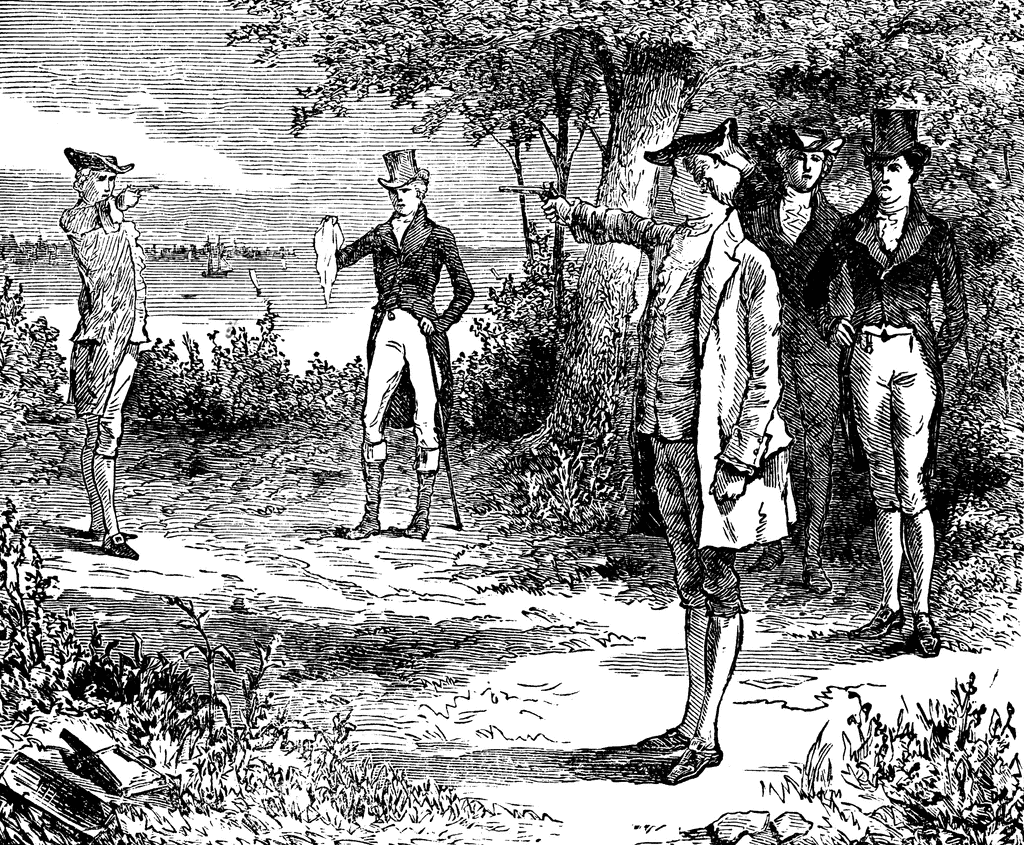
On a side note, the “gage” of mortgage was also once the name of a glove, or similar item, thrown contemptuously to the ground at the start of a conflict or duel to announce someone’s intention to fight—that’s also why you engage someone in battle. Might be worth taking one with you next time you have an appointment at the bank.
 
“You’re charging *how* much interest?”
 

9 May 2015

Magpie

Considering our mascot is a hawk*, for some reason we seem to tweet an awful lot about magpies:
And sometimes it even happens inadvertently:
We stumbled across pleany-pie a few weeks ago in a handful of old local English dictionaries. Among them was the hallowed English Dialect Dictionary, which defines a pleany-pie as “a tell-tale, a gossip; literally, a complaining magpie.” The EDD even records an old Yorkshire nursery rhyme that was presumably used to admonish schoolyard snitches back in eighteenth century England:

A pleeanie-pie tit,
Thy tongue shal be slit,
An’ iv’ry dog i’ th’ town
Shal hev a bit.

Dismembered tongues aside, it’s the “complaining magpie” part of the EDD’s definition that concerns us here: pleany– is an old dialect derivative of plain, meaning “to whinge” or “bemoan” (as in complain or plaintive), while –pie comes straight from magpie, a proverbially raucous and chattery bird. Hence a pleany-pie is an annoyingly vocal, complaining person.

Our pleany-pie tweet, however, sparked an interesting back-and-forth in the comments (we’re looking at you @BertSwattermain and @MooseAllain) about the connection between pie and magpie, and magpie and pied, meaning “black and white”, or “blotchy”. And, as always happens in cases like this, one quick bit of research opened a whole new etymological can of worms.

So, first things first. Originally, magpies were known only as pies in English—the earliest record we have of them comes from an Anglo-Saxon document that lists pyge as the Old English translation of pica, the Latin name for the magpie. It’s from this Latin name that the English pie eventually evolved, but if the word pica itself looks familiar, then that’s probably because we still use it today as the medical name for a pregnant woman’s cravings for bizarre, non-nutritious substances people shouldn’t really consume—like ice, clay, charcoal, and bread-and-butter pudding. (Bread does not belong in a dessert, people, no matter how much custard you pour over it.)

But we digress. It was the Greeks who first described these strange prenatal cravings, and it was they who chose to name them after the magpie (kíssa in Ancient Greek), because magpies, they noticed, seem to eat just about anything. They’d probably even eat bread-and-butter pudding given half a chance. 


A Eurasian magpie. Bread-and-butter pudding just out of shot.

Over time, the Greek kíssa gave way to the Latin pica, which in turn simplified to pie in English. And it’s thanks to this, and the magpie’s familiar black-and-white plumage (in Europe and North America at least—take a look at this fantastically fruity magpie from Sri Lanka), that we now have names for other black-and-white birds like the pied wagtail and the pied flycatcher, as well as for piebald horses. And it’s also why the Pied Piper was such a snazzy dresser.

So if that’s the story behind the –pie, what about the ­mag–? Well, there’s no lengthy, civilization-spanning history to talk about here. The mag– of magpie is actually just a pet form of the girl’s name Margaret, or Margery. That might sound odd, but there’s actually a long tradition in English dialect of using forenames as nicknames for birds, as in tom-tit, jenny-wren and robin redbreast (which was originally the Robert Redbreast, incidentally). 

So the goldfinch was once nicknamed the King Harry. The barn owl was once the Jenny owl. The song thrush is still known in some locations as Mavis. House sparrows were once Philips, while hedge sparrows were variously known as Mollies, Isaacs, or even Molly Isaacs. And, best of all, the green woodpecker—when it isn’t busy piloting short-haul flights for weasels—was once the laughing BetsyRecords show that magpies first earned the nickname Mag or Maggie as far back as the mid-1500s (although it was likely in use locally earlier than that), and it soon established itself as the norm—albeit, with a variety of brilliant local variations.

But that still leaves one last question—why give a person’s forename to a bird at all? Well, in the case of magpie some etymologists have pointed to a connection between chattering birds and gossiping, incessantly talking women or “chattermags” (no comment here), but it’s just as likely that it’s the familiarity of magpies, and all the other birds listed above, that earned them an equally common forename as their nickname. Which, incidentally, is the same reason why we have tomcats and billy-goats—and it’s probably why baby kangaroos are called joeys.

___________
*Actually, our mascot appears to be a kestrel—which is a falcon, not a hawk. Uh oh…